Guidebook · Clothing · Mattress · Tent · Books
Removing mildew stains — from clothing, fabric and mattress
What helps with which material, why the sun bakes the stains on, and how to get rid of the musty smell.
From Dieter Schmidt · Holder Phoenix Enzymreiniger · August 2026 · Approx. 12 min. reading time
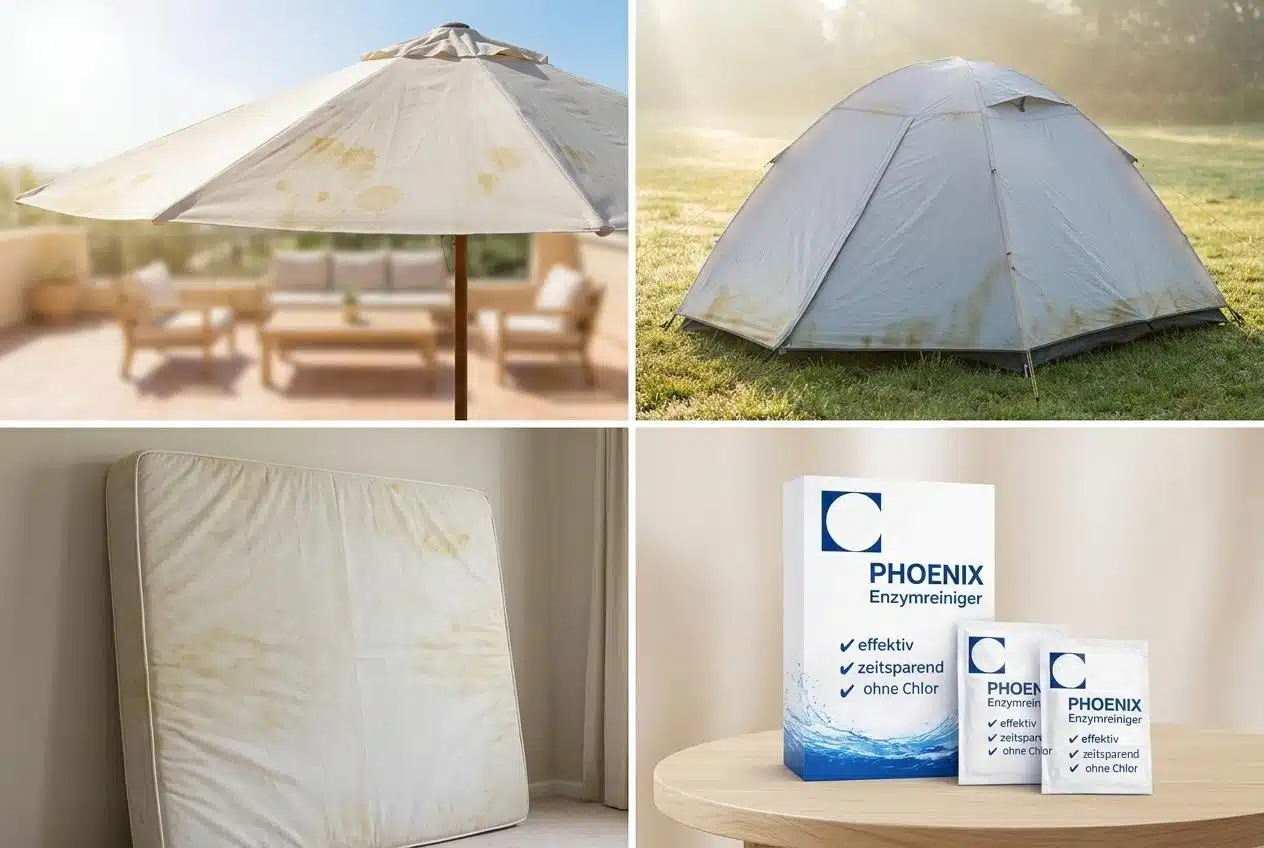
How do you get mildew stains out of clothes? Mildew stains are organic residues that form when textiles are stored damp or in airtight containers for too long. They can be removed enzymatically: Apply Phoenix Enzymreiniger directly to the stains, leave to work for 1 to 2 hours, soak overnight for stubborn stains, then wash normally. For larger areas, add an additional 20 g of granules to the washing drum, either in cold water or at 30 °C. Important: Do not leave the garment in the sun while the stain is damp—UV light will permanently fix the discoloration in the fabric.
Removing mildew stains This is one of those cases where common home remedies only make the damage worse. Bleach destroys the color, sunlight sets the stain, and hot water sets it. The stain itself consists of organic matter—and that's precisely what decomposes, not what you cover or bleach.
This guide shows you how to Removing mildew stains You can — material by material: cotton and linen, wool and silk, mattress and cushions, tent and awning, books and paper, leather and wood. This includes the process via the washing machine and the question of when a mildew stain becomes a mold problem.
Table of contents
- What exactly are mildew stains?
- The three mistakes that make the stain stick
- Material by material — how each is treated
- Removing mildew stains from clothing
- The route via the washing machine
- Mattress and pillow
- Removing mildew stains from tents and awnings
- Books, paper and wood
- How to get musty smell out of clothes
- At what point does it become mold?
- Frequently Asked Questions
Phoenix Enzymreiniger — Short & sweet
- Decomposes instead of bleaching: Amylase and protease break down the organic residues — the color of the fabric remains unaffected.
- Takes the smell with you: Musty and cellar smells originate from the same molecules as the stain.
- Continues working during the wash cycle: 20 g of granules directly into the drum, cold or 30 °C
- Made in Germany: Lowest water hazard class, surfactants at least 90% biodegradable (%)
What exactly are mildew stains?
Mildew stains are yellowish-brown discolorations on textiles, paper, or wood. They develop when organic material remains damp for extended periods and is deprived of air. Microorganisms colonize the damp surface, and their metabolic byproducts stain the fibers.
Who Removing mildew stains will, almost always encounters the same situations:
- Laundry that was left in the machine overnight
- Shirts from the suitcase, packed damp
- Wool sweaters from the basement cupboard after winter
- Mattress in a rarely used apartment
- Tent that came back wet from the holiday and went into the bag
- Books in the damp cellar or attic
Chemically, the stain is an organic residue from Proteins, lipids and polysaccharides. These building blocks can be broken down enzymatically: Amylase splits starch compounds, Protease It breaks down proteins. The fragments are water-soluble and are washed away.
Which three mistakes will permanently damage the stain?
| Mistake | What happens then | The correct way would be... |
|---|---|---|
| Place in the sun | UV light acts like a fixative on the damp stain. The discoloration is permanently baked into the fabric and is then almost impossible to remove. | Dry in the shade; only expose to air after complete treatment. |
| Wash in hot water | Heat denatures the protein components in the stain — they become stuck to the fiber, similar to blood that solidifies when boiled at 60 °C. | Wash in cold water or at 30°C. Cold water is always better for fresh stains. |
| Chlorine bleach | It bleaches both the stain and the fabric color. On colored laundry, it leaves light edges that look worse than the stain itself. | Enzymatic dissolution instead of bleaching — the fiber color remains unaffected. |
The most common mistake: Many people lay the damp garment in the sun to bleach it, because that works for grass stains. For mildew stains, it has the opposite effect.
Removing mildew stains — material by material
| material | Proceed | What to look out for |
|---|---|---|
| Cotton, linen | Apply the solution to the stains, leave it on for 1 to 2 hours, then wash normally. | Soak stubborn cases overnight. Apply cold compresses. |
| colored laundry | Similarly, test in a hidden location. | Enzymes do not attack dyes. However, water can cause dye to migrate in cheaply dyed fabrics. |
| Wool, silk | Apply briefly, do not soak, pat dry with clean water. | The duration is critical, not the contact. Do not allow it to dry out. |
| Synthetic, functional fabric | Like cotton, the soaking time is usually shorter. | Rinse membrane jackets thoroughly afterwards to maintain breathability. |
| Mattress, upholstery | Spray on damp, not wet, leave on for 30 to 60 minutes, then vacuum up with a spray extraction vacuum cleaner. | Do not vacuum immediately — the solution must remain in the material. Then allow it to dry completely. |
| Tent, awning, tarpaulin | Treat the area while upright, inside and out, paying particular attention to seams and the base tray. | Polyester and coated nylon can tolerate the solution. Pack them dry first. |
| Leather | Wipe clean only, do not soak. | The cleaner degreases. After drying, treat with leather conditioner. |
| Wood, furniture | Apply sparingly, leave on briefly, remove with a damp cloth | Water causes wood to swell. There is no guarantee for swollen edges. |
| Books, paper | Only the cut edges and the cover, with a barely damp cloth | Paper cannot tolerate moisture. Valuable books should be handled by a professional. |
Removing mildew stains from clothing — step by step
- Mixing: First, completely dissolve 20 g of granules in approximately 250 ml of hot water – this activates the enzymes. Then top up to 1 liter and allow to cool.
- Application: Thoroughly soak the stains, including the edges. For multiple items, a bowl for soaking is recommended.
- Effects: 1 to 2 hours. For old, dried-in stains, leave overnight.
- Wash: Normal wash cycle, cold or 30°C. No hotter.
- Dry: Store in the shade or in a dryer. Do not expose to direct sunlight as long as any residue is visible.
- In case of residual shadows: Repeat the process instead of bleaching. Two gentle passes are more effective than one aggressive one.
How long does the mixed solution remain effective?
Full power for 48 hours after mixing, followed by a slow degradation of the enzymes. Ready for use for up to 20 days.
Using the washing machine — when is it worthwhile?
If you have several pieces Removing mildew stains If you want to remove the stains or if they cover a large area, spot-on application is the wrong approach. In that case, you should work in two stages:
- Pretreatment: Spray the pieces with the prepared solution or soak them in it.
- Let absorb — at least one hour, preferably overnight.
- 20 g of granules directly into the drum Add the usual detergent. Use a cold or 30°C cycle.
The granules continue to work throughout the entire wash cycle. This is the difference compared to a simple stain remover, which only works before washing.
Can you find all the hidden cats? — Get a 10% discount (%)
Join in the living room hidden picture game — whoever finds all the cats immediately receives a personal discount code.
To the search game →Removing mildew stains from mattresses and upholstery — what's different?
Mattresses and cushions cannot be washed or rinsed. All the work happens within the material, and the drying process determines the result.
- Damp, not wet Spray it with something. A soaked mattress takes days to dry and smells worse afterwards than before.
- Leave on for 30 to 60 minutes. Do not vacuum up immediately — the solution must remain in the material so that the enzymes can work.
- Suction Use a spray extraction vacuum cleaner, then work from seam to seam instead of spot-by-spot.
- Dry completely, set up and with a draft. Only then move back in.
There is a separate area for ongoing upholstery maintenance: Cleaning upholstery with enzymes.
Removing mildew stains from tents, awnings, and tarpaulins
At the tent Removing mildew stains This is a classic problem after packing away a damp tent. After winter, the stuff sack smells musty, and there are stains on the seams and in the groundsheet. Pitch the tent, treat it inside and out, especially the folds where the material was pressed together. Polyester and coated nylon tolerate the solution without any problems.
Allow it to dry completely before putting it back in the bag. Otherwise, you'll have to start all over again. The same applies to awnings and boat covers.
Books, paper and wood — is that even possible?
Only to a limited extent, and we're being open about that. Paper doesn't tolerate moisture. With books, the cover and the edges can be wiped clean with a slightly damp cloth, but not the pages themselves. It's more important to store the book in a dry place and get rid of the smell from its surroundings—it's usually in the shelf and the wall, not in the book itself.
For wooden furniture: apply sparingly, allow to soak in briefly, and remove while still damp. Water causes wood to swell; there is no guarantee against swollen edges.
How do you get the musty smell out of clothes?
The smell originates from the same molecules as the stain — volatile organic compounds from microbial metabolism, including Geosmin, the substance that smells like rain on dry ground.
That's why fabric softeners and air fresheners don't work here: they simply mask the original scent. As soon as that fades, the old one returns. Enzymatic treatment breaks down the molecules themselves. For clothes that come from a musty basement, it's worth treating the closet at the same time—otherwise, the fresh laundry will absorb the odor again.
At what point is it no longer just a mildew stain, but mold?
| feature | Stain | mold infestation |
|---|---|---|
| Look | Flat, yellowish-brown, in the tissue | Raised, furry, or dot-like, on the tissue |
| Colour | Yellow to brown | Green, black, white, blue-grey |
| Smell | Musty, moldy | Significantly more intense, sometimes stinging |
| What to do | Treat and wash it; the piece can be saved. | Treat the infestation, but in cases of severe infestation on clothing, honestly consider whether the effort is worthwhile. |
If clothing comes from a room with mold, the cause is not the fabric itself. How to address the problem is explained in the... Guide to home remedies for mold.
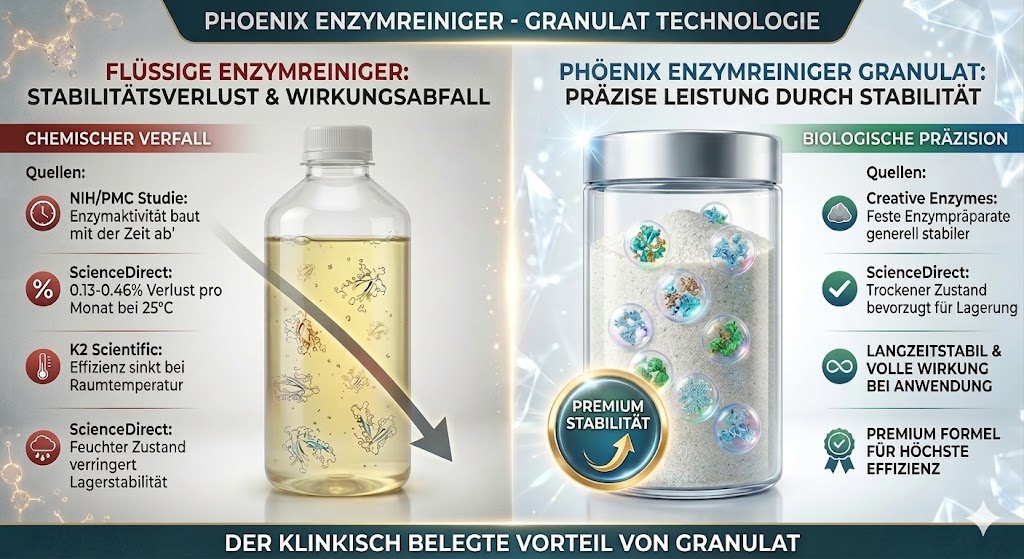
Why granules instead of ready-made solution?
Frequently asked questions about removing mildew stains
Can old mildew stains still be removed?
Phoenix Enzymreiniger also removes dried-on mildew stains, it just takes more time. Soak overnight instead of for two hours, and if in doubt, repeat the process. Stains that have been set in the fabric by sun or heat will not be removed.
Will the cleaner bleach my colored laundry?
Phoenix Enzymreiniger does not bleach. Amylase and protease break down starch and protein and do not attack dyes. What can happen depends on the water: with cheaply dyed fabrics, the color can bleed. Therefore, test on an inconspicuous area and work over a large area rather than just a single spot.
Why can't I put the piece in the sun?
Phoenix Enzymreiniger works during the wet phase. UV light permanently fixes the discoloration in the fabric during this phase, similar to heat-setting. Treat first, wash, and dry in the shade—only expose to sunlight once the discoloration is completely gone.
At what temperature should I wash?
Phoenix Enzymreiniger works at low temperatures or at 30°C. Higher temperatures are harmful because heat denatures the protein components in the stain and bonds them to the fibers. This also applies to blood and other organic stains.
What helps with mildew stains on wool?
Phoenix Enzymreiniger can be used on wool; the only critical factor is the duration. Apply briefly, do not soak, do not allow to dry, then dab with clean water. Test on an inconspicuous area beforehand.
How do I get the musty smell out of my clothes?
Phoenix Enzymreiniger breaks down odor molecules instead of masking them. Fabric softeners and air fresheners only add a second scent. If the clothes come from a musty basement, treat the closet at the same time—otherwise, fresh laundry will absorb the smell again.
How much granulate do I need for the laundry?
Phoenix Enzymreiniger is dosed at 20 g per liter of water. For the wash cycle, 20 g are added directly to the drum, in addition to the usual detergent. For regular use, larger containers of 500 g or 1 kg are recommended.
Keep out of reach of children and animals. Even if there is no danger, children and animals should not have direct access to the product.