Guide · Home remedies · Burnt-on food · Slice · Sheet metal
Cleaning the oven: Home remedies put to the test and what really works on burnt-on food.
Cleaning the oven with home remedies: Baking soda, baking powder, lemon, and vinegar in an honest comparison. Plus, the limits that no manufacturer tells you about — and how to get the oven door sparkling clean again.
From Dieter Schmidt · Holder Phoenix Enzymreiniger · August 2026 · Approx. 20 min. reading time
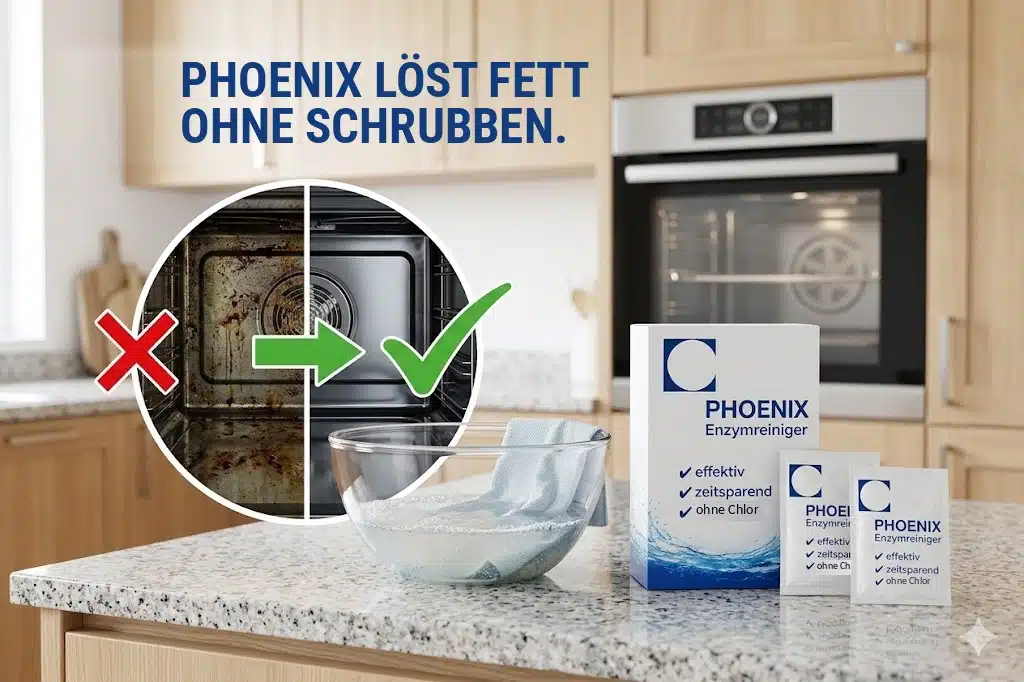
How do you clean the oven properly? Phoenix Enzymreiniger löst Speisereste enzymatisch und Fett über Tenside, statt sie zu verätzen. 20 g Granulat ergeben 1 Liter Lösung. Innenraum einsprühen, 1 bis 2 Stunden einwirken lassen, feucht abnehmen. Hausmittel wie Natron und Backpulver wirken mechanisch als feines Scheuermittel, Zitrone und Essig als schwache Säure — beide kommen an Fett nur an der Oberfläche heran. Und eine Sache muss man wissen: Verkohlte, schwarz eingebrannte Krusten sind kein Fett mehr, sondern Kohlenstoff. Die lässt kein Reiniger einfach verschwinden, dort bleibt mechanische Arbeit. Was aufliegt, geht ab. Was ins Email eingebrannt ist, bleibt.
Who Cleaning the oven with home remedies Will finds three recommendations online: baking soda, baking powder, lemon. All three work—on a light film of grease. But on the burnt-on crust from the casserole three weeks ago, none of them work as the instructions promise.
This guide explains the chemical processes and end results of each product. It also explains the end results of our own product. This is unusual for a manufacturer's website, but more honest than the alternative.
Table of contents — four parts
Basics
The four areas
- Part 1 — Home remedies put to the test Baking soda, baking powder, lemon, vinegar
- Part 2 — Burned-in memories and where the line lies
- Part 3 — Oven window and door
- Part 4 — Baking tray, rack and stove
Diploma
Briefly shown in the video
Phoenix Enzymreiniger — Short & sweet
- Dissolves instead of corrosive: Protease breaks down the protein structure, the surfactants dissolve the exposed fat — without sodium hydroxide.
- No spray mist with lye: No irritated airways, no need to wear gloves due to corrosive effects
- Gentle on materials: Enamel, stainless steel, glass and sealing rubber can withstand the gentle application (pH 8.5–9)
- Made in Germany: Lowest water hazard class, surfactants at least 90% biodegradable (%)
Why does oven grease stick so hard?
Fat in the oven isn't just fat. During every baking process, three things happen simultaneously: fat splatters onto the walls, proteins and sugars from the food adhere to it, and the heat chemically alters everything. Liquid fat transforms into a viscous, cross-linked film—this is called... Polymerization.
That's why dish soap no longer works there. Dish soap dissolves grease that is still grease. The polymerized film has become a different substance.
And if the process continues, the film turns into carbon. That's the black, shiny crust. Chemically, it's almost nothing—no fat, no protein, nothing for an enzyme or alkali to attack. Almost no cleaning instructions recognize this difference, and it explains why some stains simply won't come off.
How do I clean the oven step by step?
- Empty oven and let it cool until it only feels lukewarm. Do not use in a hot oven — the solution will evaporate before it can take effect.
- Mixing: First, completely dissolve 20 g of granules in approximately 250 ml of hot water – this activates the enzymes. Then top up to 1 liter.
- Spray generously: Back wall, side walls, ceiling, floor, and the inside of the door. On vertical surfaces, it's better to apply two thin coats than one wet coat, otherwise it will run.
- Let absorb: 1 to 2 hours for a light film of grease, 3 to 4 hours or overnight for old encrustations. Keep the door closed to prevent anything from drying out.
- Remove while damp: Microfiber cloth, in one direction. For thick deposits, carefully lift off the excess beforehand with a plastic scraper.
- Second round on stubborn areas. Softened material yields significantly more the second time.
- Wipe with clean water. and leave the door open to dry.
How long does the mixed solution remain effective?
Full power for 48 hours after mixing, followed by a slow degradation of the enzymes. Ready for use for up to 20 days.
Keep out of reach of children and animals. Even if there is no danger, children and animals should not have direct access to the product.
Cleaning an oven with home remedies — what really works?
Cleaning the oven with home remedies: Baking soda, baking powder, lemon, vinegar and dishwasher tablets in an honest comparison.
Become Cleaning the oven with home remedies There are good reasons for wanting them: they're cheap, always available, and mostly harmless. What they aren't: an equivalent replacement for a cleaner designed for polymerized grease. This table tells you what each product actually does.
| Home remedies | What actually happened | Where it ends |
|---|---|---|
| Baking soda Sodium bicarbonate | As a paste, it works primarily mechanically: fine crystals abrade the film of grease. Its slightly alkaline properties offer some help against fresh grease. | Only on the surface. Polymerized grease remains. And the crystals can dull the enamel over time. |
| baking powder | Contains baking soda plus an acidifying agent. The fizzing when moistened looks like it's having an effect, but it's just escaping carbon dioxide. | Weaker than pure baking soda, because the baking soda is partially consumed by the acid. |
| Lemon juice | Weak acid. Dissolves limescale and fresh sugar residue, smells pleasant. | Acid does not dissolve grease. It will not affect burnt-on food. |
| Vinegar, vinegar essence | Stronger acid than lemon, good against limescale on sheet metal. | Same problem: it doesn't attack grease. Fumes irritate the respiratory tract in a closed oven. |
| soda Sodium carbonate | Significantly more alkaline than baking soda, it actually saponifies fat to a certain degree. | The most effective home remedy — but it attacks aluminum and irritates the skin. |
| Dishwasher tablet | Contains alkalis, bleach, and often even enzymes. Works when dissolved in hot water. | Not intended for open surfaces, leaves residue and is difficult to rinse off. |
| shaving foam | Contains surfactants and a small amount of alkali. The foam adheres to vertical surfaces instead of running off — hence its popularity. | Its cleaning effect is comparable to mild dish soap. It has no effect on polymerized grease, but fragrances and care products remain, which must be rinsed off again. |
| Commercially available oven spray | Sodium hydroxide. Saponifies fat reliably and quickly. | Corrosive. Spray mist irritates eyes and respiratory tract; gloves are mandatory; aluminum and some seals are affected. |
| Phoenix Enzymreiniger | Protease breaks down the protein structure, and the surfactants dissolve the exposed grease. Oven grime consists precisely of these two components. It works even within the softened film, not just on the surface. | It takes time, not strength: 1 to 4 hours. And it too ends with a charred crust — see Part 2. |
Mixing baking soda and vinegar is the most common mistake. The two neutralize each other to form sodium acetate and water. The foaming is spectacular, but what remains is salt water. If you're going to use home remedies, do them one at a time.
Does burnt-on food really come off in the oven?
The section that no manufacturer likes to write.
„"Burn-in" is not a uniform state. There are three stages, and they behave completely differently.
| Level | How you can recognize them | What is possible |
|---|---|---|
| 1. Grease film | Sticky, yellowish-brown, yields to finger pressure | Enzymatisch gut lösbar. 1 bis 2 Stunden reichen. |
| 2. Polymerized layer | Tough, dark brown, matte, can be scratched with a fingernail | Solvable, but takes time: 3 to 4 hours or overnight, usually two passes. |
| 3. Charred crust | Black, shiny, hard, splinters off when scratched. | This is where the chemistry ends. This is carbon, no longer an organic substrate. The cleaner softens the edges and shortens the soaking time—the crust itself must be removed mechanically. |
| Discoloration in the enamel | Brownish shadow, smooth, cannot be scratched | It remains. This is no longer a coating, but altered material. No cleaner can restore enamel. |
The key phrase: What lies on the surface of the material comes off. What is altered within the material remains.
This applies to all cleaning agents, including sodium hydroxide. An oven cleaner that supposedly dissolves charred crusts actually dissolves the softened material around them, causing the crust to fall off. Enzymes do exactly the same thing—only without the corrosive effect.
Cleaning an oven with home remedies for a charred crust — what actually helps
- Soak for a long time instead of scrubbing hard. Apply the solution overnight, then place a damp cloth on the area to prevent it from drying out.
- Plastic scraper, not metal. Metal leaves scratches in the enamel, in which even more metal will become embedded the next time.
- Start at the edge, not in the middle. Softened crusts detach from the outside in.
- Several short passes They bring more than a long, violent approach.
- In case of complete charring: Pyrolysis, if your appliance has it. More on that in Part 4.
Can you find all the hidden cats? — Get a 10% discount (%)
Join in the living room hidden picture game — whoever finds all the cats immediately receives a personal discount code.
To the search game →How do I make the oven door clear again?
Why the window looks fogged up on the inside — and what's between the panes.
Become Cleaning the oven with home remedies The attempt often fails, especially on glass: baking soda paste doesn't clean glass cleanly; it leaves streaks. Oven window This is the area where you can immediately see the condition of the oven.
Clean the inner disc
Spray generously, let it soak in for 30 to 60 minutes, remove with a microfiber cloth, and polish with a second dry cloth. For heavy deposits, a glass scraper with a fresh blade will help—hold it flat, never tilt it. Glass can withstand this, enamel cannot.
Between the discs
The brown film between the glass panes is grease vapor that has accumulated over the years through the ventilation system. It's inaccessible from the outside. On most appliances, the door can be removed and the inner pane taken out—on Bosch, Siemens, and Neff models, this is usually done using two clips at the top edge.
Check your appliance's instruction manual beforehand. Some doors have a hinge lock that needs to be released, otherwise the hinge will snap shut.
Door seal
Only wipe the rubber seal with a damp cloth; never soak it or scrape it. If it becomes hard or cracked, the oven will no longer close tightly, and the next layer of grease will adhere directly to the glass.
How to clean baking trays, racks and ceramic hobs with home remedies or enzymes?
Everything that comes out of the oven — and the surfaces next to it.
| Part | Proceed | What to look out for |
|---|---|---|
| Enamelled baking tray | Place in the sink, cover with solution, leave to soak for 2 to 4 hours. | No steel wool. Scratches in the enamel are the beginning of the next problem. |
| Baking tray, non-stick coated | Simply spray and wipe off while damp, do not soak. | Coatings don't like prolonged dampness or alkalis. Therefore, no soda here. |
| Oven rack, grid | Lay flat in a tub or bathtub, cover with solution, leave overnight | Line the bathtub with a towel beforehand, otherwise the enamel will get scratched. |
| frying pan | Like the sheet metal, but a more comprehensive solution — it holds significantly more | If heavily encrusted, first roughly remove the residue, then soak. |
| ceramic hob, glass ceramic | Spray on, leave for 15 to 30 minutes, then scrape off with a glass scraper. | Spilled sugar must be removed immediately while it is still warm — otherwise it will etch into the surface. |
| Grill rack | Like the oven rack, soak overnight | Dry and oil cast iron grates afterwards, otherwise they will rust. |
| Extractor hood filter | Place metal filters in hot solution for 1 to 2 hours. | Do not wash activated carbon filters — they are replaced, not cleaned. |
Pyrolysis and catalysis — do I still need a cleaner?
Pyrolysis It heats the oven to about 500°C and burns all organic matter to ash. This works, but has three drawbacks: the process takes two to three hours and therefore consumes a lot of electricity, the kitchen smells, and trays, racks, and seals have to be removed because they can't withstand the temperature. Manufacturers recommend using it no more than a few times a year.
Catalytic walls These appliances use a porous coating that gradually breaks down grease at temperatures above 200°C. They only work with a thin film of grease and must never be treated with cleaning agents – this will permanently clog the pores. The base and door of these appliances are usually not catalytic; you'll have to clean those manually anyway.
For everyday cleaning, such as cleaning the glass, door, trays, and racks, traditional oven cleaning with home remedies or enzymes is still sufficient. And those who wipe down the oven regularly won't even need pyrolysis in the first place.
Frequently asked questions about cleaning the oven
Cleaning an oven with home remedies — how does it work with baking soda?
Phoenix Enzymreiniger works differently than baking soda, hence the honest comparison: Baking soda as a paste works primarily mechanically; the fine crystals abrade the grease film. This helps with fresh grease but doesn't reach polymerized layers. If you still want to try it: Mix a paste of baking soda and water, apply it, let it sit for several hours, remove it while damp—and use a plastic scraper instead of a steel wool pad.
What is the purpose of baking powder in the oven?
Weniger als reines Natron. Backpulver enthält neben Natron ein Säuerungsmittel, das einen Teil davon bereits verbraucht hat. Das Sprudeln beim Anfeuchten ist entweichendes Kohlendioxid, keine Reinigungswirkung. Phoenix Enzymreiniger setzt stattdessen an der Ursache an: Enzyme spalten Eiweiß und Stärke, Tenside lösen das Fett.
Does lemon help against oven grease?
It works against limescale and fresh sugar residue, but not against grease. Citric acid doesn't dissolve grease—that's a matter of chemistry, not quantity. Phoenix Enzymreiniger dissolves the grease via its surfactants; the protease breaks down the protein that holds the dirt together.
Can burnt-on food even be removed in the oven?
It depends on the stage. A sticky film of grease and a tough, polymerized layer dissolve completely enzymatically; the latter takes 3 to 4 hours or overnight. A black, shiny, charred crust, on the other hand, is carbon and no longer an organic substrate—Phoenix Enzymreiniger softens the edges and shortens the soaking time, but you have to remove it with a plastic scraper. And baked-on stains in the enamel remain; that's altered material, not a coating.
How do I get the oven door clear again?
Apply Phoenix Enzymreiniger generously to the window, let it work for 30 to 60 minutes, remove while still damp, and polish with a dry cloth. For stubborn deposits, use a glass scraper with a fresh blade, held at a shallow angle. If the film is trapped between the panes of glass, the door must be opened and the inner pane removed.
Can I combine baking soda and vinegar?
It's best not to. The two neutralize each other to form sodium acetate and water. The foaming might look like it's working, but all that's left is salt water. Phoenix Enzymreiniger doesn't need to be combined; the enzymes work on their own.
How do I clean a burnt-on baking tray?
Pour Phoenix Enzymreiniger into the sink, completely covering the baking sheet, and let it soak for 2 to 4 hours. For non-stick coated baking sheets, only spray and wipe off while damp; do not soak—coatings do not tolerate prolonged moisture or alkalis. Do not use steel wool; scratches in the enamel will only lead to further problems.
Is the cleaner safe for children and pets?
Phoenix Enzymreiniger is not subject to labeling requirements, is chlorine-free, and has the lowest water hazard class. Nevertheless, it is important to keep it out of reach of children and animals. Even though there is no immediate danger, children and animals should not have direct access to the product.
Do I need to wear gloves?
Not for etching reasons — Phoenix Enzymreiniger is only slightly alkaline (pH 8.5–9) and contains no sodium hydroxide. Gloves are still advisable, however, because the cleaner degreases and prolonged contact can cause skin tightness.
How often should I clean the oven?
Cleaning the oven with home remedies or enzymes becomes significantly easier if you don't wait: If you wipe away the worst of the grease splatters with a damp cloth after baking, while the oven is still lukewarm, you only need to do a thorough cleaning two or three times a year. The difference is considerable: Fresh grease comes off in minutes, polymerized grease takes hours, and charred grease never comes off completely.
Can I also use it to clean the ceramic hob?
Yes. Spray on Phoenix Enzymreiniger, let it sit for 15 to 30 minutes, and then scrape it off with a glass scraper. The exception is boiled-over sugar: this must be removed immediately while it's still warm, otherwise it will etch into the glass-ceramic surface and leave a dull spot that will remain.
Does shaving foam work in the oven?
Er haftet gut an senkrechten Flächen, das ist der ganze Vorteil. Die Reinigungswirkung entspricht mildem Spülmittel — bei polymerisiertem Fett passiert nichts, und Duft- und Pflegestoffe bleiben zurück. Phoenix Enzymreiniger haftet ebenfalls, wenn du zweimal dünn statt einmal nass sprühst, und löst dabei mit den Tensiden auch das Fett.
Do I need this product if my oven has a pyrolytic cleaning function?
Less frequently for the interior, but more often for everything else. Trays, racks, drip trays, and seals must be removed before pyrolysis and are not cleaned during the process. The door and glass are also excluded in many appliances.
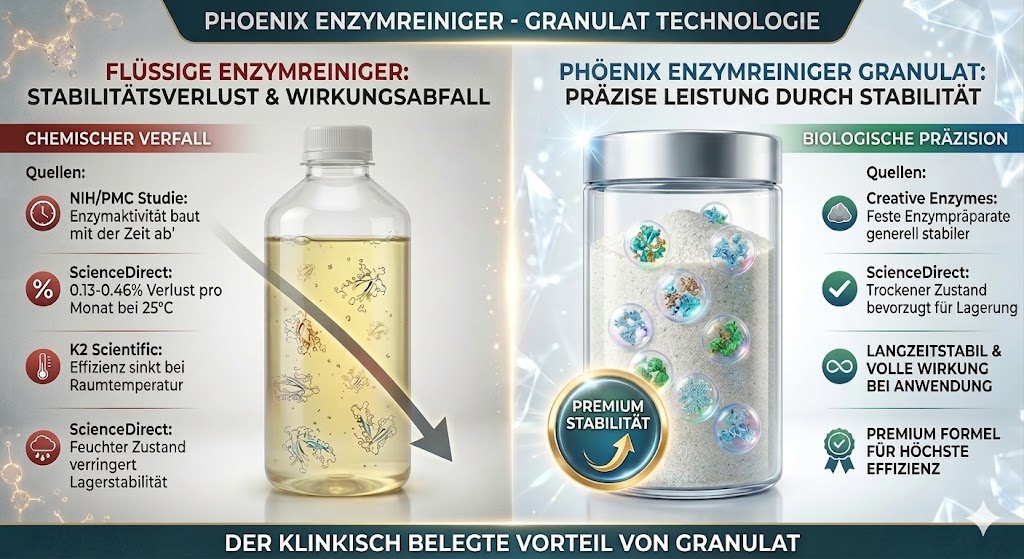
Why granules instead of ready-made solution?