Removing blood stains from clothing – jeans, shirts and white laundry

From Dieter Schmidt · Owner PHOENIX Enzymreiniger®
Removing bloodstains from clothing almost always fails due to the same mistake: using water that is too hot. Blood consists primarily of hemoglobin, a protein molecule. When protein comes into contact with heat, it coagulates and forms solids. Peptide bonds with the fiber. This Heat fixing This is the reason why a stain often looks worse after washing than before.
This guide goes through each item of clothing individually – jeans, shirts, whites, T-shirts, and delicate fabrics. You'll learn why you should Removing blood stains from clothing You can only do it cold, what home remedies can really do and how the enzymatic Microfission functions.
🧬 Phoenix duration of effect at a glance
Full power for 48 hours after mixing, followed by a slow degradation of the enzymes. Ready for use for up to 20 days. The granules remain stable until mixing – full enzymatic activity exactly when you need it.
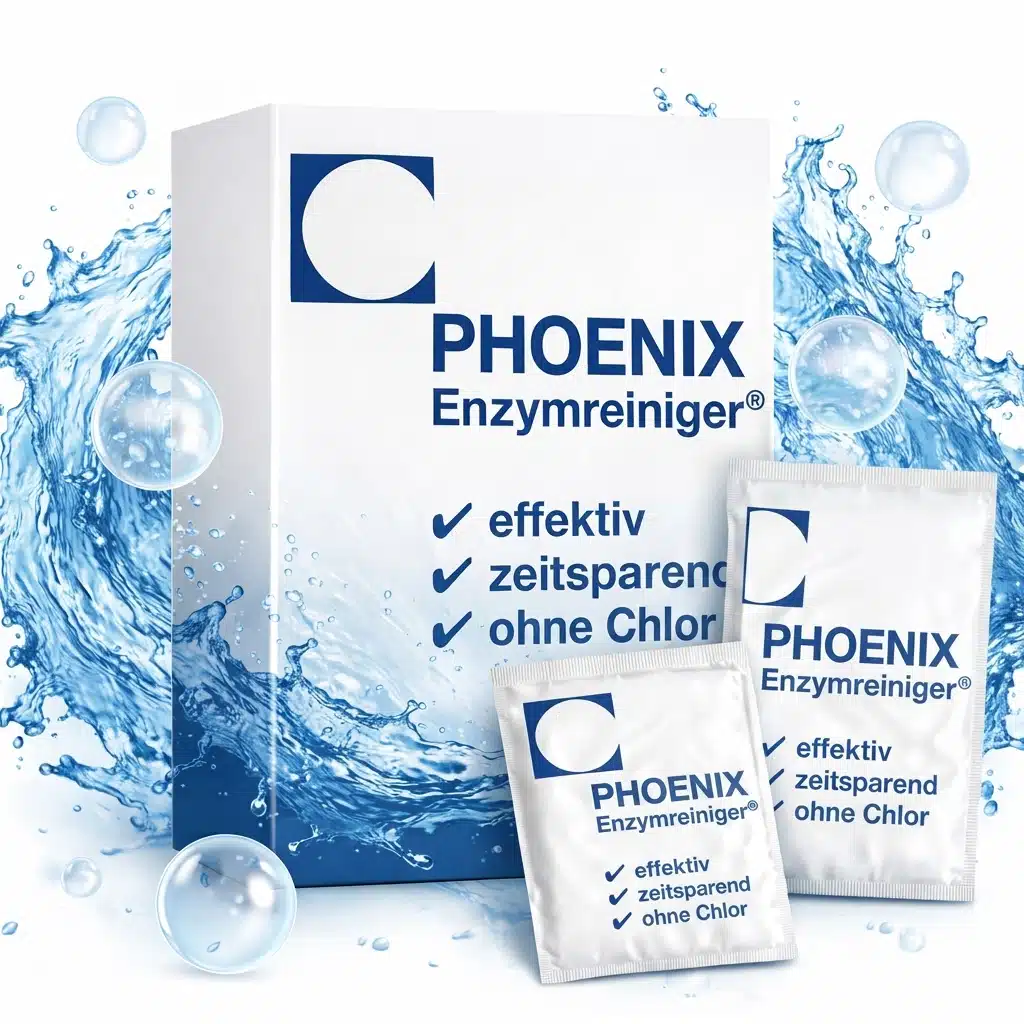
PHOENIX Enzymreiniger® for blood
Granular concentrate, freshly mixed. 20 g makes 1 liter of application solution – for pretreatment and for washing. Made in Germany.
About the product To the comprehensive guide📋 Table of Contents
- 1. The one rule: never warm
- 2. Jeans and trousers
- 3. White laundry, shirts and blouses
- 4. T-shirts and tops
- 5. Large stains: into the washing machine.
- 6. Fabric types: what is compatible with what
- 7. Dried bloodstains on clothing
- 8. Home remedies for clothing
- 9. What makes enzymes different
- 10. Instructions in 5 steps
- 11. Frequently Asked Questions
1. The one rule: never warm
Blood clots when heated – just like egg whites solidify in a pan. The same thing happens in the fibers. The amino acids of hemoglobin form strong bonds with the tissue, and from that point on, the stain is permanent. The technical term for this is... Denaturation.

2. Jeans and trousers
Denim is robust and can withstand almost any treatment. The crucial factor is the direction: always apply the stain directly. from the back Squeeze the substance out with cold water, do not rinse from the front. Otherwise you will force the blood through the entire tissue.
Fresh stain: Rinse with cold water from the back, treat with enzyme solution for 15 to 30 minutes, then wash.
Dried blood on jeans: First, thoroughly soak the denim to soften the crust. Then let it soak for one to two hours. Dark denim can tolerate longer soaking times. Two shorter applications are more effective than one long one.
3. White laundry, shirts and blouses
With white fabrics, the temptation to use bleach is strong. This removes the color, but doesn't eliminate the stain. The protein remains in the fibers and becomes visible again over months as a yellowed edge – the classic shadow on a stored shirt.
The correct order is the reverse: first remove the protein, then wash. For delicate shirts, test on the inside seam beforehand.
🩸 Removing blood stains from clothing – with enzyme granules
20 g of granules make 1 liter of solution. Mix with cold water, apply, and let it soak in. For jeans, shirts, bed linen, and upholstery.
About the product4. T-shirts and tops
Jersey is thinner than denim, so the stain often penetrates both layers. Place an absorbent cloth underneath to allow the dissolved blood to soak in instead of spreading.
5. Large stains: into the washing machine.
A palm-sized stain on a shirt is not something that can be treated by simply dabbing it. For washable clothing, the most reliable method is a combination of pre-treatment and washing.
1 Pretreatment – generously spray or soak the area with the prepared solution so that it is thoroughly wet.
2 Let absorb – 30 minutes for fresh blood, longer for dried blood
3 Wash – Add 20 g of granules directly to the drum, cold or 30 °C program
The granules continue to work during the wash cycle, while the drum's mechanics rinse the dissolved hemoglobin out of the fibers. The combination of both is more reliable than any hand-blowing.
6. Fabric types: what is compatible with what

| Material | Treatment |
|---|---|
| Cotton, denim, linen | non-critical, full exposure time |
| Jersey, Polyester | Non-critical, place an absorbent cloth underneath. |
| Wool | Apply to cold water, leave on briefly, rinse thoroughly. |
| silk | cold, very short, test in a hidden area beforehand |
| Coated, impregnated | Test first, the coating may be damaged |
7. Dried bloodstains on clothing
Old stains need time, not more heat. That's the most common misconception: when cold isn't enough, most people reach for hot water – and permanently set the stain.
The correct procedure is: thoroughly soak the stain, cover it with foil to keep it moist, and leave it overnight. With very old stains, the hemoglobin has already dissolved. Hemosiderin The iron-containing breakdown product is formed. It causes the typical brown edge and usually requires two passes.

Can you find all the hidden cats? — Get a 10% discount
Join in the hidden object game — whoever finds all the cats will immediately receive a personal discount code.
To the search game →8. Home remedies for clothing – what really helps
One thing at a time, honestly
Cold water is the best home remedy, as long as the stain is fresh. Salt It draws out fresh blood; nothing happens with dried blood. Baking soda and baking powder They dissolve superficially, but do not break down the protein bonds. Gall soap It attacks the dye, not the structure. hydrogen peroxide bleaches – possible on white, risky on colored.
saliva It actually works because it contains enzymes. That's enough for a drop, but not for a shirt.
9. What makes enzymes different
All the home remedies mentioned above work mechanically or optically: they dilute, dissolve, or bleach. None of them break down the protein. That's precisely what they do. Proteases They break the bonds that hold the blood to the fibers. What remains is something that can be washed out with water. The same process as with saliva, only in a quantity sufficient for an entire garment.
More information on the mechanism of action and all other applications can be found in the Comprehensive guide to removing bloodstains.
10. Instructions in 5 steps
1 Rinse Rinse the stain with cold water from the back, do not rub.
2 Start – 20 g of granules in 1 liter of cold water, stir well
3 Apply Apply generously; cover with foil if the blood dries.
4 Effect – 30 minutes for fresh blood, overnight for old blood
5 Wash Wash in cold water or at 30°C, add 20g of granules to the drum – check before drying
Why granules instead of ready-made solution?
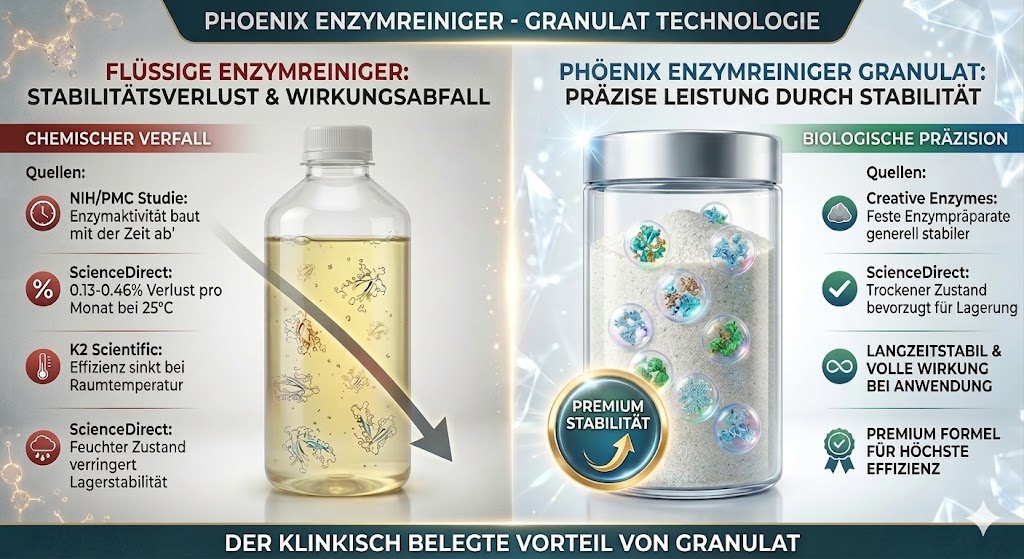
Enzymes degrade during storage – often already weakened before sale. In the case of blood: less effectiveness precisely when you need it.
Enzymes remain stable until they are mixed. Freshly mixed = full power. Ready for use for up to 20 days. According to Dr. Mang's expert opinion, suitable for cleaning work in the food industry.
Phoenix Enzymreiniger comes as granules – not as a ready-mixed liquid. This has a crucial advantage if you Remove dried bloodstains want: Maximum enzyme activity precisely when the proteases need to break down the protein.
Ready-mixed enzyme cleaners lose their effectiveness even during storage. The enzymes break down before you even use the product. Scientific studies show that enzymes in solution degrade over time – their activity continuously decreases.
Phoenix granules remain stable until you mix them. Freshly mixed, they unfold their full enzymatic power. The mixed solution remains until Ready for use in 20 days. For blood and stubborn stains, we always recommend freshly mixed cleaner for full effectiveness.
The result: You get reliable cleaning service – exactly when you need it.
📚 Scientifically proven: Enzymes in solution degrade continuously. How enzyme cleaners work
11. Frequently Asked Questions
The stain has already been washed in hot water. Is there anything else that can be done?
A shadow usually remains because the protein is thermofixed. However, it's still worth trying overnight, as long as the fiber is intact.
Can I wash the garment normally afterwards?
Yes. Cold or at 30 °C, and add 20 g of granules directly into the drum.
Does this also work with colored clothing?
Yes. Enzymes attack the protein, not the dye. However, test on a hidden area first with sensitive fabrics.
And what if the stain is still there after washing?
Do not put in the dryer, as this will permanently set the residue. Apply a second time with a longer soaking time.
Why cold, when hot usually cleans better?
Because blood is protein. Heat causes protein to coagulate and bind it firmly to the fiber. With blood, the opposite of the usual rule applies.
How much granulate do I need for one shirt?
20 g per liter is the standard mixture. For a single garment, a fraction of that amount is sufficient, prepared in the same ratio.
Conclusion
Removing bloodstains from clothing isn't a matter of strength, but of temperature and time. Rinse in cold water, treat with an enzymatic agent, let it soak in, then wash in cool water. Following this sequence will even save old stains.
Enzyme cleanser for blood To the comprehensive guide