Removing blood stains – this is how it works even on old and dried stains.

From Dieter Schmidt · Holder Phoenix Enzymreiniger
Remove bloodstains Cleaning is one of the most difficult tasks imaginable. Whether it's period blood on the mattress, damage from a wildlife collision in the car, a cut in the kitchen, or professional crime scene cleanup – blood consists of hemoglobin, remnants of red blood cells, proteins, and fats that penetrate deep into fibers, upholstery, and even concrete. Conventional cleaners usually fail because they... Microfission cannot afford the organic protein chains.
In this guide, we'll show you how to Remove bloodstains You can handle everything from standard household renovations to professional-grade remediation. You'll learn the scientific fundamentals of hemoglobin, hemosiderin, and peptide bonds, all relevant applications, and receive clear instructions for your specific situation.
🧬 Phoenix duration of effect at a glance
Full power for 48 hours after mixing, followed by a slow degradation of the enzymes. Ready for use for up to 20 days. The granules remain stable until mixing – so you have full enzymatic activity exactly when you need it.
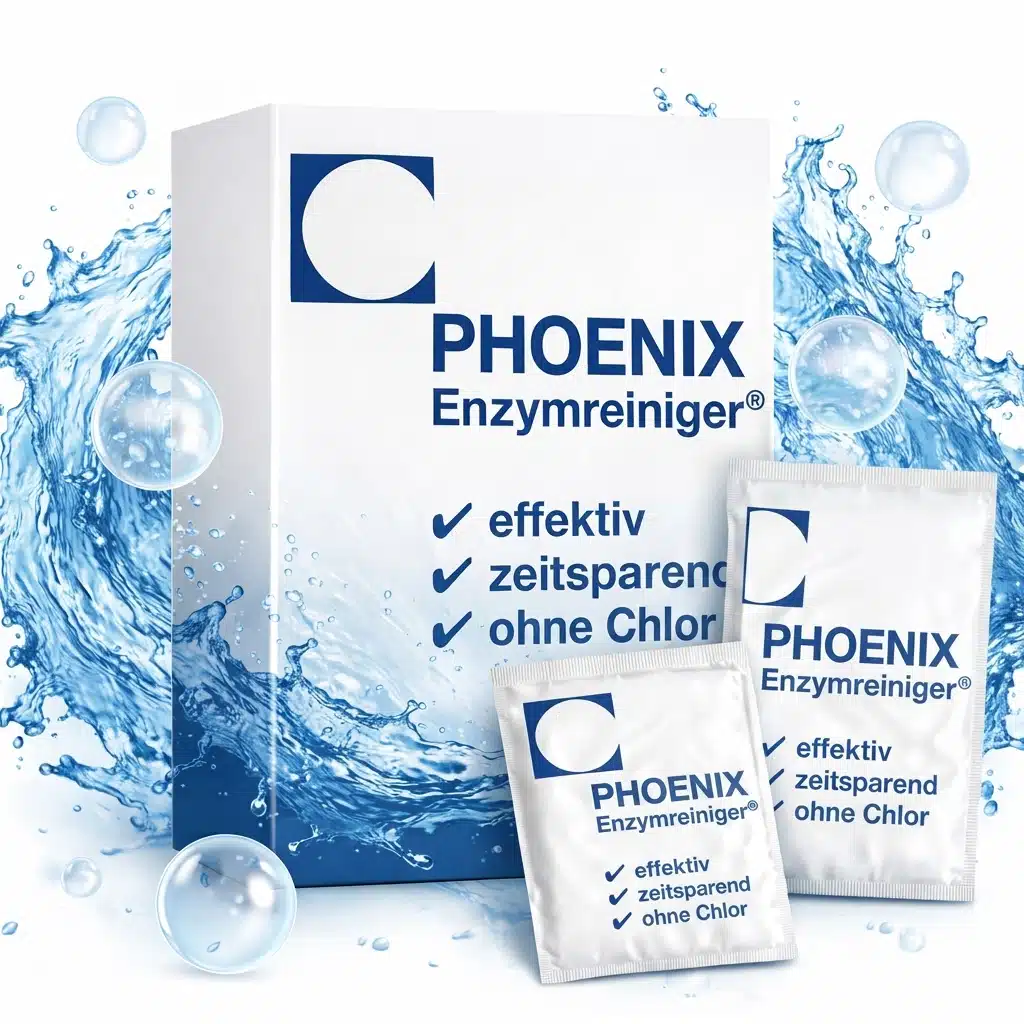
PHOENIX Enzymreiniger® for blood
Granular concentrate, freshly mixed. 20 g makes 1 liter of application solution – for pretreatment and for washing. Made in Germany.
About the product Clothing Guide📋 Table of Contents
- 1. The power of micro-fission
- 2. Myth-busters for removing bloodstains
- 3. Removing blood stains from a mattress
- 4. Remove dried bloodstains & hemosiderin
- 5. Removing bloodstains from period blood
- 6. Removing bloodstains from a car
- 7. Premium materials: silk, cashmere, velvet, down, leather
- 8. Natural stone and unsealed surfaces
- 9. Campervan, Vanlife and Motorhome
- 10. Public transport, taxis and long-distance buses
- 11. Mountain sports, SAC huts and climbing halls
- 12. Doctor's office and outpatient care
- 13. Crime scene cleaning and forensics
- 14. Smell of decay and substrate depletion
- 15. Dog blood, heat cycles and animal care
- 16. Butcher shop, slaughter aprons, HACCP
- 17. Jerseys, boxing gloves and sports mats
- 18. Wound drainage and home care
- 19. Permanent makeup and microneedling
- 20. Yacht, Charter and Maritime Application
- 21. Prison, animal shelter and resale luxury
- 22. Veterinary practices and large animal husbandry
- 23. Carpet, upholstery and wall coverings
- 24. Hunting and Game Processing
- 25. Funeral directors and transport vehicles
- Application process in 4 steps
- 28. FAQ: The 15 most important answers
- 27. Conclusion

1. The power of micro-fission
If you Remove bloodstains When people want to treat blood, most immediately think of bleach, pre-wash spray, or the good old home remedy of cold water. This sometimes works – but only superficially. Once the blood has penetrated deeper, you need a different tool.
Phoenix Enzymreiniger works biocatalytically: enzymes break down the Peptide bonds of the protein chains and break them down into small, water-soluble amino acids. We call this... Microfission. Result: The bloodstain is not covered up or bleached – it is broken down at the molecular level.
The red pigment in blood is the hemoglobin – an iron-containing protein that is particularly stubborn in fibers. This is precisely where the protease comes into play: it cleaves the protein shell of hemoglobin, making the iron-heme complex water-soluble and allowing it to be washed out.
Phoenix works with high Substrate specificityThe enzymes only attack organic substrates (protein, fat, starch); the fiber itself remains undamaged. Surfactant synergy This also relieves the surface tension, allowing the solution to flow over Capillary action penetrates deep into the material. The surfactants are at least 90% biodegradable (according to SDS section 12). Phoenix is VOC-free – no volatile organic compounds.
2. Myth Buster: What really doesn't help when removing bloodstains
❌ Myth 1: Baking soda removes old bloodstains
Baking powder is often advertised as a miracle cure. The reality: Baking powder is sodium bicarbonate – a mild alkali that can loosen surface dirt. However, it's not suitable for removing dried blood that has spread over skin. Peptide bonds Baking powder simply can't penetrate the fibers where the protein has bonded. The stain will lighten, but the protein remains in the material – as a source of odor and a breeding ground for bacteria that cause rot.
❌ Myth 2: Hot water dissolves blood better
Quite the opposite. Hemoglobin denatures at around 40 °C – this is called denaturation. Heat fixing. The blood protein binds permanently to the fiber. Washing a fresh bloodstain in hot water makes it practically indelible. The correct Cold water activationMaximum temperature: 30°C, no heating, no sun, no hairdryer.
❌ Myth 3: Bleach is the solution
Bleach oxidizes the red pigment – the stain disappears visually. However, the protein structure remains in the material. After days or weeks, the odor returns because putrefactive bacteria decompose the remaining protein and Ptomaine Release. Phoenix completely removes the protein source – no odor comeback.
The home remedies in detail
Cold water This is the best home remedy available, as long as the stain is fresh. It dilutes the hemoglobin before it forms peptide bonds with the fiber. Often, that's all it takes.
Salt It draws fluid and fresh blood from the tissue. Nothing happens with dried blood, as cross-linking has already occurred.
Baking soda and baking powder They have a slightly alkaline effect and dissolve surfaces. They do not break peptide bonds. A shadow typically remains on light-colored fabric.
Gall soap It is highly effective on greasy stains, moderately effective on blood. It attacks the pigment, not the protein structure. The stain fades, but the underlying substance remains.
hydrogen peroxide It removes blood visibly quickly because it bleaches. It also bleaches the material, leaving the protein structure behind in the tissue. Suitable for white surfaces, risky for colored fabrics and upholstery.
saliva It actually works, and for precisely the reason this article is about: Saliva contains enzymes. That's enough for a single drop. Not for a bed sheet.
3. Removing blood stains from a mattress: Deep cleaning without residue
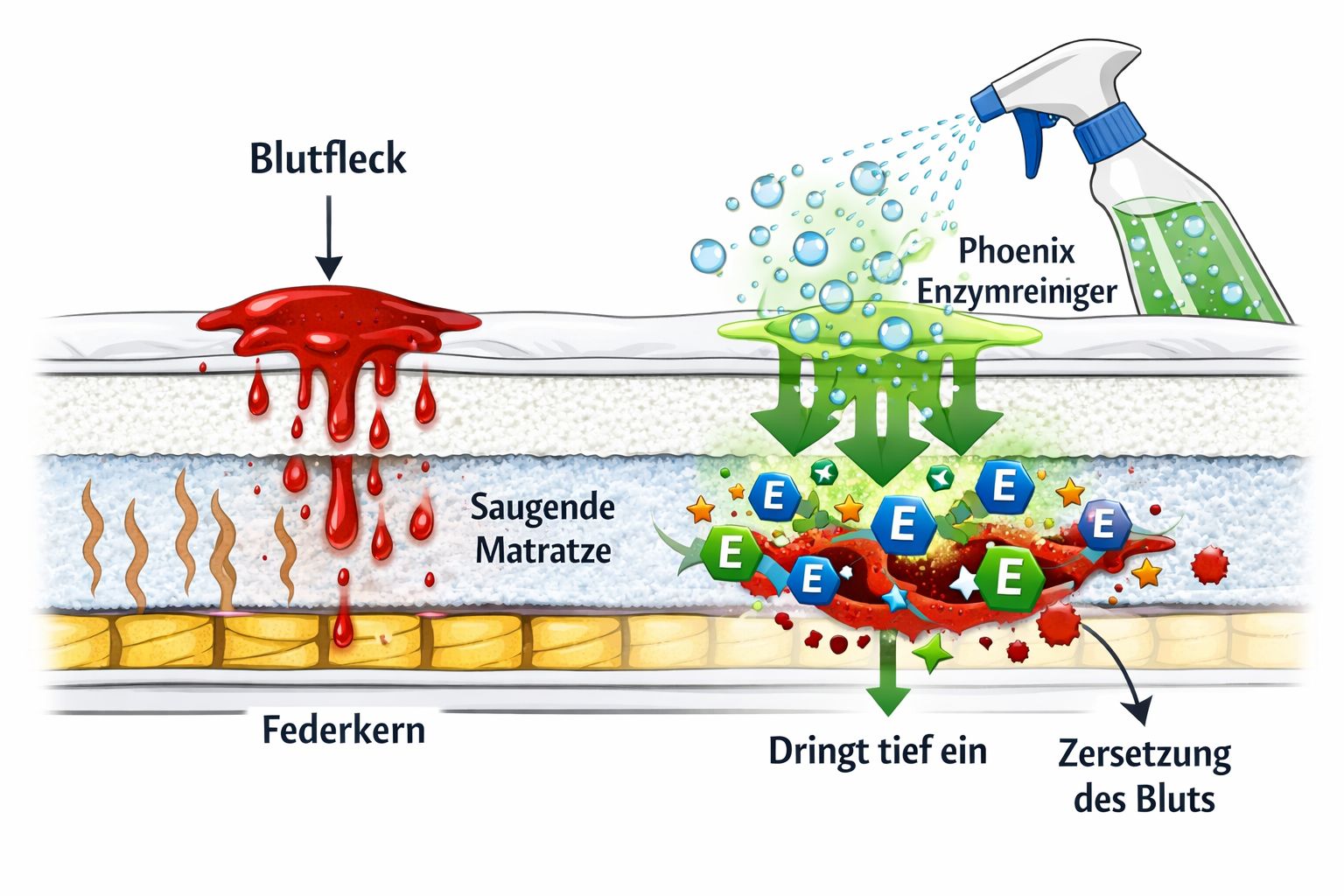
Removing bloodstains from a mattress is particularly tricky because mattresses are highly absorbent. Period blood, nosebleeds, or wound blood soaks into the spring core within seconds. If you then react with warm water, you will permanently fix the blood protein into the fibers through heat fixation.
Phoenix operates cold. Protease It travels with the water via capillary action into the depths of the mattress and breaks down the protein chains in the blood there. incubation period The enzymes need at least 30 minutes to work – for deep areas, cover overnight with foil (occlusion) to keep it moist. The resulting bio-sludge is then sprayed with clean water and vacuumed up with a wet vacuum.
🩸 Mattress application
Recommended: Pressure sprayer bundle (DS) for even distribution into deep layers. The granular concept is particularly economical here – you mix only the amount you need.
Go to shop →4. Removing dried bloodstains — the hemosiderin problem
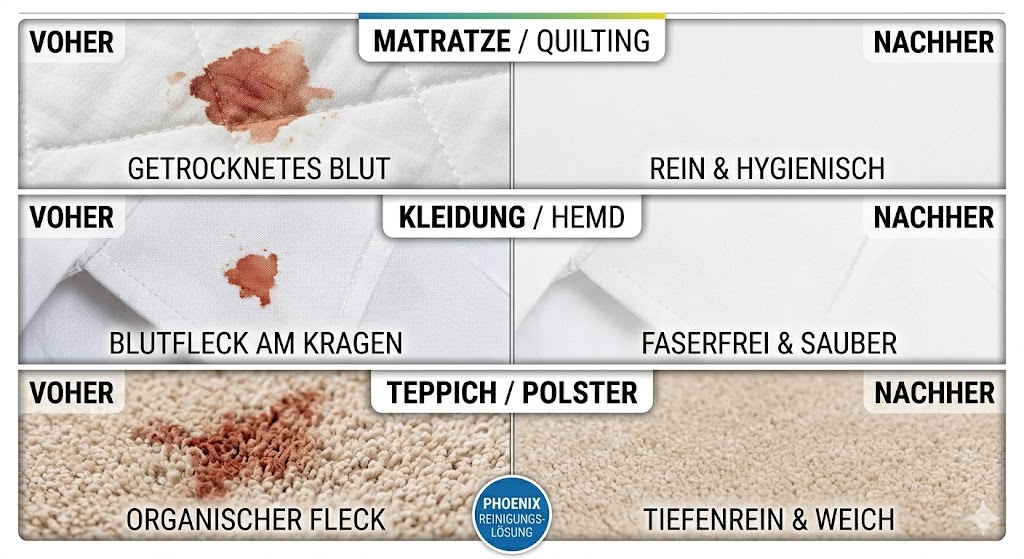
When blood is dried, you're no longer dealing with fresh hemoglobin. Over time, the body – or rather the tissue in which the blood is stored – gradually breaks down the hemoglobin. This process creates... Hemosiderin, an iron-storing mining product that is responsible for the typical brown edges with old bloodstains.
Here is the most important rule for removing blood: Never use hot water. Hemoglobin coagulates at around 40 °C – that is the Denaturation. The blood protein binds permanently to the fiber structure, making the stain practically permanent.
Dried bloodstains require more patience than fresh ones, but they are not lost. The enzymes in Phoenix continue to work even after days, weeks, or months – the peptide bonds of the dried blood remain accessible to the protease as long as the protein has not been heat-set. For hemosiderin-based stains, a second or third application may be necessary.
Procedure for old stains: Double the incubation time (2-3 hours instead of 30 minutes), apply occlusive film, then spray again with Phoenix and suction. For very old stains with brown hemosiderin edges: Plan for 2-3 applications.
5. Removing bloodstains from period blood on underwear and bed sheets

Period blood on the bedsheet, in your underwear, or on the couch – it happens to every woman, but it's still unpleasant. Period blood is chemically unique because it Fibrinogen It contains a coagulation factor from the coagulation cascade, which causes period blood to adhere differently than blood from injuries – it forms a thin film on fibers more quickly, which is hardly soluble with water alone.
Phoenix dissolves fibrinogen just like other blood proteins: by micro-cleaving the peptide bonds. You spray the solution onto the underwear, sheet, or pillowcase, let it sit for 30 minutes, and then wash in cold water (max. 30°C). For pillowcases: after the solution has taken effect, wipe with a damp cloth or vacuum with a wet vacuum cleaner.
Important: Do not use bleach. While bleach will remove the red dye, the protein remains in the fabric – and so does the odor after a few days. Phoenix removes all organic material, not just the color.
6. Removing bloodstains from a car: wildlife collision, upholstery, seat belt
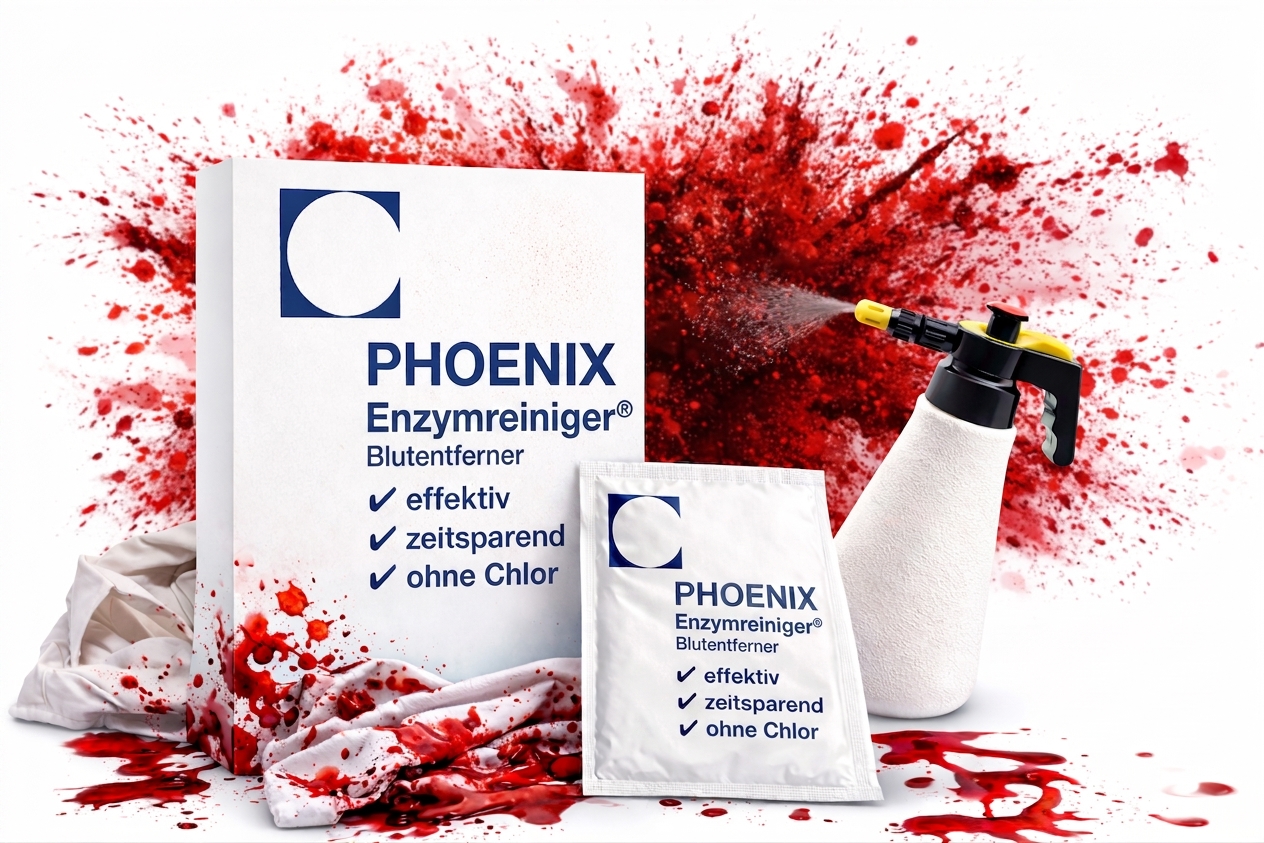
Whether it's a collision with wildlife, a traffic accident, or a sports injury, blood in the trunk is a nightmare because upholstery, carpets, seat belts, and door panels are all made of different materials. Hemoglobin reacts strongly with plastic surfaces due to its iron-heme complex – meaning the longer it's in contact with the surface, the heavier the stain becomes.
Step-by-step instructions for car interiors: First, remove loose debris mechanically, then spray Phoenix liberally with a pressure sprayer. Allow it to soak into upholstery for 1-2 hours, then vacuum it up with a wet/dry vacuum. Seat belts can be soaked in a Phoenix solution – important: check material compatibility with the manufacturer, as some belts have special coatings. Do not subject the belt to mechanical stress during washing, as this could reduce its load-bearing capacity.
Phoenix is now being used by workshops and used car dealers for the refurbishment of accident-damaged vehicles. Also of interest: we have a [product/service/solution] for vehicle detailers. Special cleaner for car seats using the same enzyme technology.
7. Premium materials: silk, cashmere, velvet, down, leather
Sensitive materials are the ultimate challenge. Aggressive chemicals destroy the fibers, and mild home remedies are insufficient for blood proteins. Phoenix works here with full force. Substrate specificityOnly the organic blood protein is attacked; the fiber structure remains unaffected.
🧣 Silk
Very sensitive protein material. Use Phoenix solution diluted (half the concentration), short contact time (15 minutes), test first on an inconspicuous area. Rinse with cold water, air dry.
🧶 Cashmere
Animal fiber, therefore pH sensitive. Apply Phoenix sparingly, only to the stain, not over a large area. Then rinse with clean water and dry flat.
👑 Velvet
Pay attention to the pile direction. Spray the solution in the direction of the pile, let it soak in, then remove it with a soft cloth in the direction of the pile. Never rub against the grain.
🧥 Down jacket
Phoenix solution penetrates the outer material and reaches the down. Important after washing: dry with tennis balls in the dryer, otherwise the down will clump.
🛋️ Smooth leather
Phoenix biocatalytically safe for most types of leather. For aniline or light-colored smooth leather: test on an inconspicuous area first. After cleaning, condition with leather care product.
🎒 Suede & Velour
Use Phoenix solution very sparingly, otherwise watermarks will appear. Apply sparingly with a sponge, rub in cold water, let it air dry, then roughen with a velour brush.
8. Natural stone and unsealed surfaces
Bloodstains on unsealed natural stone – sandstone patios, granite entrance steps, old limestone slabs – are problematic. Stone is porous, and blood penetrates deep into the capillary system. Conventional cleaners are often ineffective because the protein compounds are deeply embedded in the stone.
Phoenix penetrates deep into the surface via capillary action and breaks down the protein where it is located. Spray generously, cover with foil (occlusion), leave overnight, rinse with clean water, brushing the surface is optional. For very old stains, plan on two to three applications.
Important: When using on polished or varnished natural stone, test on an inconspicuous area first. Phoenix is pH-neutral and gentle on materials, but the fiber structure of the specific stone is the determining factor.
9. Campervan, Vanlife and Motorhome
Things can get messy quickly in a camper: injuries on the road, bloody fish in the sink, a dog in the pop-top roof. Limited water resources, small spaces, sensitive materials (wood veneer, upholstery, foam mattress). Phoenix granules are particularly economical here because you only mix the amount you need.
Vanlife-specific application: Mix one 20g portion in 200ml of water, apply with a small spray nozzle, let it soak in, and remove with a microfiber cloth. No wet vacuum cleaner is needed for small areas. There's a separate trick for the toilet cassette – Phoenix can also dissolve protein deposits there, however, we recommend our [product name] for that. Caravan specialist cleaner.
10. Public transport, taxis and long-distance buses: Hygiene in passenger transport
Incidents occur constantly on commuter trains, long-distance buses, and taxis: nosebleeds, cuts, emergencies after fights. Cleaning staff often have only short breaks between trips – the solution must be quick and gentle on materials.
Phoenix can be used for pre-cleaning in 30-60 minutes. Procedure: spray on, let it work, remove with a microfiber cloth or wet vacuum cleaner, seat can be reused. Substrate specificity This prevents upholstery fabrics from fading. The pressure sprayer set is worthwhile for taxi companies with high call volumes.
11. Mountain sports: SAC huts, climbing halls, ski schools
SAC and ÖAV huts, climbing gyms, and ski schools have a constant need for blood purification. Falls, split lips, cut fingers on climbing holds – these are everyday occurrences. Hut mattresses, bouldering pads, and first-aid rooms must be quickly ready for use again.
Phoenix is practical here because the granular concept is suitable for storage (the solution doesn't spoil until you mix it). A 1 kg can in the hut warden's room is enough for an entire season. For bouldering mats and crash pads: spray, let it soak in, wipe off – no wet vacuum needed.
12. Medical practice and outpatient care: Pre-cleaning for hygiene
In doctors' offices, midwives' rooms, tattoo studios, and care facilities, blood purification is part of daily hygiene. Phoenix Enzymreiniger is doubly interesting here: First, it reduces germs by depriving them of their food source (the bacteria lose their food base); second, it is Expert opinion by Dr. Mang (Chemical Laboratory Frankfurt, 2004) Suitable for cleaning in food areas (with mandatory rinsing).
In practical terms, this means you can clean treatment chairs, couches, waiting rooms, and even food contact areas (pharmacy refrigeration, medical practice kitchen) with the same product. The surfactants are at least 90% biodegradable (SDS section 12), not subject to EC labeling requirements, and not classified as dangerous goods.
Important for compliance: Phoenix is NOT a disinfectant and does not replace surface disinfection according to RKI guidelines. We reduce the germ load by removing the substrate – this is a cleaning step, not a biocide step.
👨⚕️ Note for practice owners
Phoenix can be used as a pre-cleaner BEFORE surface disinfection. It removes the organic load (blood, protein, grease) so that the subsequent disinfectant can develop its full effect. This is even true in the RKI recommendations on hospital hygiene As planned: first cleaning, then disinfection.
13. Crime scene cleaning and forensics: When Luminol tells the truth
Commercial crime scene cleaning, apartment clearing after a body has been found, remediation of crime scenes – these are the toughest cases where bloodstains need to be removed. It's not just about appearance, but also about odor neutralization, germ reduction, and forensic compliance.
Professional crime scene cleaners use Phoenix as a pre-cleaning agent because the product offers three advantages: First, it completely breaks down blood proteins through micro-splitting. Second, it neutralizes the odor of decomposition by removing the substrate. Third, the surfactants are at least 90% biodegradable (SDS section 12) – which is crucial when disposing of contaminated wastewater.
Forensic credibility: Phoenix removes the hemoglobin so completely that even Luminol or BlueStar no longer detect any significant residual traces in subsequent tests – crucially important for commercial crime scene cleaners who must not leave any residual contamination after handing over the apartment.

Can you find all the hidden cats? — Get a 10% discount
Join in the hidden object game — whoever finds all the cats will immediately receive a personal discount code.
To the search game →14. Removing the smell of decay: Substrate removal instead of masking.
The smell of decay is caused by putrefactive bacteria, which decompose organic material (blood, tissue, protein) and release volatile sulfur and nitrogen compounds – the Ptomaine and biogenic amines. Classic odor neutralizers only mask this odor with fragrances; the actual cause remains in the material.
Phoenix works differently: We deprive the putrefactive bacteria of their food source. When the enzymes break down the peptide bonds, there's nothing left for the bacteria to metabolize. No food = no odor production. We call this Substrate removal.
The effect: Even in apartments that have been vacant for a long time, the odor can be permanently eliminated – without lengthy ventilation periods, without removing wallpaper during renovations, and without replacing the screed. The only requirement is that the material is not so saturated that the solution can no longer penetrate it.
15. Removing bloodstains from dog blood, heat cycles, and pet care
You know how it is: your dog comes back from a walk, cuts himself on a piece of broken glass, and leaves a trail of blood on your favorite sofa. Or your female dog is in heat and leaves marks on her dog bed. During surgery or in a whelping box during birth, the amount of blood is often significantly greater.
Animal blood is chemically very similar to human blood: hemoglobin, proteins, and some fat. Phoenix uses the same trio of enzymes. The difference is that in dogs, the blood often contains traces of fur fat, which are also enzymatically broken down. Therefore, the results with animal blood are often even better than with human blood, because the enzymes cover a broader spectrum.
Important: Phoenix is safe for animals when used correctly. Nevertheless, rinse thoroughly after use before your dog uses the sofa again. If you generally want to eliminate pet odors, it's worth taking a look at our Special cleaner for pet odors.
16. Butcher shop, slaughter aprons, HACCP
In butcher shops, slaughterhouses, and meat processing plants, blood residue, protein deposits, and grease films are daily cleaning challenges. Conventional cleaning agents are often either too aggressive (posing food safety concerns) or too weak (protein remains on the floor, cutting board, or apron).
Phoenix offers a good compromise: It dissolves blood proteins through hydrolysis (water + enzyme break down the peptide bonds), while simultaneously removing fat and starch residues – the full spectrum of substances found in a butcher shop. According to Dr. Mang's expert opinion, it is suitable for cleaning in food processing areas (with mandatory rinsing).
For cleaning slaughter aprons: soak overnight in Phoenix solution (1 kg to 50 liters), rinse with cold water in the morning. This saves on laundry costs and extends the apron's lifespan. HACCP concept Plan it as a cleaning step before disinfection.
17. Jerseys, boxing gloves and sports mats
In combat sports, blood is part of the game. Boxing gloves after a tough sparring session, mouthguards after a foul, BJJ mats after training – blood splashes are everywhere, not only unsightly but also hygienically problematic. In team sports, blood-stained jerseys after foul injuries are also standard.
With sports equipment, the challenge lies in the material: leather (boxing gloves), rubber (mouthguards), foam (pads), synthetic fabrics (jerseys). Phoenix works on all of them – the enzymes attack the blood proteins, not the material. The amino acids remaining after micro-cleavage are water-soluble and are washed away with clean water.
For jerseys and sportswear: Spray with Phoenix, leave on for 30 minutes, then wash in cold water (max. 30°C, otherwise heat setting will occur). For boxing gloves and pads: Spray on, wipe with a damp cloth, and air dry.
18. Wound drainage and home care
Caregiving relatives are familiar with the problem: wound exudate from chronic wounds, pressure sores, recently operated areas, or diabetic ulcers ends up on bed sheets, pillows, and care clothing. Wound exudate is essentially plasma fluid with proteins – chemically similar to diluted blood, but often with a higher fibrinogen content.
The peptide bonds in wound exudate are broken down by the same enzymes that break down blood. Phoenix removes wound exudate stains from bedding, incontinence pads, hospital clothing, and cushions. Important: apply cold to prevent the protein from becoming heat-fixed.
🏥 Tip for family caregivers
Phoenix is not subject to labeling requirements, is not classified as hazardous material, and has the lowest water hazard class. You can easily mix the solution at home and apply it to hospital beds. Rinse thoroughly with water after use before the person being cared for comes into contact with the surface again.
19. Permanent makeup and microneedling
In permanent makeup studios, tattoo parlors, and microneedling practices, small mixtures of blood and secretions constantly accumulate on treatment tables, work clothes, and towels. Hygiene standards are high, but the equipment is delicate – treatment table covers, foam pads, and fitted sheets cannot withstand harsh cleaning agents.
Spray Phoenix directly onto the stain, let it work for 15-20 minutes, then remove with a damp cloth. Surfactant synergy At the same time, it also removes pigment residues. Afterwards, disinfect the surface according to the hygiene plan – Phoenix does not replace this.
20. Yacht, Charter and Maritime Application
Blood-related incidents are not uncommon on sailing yachts and charter boats – cuts while docking, fishing blood on upholstery, bloody fish preparation in the galley. Nautical upholstery is often made of synthetic leather or moisture-resistant fabric – materials that quickly absorb odors because of the warm, humid climate.
Phoenix is economical here because the granules can be stored in the yacht's storage compartment – no risk of freezing during winter storage, no odor development in enclosed spaces. Before winterizing: thoroughly pre-clean upholstery with Phoenix; this prevents mold growth during the period of storage.
21. Prison, animal shelter and resale luxury
Three worlds, one common requirement: discreet and gentle blood protein removal. In prisons, it's about cell cleaning and laundry processing – a high demand for effective protein solutions without aggressive fumes. In animal shelters, it's about quarantine stations and transport crates – cleaning organic loads without biocide contamination. In the high-end second-hand market (designer handbags, vintage fashion), it's about preserving value through fiber-friendly processing before resale.
Phoenix meets all three requirements: enzymatic micro-cleavage instead of aggressive chemical agents, not classified as hazardous material, lowest water hazard class.
22. Veterinary practices and large animal husbandry
Veterinary practices are demanding cleaning environments: animals change daily, each with different secretions, frequent surgeries, and emergencies involving large amounts of blood. The operating table, the cages, the waiting room benches, the blankets in the kennels – everything must be regularly cleaned of organic residue.
Phoenix works here with the iron-heme complex of hemoglobin, which is chemically almost identical in animals to that in humans. Enzymatically, protein structures, fat components from skin secretions and fur, as well as saliva and starch from leftover food are broken down.
In large animal practices (horses, cattle), the blood volumes are larger – here, a 1 kg can plus pressure sprayer is standard. Phoenix reduces the bacterial load by removing substrate, but it does not replace veterinary disinfection according to the DVG list.
23. Removing blood stains from carpet, upholstery, and wall coverings
Removing bloodstains from a carpet is the ultimate challenge: carpet fibers are extremely absorbent, blood seeps deep into the backing layer and often permanently stains the fibers. While classic bleaching agents do work, they leave light patches.
Phoenix uses microsplitting and the Substrate specificityThe enzymes break down the blood proteins without damaging the fiber color. You are only treating the blood, not the carpet. Procedure: Spray Phoenix evenly onto the stain and a 5 cm radius around it using a pressure sprayer, let it work for 30-60 minutes, rinse with clean water, and vacuum with a wet vacuum.
For carpets with a light background (beige, white, light gray): First test on an inconspicuous area – very rarely do sensitive wool fibers react to the pH value of the solution. There are no problems whatsoever with synthetic fibers (polyester, polyamide). Cellulose structure Plant fibers are resistant to enzyme activity.
24. Hunting and Game Processing
Hunters and foresters have their own specific applications: preparing game meat in the game larder, cleaning tools after butchering, and cleaning car trunks after transporting game. Here, it's not just about appearance, but about food hygiene standards – after all, game meat ends up on the plate.
According to Dr. Mang's expert opinion, Phoenix is suitable for cleaning in food processing areas (with mandatory rinsing). The protease dissolves all blood proteins that adhere to tools, cutting boards, and floor surfaces after butchering. In game processing rooms: after rinsing with clean water, the surface is ready for the next game processing job.
25. Funeral directors and transport vehicles
Funeral homes have specific cleaning needs: preparing rooms after viewings, cleaning transport vehicles, and sanitizing coffin services. Blood, bodily fluids, and the smell of decomposition come together here – in an environment that demands absolute discretion and hygiene.
Phoenix is used as a universal pre-cleaning step: rooms are sprayed, odor sources are neutralized by substrate removal, and blood proteins are dissolved by micro-cleavage.
Application process in 4 steps
1 Find – Use a UV lamp in the dark to mark all traces (especially important for crime scene cleaning)
2 Spray – Spray Phoenix solution generously and thoroughly (pressure sprayer recommended)
3 Incubation – Cover with foil overnight for at least 30 minutes for deep stains (occlusion).
4 Suction – Spray with clean water and completely vacuum with the wet vacuum cleaner.
The blood proteins are biocatalytically broken down – no stain, no odor, no residue.
26. Bed linen and white linen
The most common scenario, and the one where things go most wrong. A bloodstain on the sheet is discovered in the morning, meaning it's already several hours old, and then goes into the washing machine at 60°C. This is precisely what heat setting is: the heat denatures the hemoglobin and permanently cross-links it to the cotton fibers.
The correct order is the reverse. First pretreat with cold water, then wash, either with cold water or at 30°C.
- Moisten the area with cold water, do not rub.
- Apply the solution generously; cover with foil if the blood dries.
- Leave on for 30 minutes to overnight
- Rinse, then wash in cold water or at 30°C and add 20g of granules to the drum.
With white laundry, the temptation to use bleach is strong. This removes the color from the stain, but it doesn't remove it. The protein remains in the fabric and becomes visible again over time as a yellowed edge.
27. Bloodstains from clothing
Jeans, shirts, white laundry and the question of the correct washing temperature are covered in detail in our own guide:
👕 How to remove blood stains from clothing
Jeans, shirts, T-shirts and delicate fabrics – with instructions for pre-treatment and washing.
Go to the clothing guide →28. FAQ: The 15 most important answers
What's the best way to remove old bloodstains?
Enzymatic cleaners like Phoenix are the targeted solution for dried bloodstains. The enzymes break down the blood proteins even after days or weeks, as long as the proteins have not been heat-set. Important: double the incubation time (2-3 hours), use occlusive film, and apply 2-3 times if necessary.
Does baking soda really help with old bloodstains?
No. Baking soda is sodium bicarbonate, a mild alkali. It only helps cosmetically with dried blood – the protein remains in the material and becomes the source of the odor. Enzymatic cleaners break down the peptide bonds; baking soda cannot. It's one of the most persistent home remedy myths.
What happens if you wash bloodstains at too high a temperature?
Above 40°C, hemoglobin coagulates and binds permanently to the fiber – this is heat fixation. Phoenix can still remove residual protein, but the thermal damage to the fiber is irreversible. Rule of thumb: always work with cold water when handling blood, wash with cold water, and do not use a hairdryer.
Is it possible to remove dried blood after years?
Yes, to a degree. As long as the protein hasn't been heat-fixed, the protease will still attack even after years. Very old stains develop brown hemosiderin edges – these require 2-3 applications. Important: The material must be absorbent, otherwise the solution won't penetrate.
How do I remove blood without soaking the pillow core?
Use Phoenix very sparingly, applying it by dabbing with a microfiber cloth instead of spraying. Allow to incubate for 20-30 minutes, then remove with a damp cloth. For deep cushions: several short applications instead of one long one; this keeps the cushion core dry.
How do I remove blood from the mattress?
Spray on Phoenix Enzymreiniger, leave to work for 30 minutes to overnight (cover with foil for deep stains), rinse with clean water, and vacuum with a wet vacuum. Never use warm water – otherwise, you will permanently fix the blood protein through heat fixation.
Does Phoenix help with old bloodstains on clothing?
Yes, with double the incubation time. Spray liberally, leave on for at least 1 hour, then wash in cold water (max. 30°C). For very old stains: spray again before washing. For premium materials (silk, cashmere), halve the concentration.
Is Phoenix safe for pets?
Phoenix is harmless to humans and animals when used correctly. Nevertheless, keep animals away from the treated area during the incubation period and rinse thoroughly with water after application. The product does not require labeling and has the lowest water hazard class.
Why can't I treat blood with warm water?
Hemoglobin in the blood coagulates at around 40°C – heat-fixation. The blood protein then binds permanently to the fiber. Therefore: always work in cold conditions, wash in cold water, do not use a hairdryer, and do not dry on a radiator.
Does Phoenix also work on leather?
Yes, it works on most types of leather. Phoenix is biocatalytic and only attacks the blood proteins, not the leather itself. With very delicate leathers (aniline leather, light-colored smooth leather), always test on an inconspicuous area first. After cleaning, apply leather conditioner.
Can I use Phoenix in the food industry?
Yes, according to an expert opinion by Dr. Mang (Chemical Laboratory Frankfurt, 2004), Phoenix is suitable for cleaning in the food industry – with mandatory subsequent rinsing. Surfactants are at least 90% biodegradable (SDS section 12), not subject to labeling requirements according to EC regulations.
How long will the mixed solution keep?
Full potency for 48 hours after mixing, followed by a slower degradation of the enzymes. Ready for use for up to 20 days. Advantage of the granule concept: you only mix the amount you need.
What does decomposition smell like after Phoenix treatment?
When used correctly, the odor disappears completely due to substrate removal – the putrefactive bacteria lose their food source (protein), no ptomaines, no biogenic amines. The characteristic Phoenix odor dissipates completely after drying. In extreme cases, plan for 2-3 applications.
Does Phoenix replace a disinfectant?
No. Phoenix is a cleaner, not a biocide. We reduce germs by removing substrate. This does not replace a proper surface disinfection (e.g., according to the RKI or DVG lists). In practice, Phoenix is used as a cleaning step BEFORE disinfection.
What to do if Phoenix doesn't remove the stain?
Three most common causes: 1) The blood protein was heat-fixed (hot laundry, sun, heating). In this case, there is usually nothing that can be done. 2) The incubation time was too short – for old stains, 2-3 hours with occlusion. 3) The material itself is damaged (fiber bleaching, leather cracks). Phoenix removes organic deposits but does not repair material damage.
🩸 Premium granules instead of ready-made solution
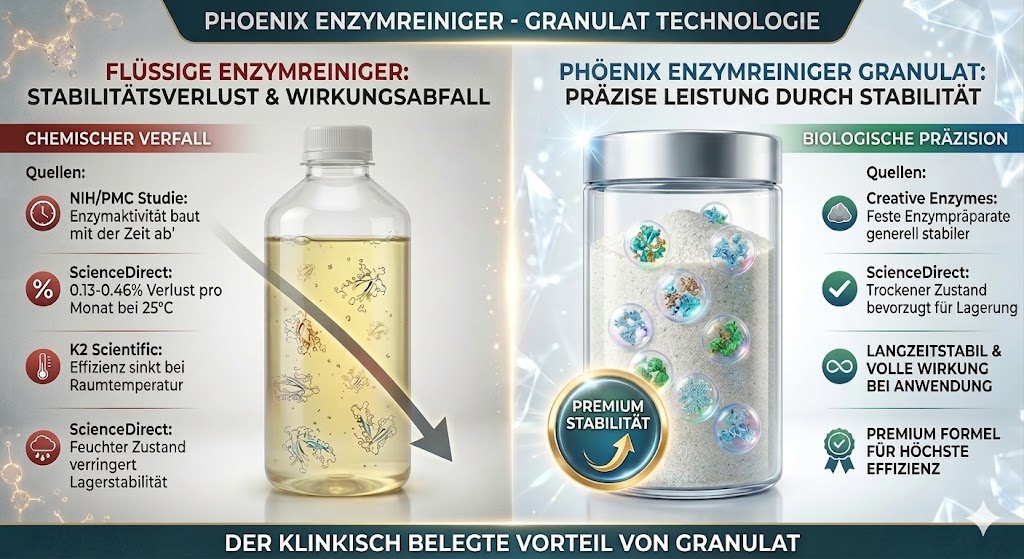
The Phoenix granule concept has three clear advantages over ready-to-use spray bottles:
- Freshly mixed = full enzyme power Ready-made liquid cleaners lose their effectiveness within weeks
- Portionable – you only mix what you need (10g, 20g, 100g)
- Economically – 1 kg of granules yields approximately 50 liters of application solution
Made in Germany. Granules, freshly mixed.
29. Conclusion: Organic purity through enzymatic intelligence
Removing bloodstains isn't a matter of brute chemical power, but of intelligent biocatalysis. Phoenix enzymatically breaks down organic residues and decomposes blood proteins – whether on mattresses, sofas, car upholstery, jerseys, boats, or crime scene floors. From discreet period blood on the couch to professional crime scene cleaning, Phoenix covers the entire spectrum.
The biodegradability of the surfactants (at least 90% according to SDS section 12) and the expert opinion of Dr. Mang make Phoenix a universal tool for private, B2B and professional users. Freshly mixed, portionable, gentle on materials, Made in Germany.
We bring the science of enzymes into your home – all you have to do is spray, wait, and vacuum. The micro-digestion does the rest.
🚀 Ready for clean results?
PHOENIX Enzymreiniger® Granules – freshly mixed, portionable, and gentle on materials. For private, B2B, and professional users.
To the Phoenix Blood Remover →