How to neutralize cat urine — the complete guide
Home remedy fact check, enzymatic method & step-by-step instructions for each surface — from carpet to washing machine
From Dieter Schmidt · Holder Phoenix Enzymreiniger

You want Neutralize cat urine —and in such a way that the smell doesn't return in two weeks? Then you don't need home remedy myths, but rather enzymatic breakdown. Because only enzymes can break down the felinine proteins and uric acid crystals that are responsible for the persistent odor. It's best to read this guide first—so that you're prepared when you try it. Neutralize cat urine so you don't make the classic mistake of experimenting with vinegar or baking soda.
This guide explains why cat urine is so uniquely difficult to analyze chemically, which home remedies work (and which definitely don't), and how to... Neutralize cat urine You can find information on 11 different surfaces — from carpet to washing machine to sisal scratching post — and what you can do after taking over an apartment if the previous tenant had a cat.
📋 Table of Contents
- Why cat urine is chemically so unique
- Home remedies fact check: Vinegar, baking powder, baking soda & Co.
- Why enzymes are the only real solution
- Neutralizing cat urine — per surface (11 materials)
- Apartment handover: Cat urine from previous tenant
- Prevention: to prevent cat urine from forming in the first place
- Application process: 4 steps to success
- Frequently asked questions about neutralizing cat urine
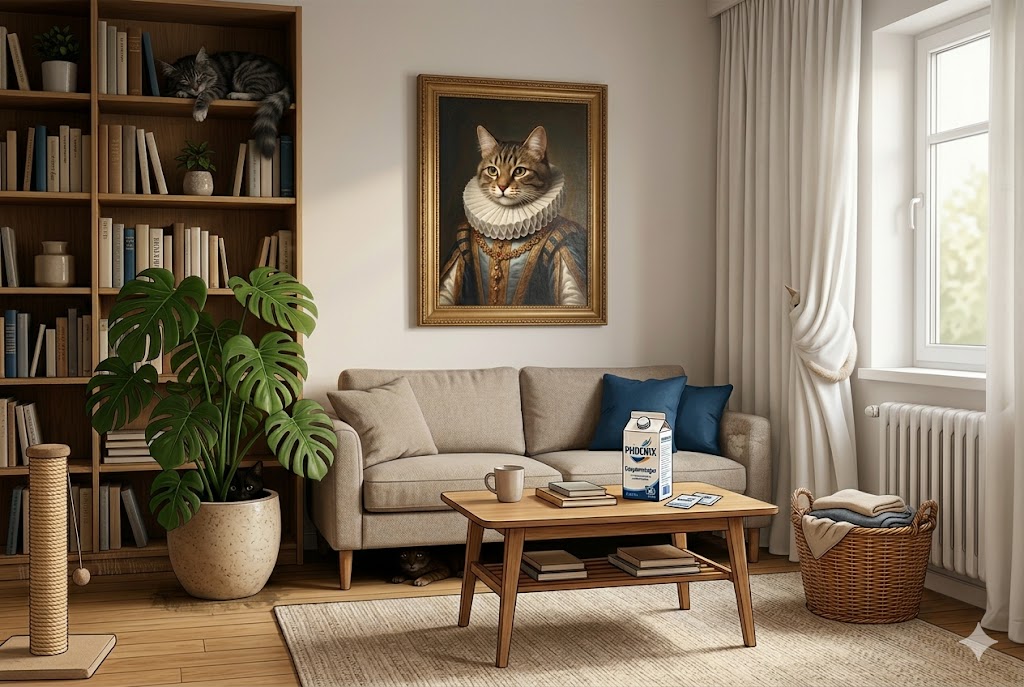
Can you find all the hidden cats? — Get a 10% discount
Join in the fun right here in this post with the living room hidden picture puzzle — whoever finds all the cats will immediately receive a personal discount code.
To the search game →
Why cat urine is chemically so unique
Who Neutralize cat urine Anyone who wants to understand this smell must first understand why it is chemically so unique. Cat urine contains, among other things... urea and uric acid, a substance found only in cats: Feline, a sulfur-containing amino acid. During bacterial degradation (especially by Proteus mirabilis and ureolytic microflora) the actual stink molecule is produced from felinine: 3-Mercapto-3-methyl-1-butanol (L-MMB), one of the most intense known Mercaptans.
Uric acid crystallizes out during drying. Uric acid crystals They bind cationically to carpet fibers, wood pores, upholstery, and plaster. These crystals are hygroscopic—they draw moisture from the air, and it is precisely then that the L-MMB molecules are released again. This is the wick effect: you clean superficially, and three days later it smells again. To neutralize cat urine, you have to penetrate down to the crystalline structure.
💡 The wick effect explained
Cat urine dries, and the uric acid crystallizes deep within the fibers. In humid or warm conditions, the fibers become more susceptible to crystallization. hygroscopic The water crystals partially dissolve and release the mercaptans. Per Capillary rise They migrate back upwards — the smell is suddenly there again. That's why superficial cleaning doesn't work.
🔦 Before you treat, you must find: Anyone who understands the chemistry will now know the problem—the mercaptans migrate back upwards as soon as the area absorbs moisture. To ensure you don't miss any locations, the most reliable method is... UV lamp scan (black light cat urine) — Cat urine then fluoresces yellowish-green, you mark, treat, done.
Home remedies fact check: what can really neutralize cat urine
You can find dozens of home remedy tips online: vinegar, baking powder, baking soda, dish soap, lemon juice. Some offer short-term relief—none can neutralize cat urine at a molecular level. Here's a fact check, sorted by effectiveness against Feline, uric acid crystals and L-MMB.
❌ Vinegar — even counterproductive
What he can do: Acid neutralizes alkaline ammonia residues on the surface. Short-term odor reduction.
Why it is not enough: Acetic acid does not break down feline proteins or uric acid crystals. Worse still: The acidic smell resembles a territorial marking for cats—some cats then urinate in the area. again in the same spot. On natural stone, slate and marble, vinegar further damages the surface structure.
❌ Baking powder / baking soda — only masks
What he can do: Sodium bicarbonate physically binds moisture and some odor molecules. When sprinkled on the surface for several days, it absorbs volatile compounds.
Why it's not enough: It doesn't break down feline proteins or uric acid crystals. As soon as you vacuum up the baking soda residue, the crystals are back in the material. The smell returns after 2-3 weeks. Baking soda can neutralize cat urine on the surface—not deep down.
❌ Dishwashing liquid / All-purpose cleaner — Symptom treatment
What he can do: Surfactants dissolve grease and surface film. Visible stains disappear.
Why it's not enough: Pure surfactants without enzymatic activity leave the felinin proteins intact. The mercaptan odor returns on the first warm day.
❌ Lemon juice — like vinegar, only more expensive
Citric acid is chemically similar to acetic acid. Same effect: surface masking, no enzymatic breakdown. Plus: just as aggressive on sensitive surfaces (wood, natural stone). It's supposed to neutralize cat urine—but it can't.
✅ Enzyme cleaner — the only biochemical solution
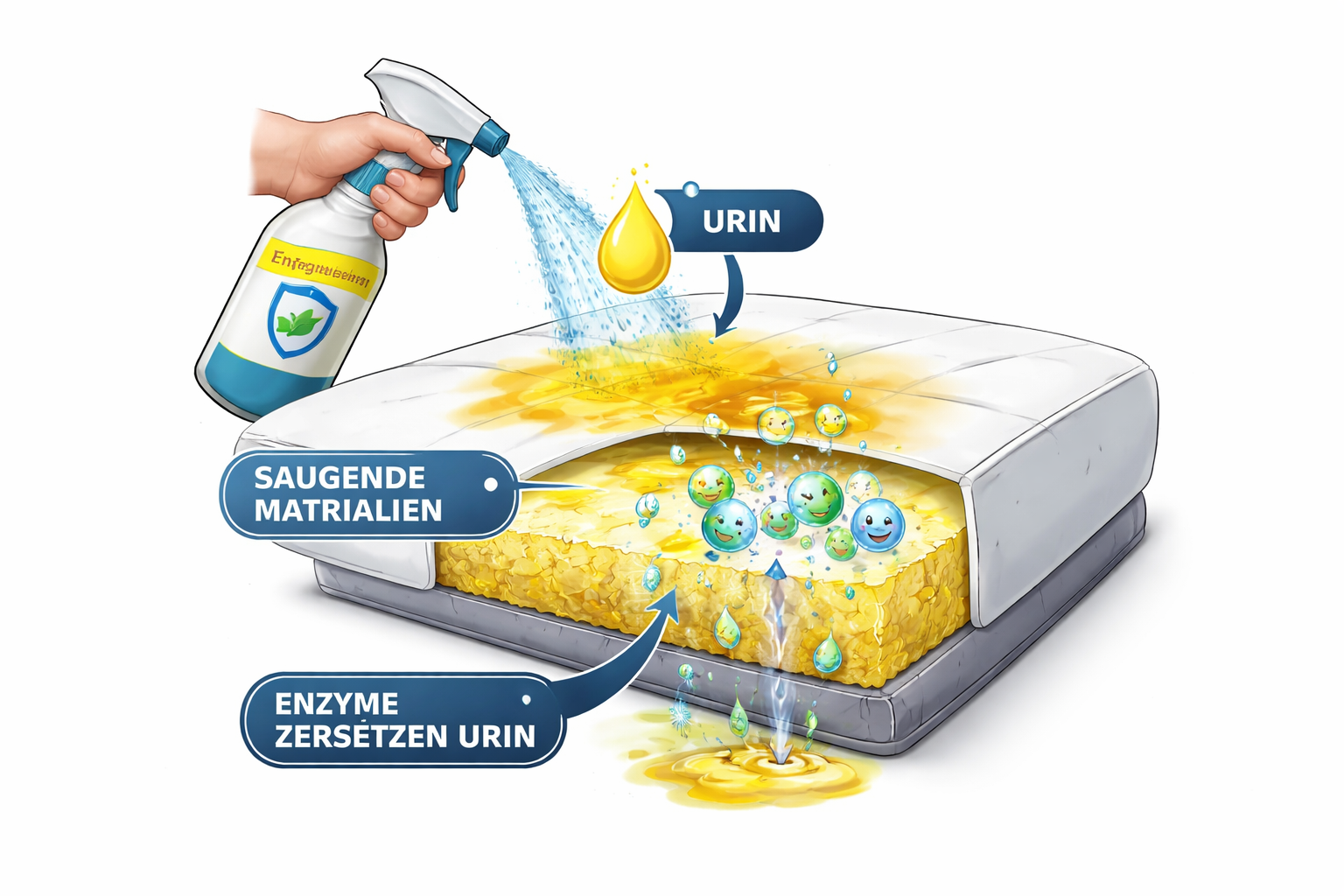
What he can do: Proteases cleave felinine protein chains, Amylases Carbohydrate residues, which contain surfactants They dissolve the fats in the marking secretions. This removes the organic basis of the odor.
Why it works: Enzymes work in a substrate-specific manner and leave the material untouched. There is no more wicking effect because there are no longer any crystals that could absorb water.
So if you really Neutralize cat urine If you want to get rid of the smell permanently and not just mask it temporarily, enzymatic cleaning is the only reliable method. Home remedies are okay as a first-aid measure if nothing else is available—but you'll know why when the smell returns after 2-3 days.
Why Enzymes Neutralizing cat urine — a brief textbook explanation
Enzymes are natural protein molecules that act as catalysts. They bind to specific molecules (substrates) and accelerate their breakdown. Three enzyme classes are crucial for neutralizing cat urine:
They cleave felinine protein chains and other nitrogen-containing compounds, preventing the formation of the foul-smelling molecule L-MMB from felinine.
They dissolve fats, sebum, and pheromone-containing marking secretions. Important for intact male cats, whose marking sprays are richer in fat.
They break down starch and carbohydrate residues from feed and secretions. Less organic material means less food for the bacteria that produce the odor.
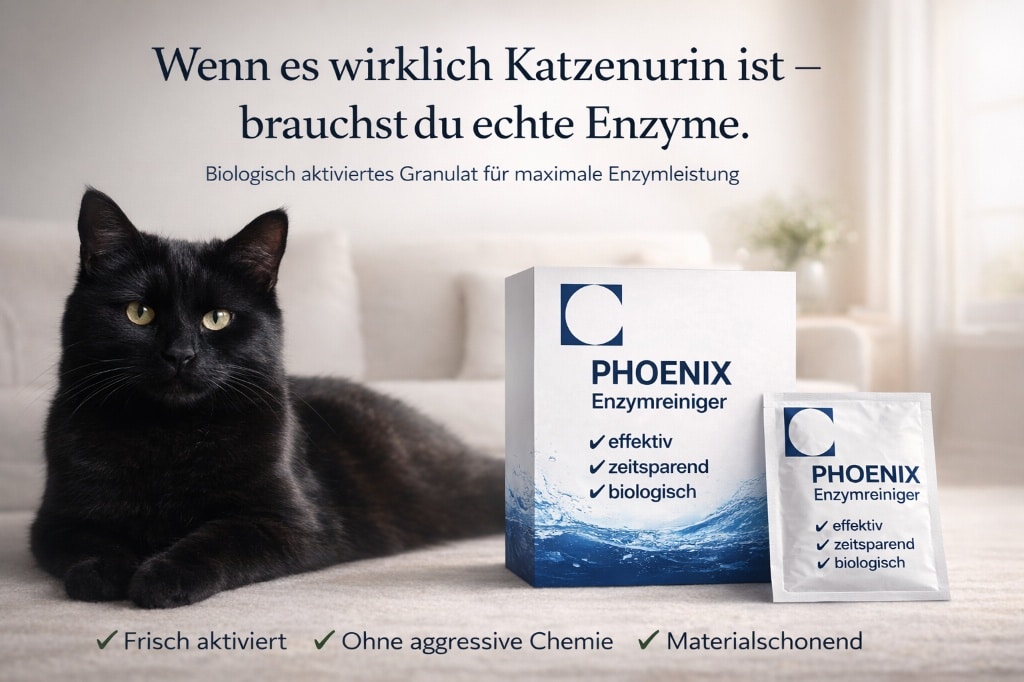
Phoenix Enzymreiniger combines precisely these three groups of active ingredients in one granules. You mix it fresh; the enzymes activate upon dissolving—and at full strength. That's the difference to ready-made solutions: their enzymes degrade continuously during storage.
💡 Why granules — and not a ready-made solution?
Enzymes are unstable in aqueous solution. With liquid cleaners, the loss of activity begins on day one in the bottle. With Phoenix granules, the enzymes remain stable in their dry form—the loss of effectiveness only starts after mixing. Freshly mixed = full enzymatic power. Ready for use for up to 20 days.
🧪 Scientifically proven
According to a chemical report (Dr. Mang, Chemical Laboratory Frankfurt, August 17, 2004), PHOENIX Enzymreiniger is suitable for cleaning work in the food industry. The surfactants are at least 90% biodegradable, not subject to EC labeling requirements, not classified as dangerous goods, and belong to the lowest water hazard class.
Neutralize cat urine — per surface
Depending on the surface, you'll need a tailored treatment. Here are the methods for the 11 most common materials — from easy (smooth surfaces) to more complex (mattress, sisal scratching post). With Phoenix Enzymreiniger, you can use it on virtually all water-resistant materials. Neutralize cat urine.

🏠 Carpets, runners, cushions & sofas
Absorbent fibers need the most Phoenix solution—it must penetrate all the way to the carpet backing. Mix 20 g of granules in 1.0–1.5 liters of water, spray or pour liberally, and let it soak in for at least 30 minutes. For older areas, cover overnight with cling film (occlusion method). Then vacuum with a wet vacuum—rinsing again with clean water afterward.
🛏️ Mattress
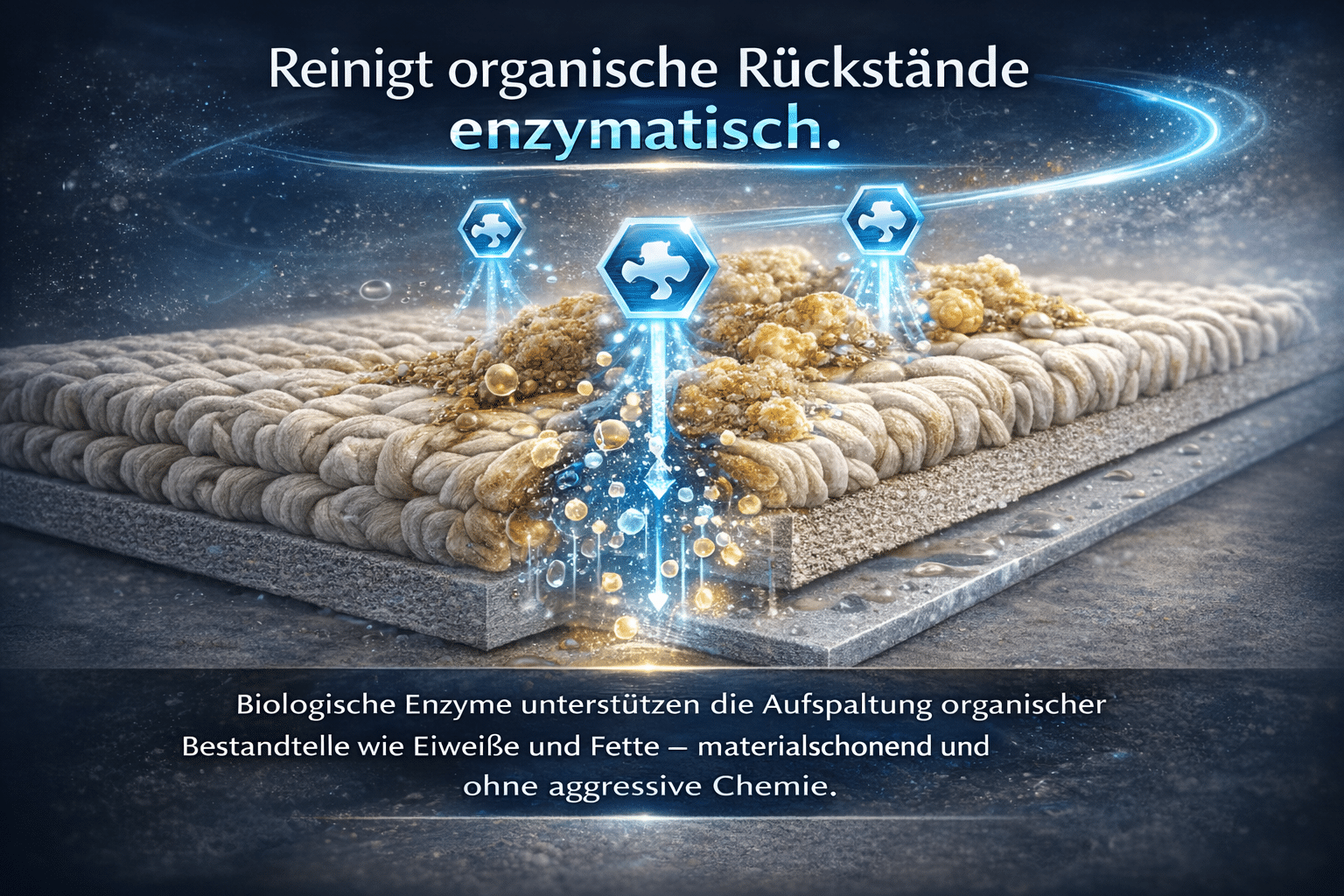
Cat urine soaks into the foam—deep into the spring core. Quick action is crucial: first, absorb as much of the liquid as possible with an absorbent cloth (do not rub!), then pour in a generous amount of Phoenix solution (1:50) until the area is thoroughly saturated. Leave to soak for at least 4 hours, ideally overnight. Allow to air dry, ideally with a fan. For innerspring mattresses, treatment may need to be repeated.
🪵 Wooden flooring, parquet & planks
Oiled or untreated wood absorbs cat urine deep into the fibers. Varnished parquet adheres superficially, but urine still seeps through cracks and gaps. Spray on a 1:50 Phoenix solution, let it soak in for 30 minutes, then wipe with a damp microfiber cloth. Test on a small, inconspicuous area first—the cleaner is gentle on materials, but for heavily used wood, a subsequent oiling is recommended.
📐 Laminate joints — the underestimated culprit
Laminate flooring has a surface that can be washed — but urine seeps into the core. Joints The odor penetrates between the panels, sometimes even reaching the screed beneath. There, it becomes trapped and cannot be neutralized by surface cleaning. The best method: Apply Phoenix solution directly into the joint using a pipette or fine syringe, let it work for one hour, then wipe with a damp microfiber cloth. If visible swelling occurs: replace the affected panel—the damage is mechanical, not chemical.
🪨 Slate, natural stone, marble & sandstone
Natural stone is porous and sensitive to acids. Important: Never use vinegar or citric acid – this will permanently damage the stone surface (dull spots, loss of shine). Phoenix Enzymreiniger is gentle on materials and compatible with stone. Spray a 1:50 solution liberally, leave to work for 30-60 minutes, then wipe off with a soft cloth. For impregnated stones: renew the impregnation after treatment.
🏗️ Screed, concrete & mineral substrates
If urine has seeped through laminate or vinyl flooring down to the underlying screed, the main problem lies beneath the surface—the surface no longer offers protection. Screed is highly porous, and uric acid crystals become deeply embedded in its mineral structure. The only solution is to remove the flooring and thoroughly treat the screed: Pour in Phoenix 1:50, 2-3 liters per square meter, let it soak in for at least 24 hours, allow it to dry completely, and repeat the process if necessary. Only then should you install new flooring—otherwise, the odor will simply resurface.
🐾 Sisal cat tree & scratching furniture
Has your cat marked the scratching post? Sisal fibers are extremely absorbent and retain the smell for months—many owners then throw the scratching post away. But it doesn't have to be that way: Spray the post liberally with a 1:50 Phoenix solution, saturating it from all sides until it soaks through. Let it work for 2 hours, then dry in the fresh air (garden, balcony). For particularly stubborn spots: treat twice. No fiber damage—sisal is compatible with the material.
🚗 Car upholstery, fabric seats & trunk
When it comes to cars, quick action is crucial—especially when returning a leased vehicle or selling it. Mix Phoenix 1:50, spray liberally until the cleaner soaks through, let it work for 30–60 minutes, then extract with a microfiber cloth or wet vacuum. For child car seats, wipe with clean water before reuse as an extra precaution. Don't forget the UV scan: Buyers and rental companies are increasingly using UV lamps to check cars for hidden animal traces.
🌀 Washing machine — when cat urine has ended up in textiles
Simply throwing bed linens, pillowcases, or sofa covers that have come into contact with cat urine into the washing machine is usually not enough. At 30°C or 40°C, the felinine proteins are not sufficiently broken down—the odor remains in the fabric and gets into the machine. Solution: Pre-treat the textile item for 30 minutes in a bowl with 2-3 liters of Phoenix solution (1:50), then wash with regular detergent at 60°C. If the machine itself smells: run an empty cycle at 60°C with 30 g of Phoenix granules in the drum—this removes felinine residue from the seals and drum.
You can find more information about cleaning washing machines with enzymes in the Machine cluster.
🧱 Walls, plaster & wallpaper
Marker spray on walls is particularly detrimental to felinine concentration—the high pheromone load produces an extremely strong odor. Generously spray a 1:50 Phoenix solution (use a splash guard to protect the floor), let it work for 60 minutes, then wipe with a damp sponge. For highly absorbent surfaces (woodchip wallpaper, plaster), treat several times. For wallpaper: test on a small, inconspicuous area—some adhesives can loosen when exposed to moisture.
👜 Leather & Faux Leather
Leather is acceptable — but with caution. Phoenix Enzymreiniger is gentle on materials and compatible with them, but: Test a sample in an inconspicuous location! The surfactants in this product dissolve fats—including the natural oils in the leather. Therefore, after treatment: apply leather conditioner and re-oil. For valuable leather items (sofas, car interiors), it's best to have them professionally cleaned rather than attempting it yourself.
Apartment handover: Neutralizing cat urine after previous tenant
You move into a new apartment, everything seems clean—and after three warm days, it suddenly smells strongly of cat urine? Classic case: The previous tenant had a cat, superficially cleaned, and the smell was neutralized by the time of handover. But the uric acid crystals are deeply embedded in the screed, the wood, and the grout. When the surface warms up, the mercaptans are released.
The 4-step diagnosis
1. Locate the positions: Systematically search the apartment you have taken over. The most reliable method is... UV lamp (UVA 365–395 nm) Cat urine fluoresces yellowish-green. Alternatively, you can perform a smell test on your knees at typical marking spots: door frames, radiator recesses, behind furniture, and lower wall areas. Detailed instructions for the blacklight scan can be found in the linked UV article.
2. Focus on transitions and joints: Floor-wall transitions, baseboards, door thresholds, carpet-laminate transitions. Urine collects in the joints at precisely these points—it's an underestimated classic problem. Removing cat urine odor from grout If the affected area is treated thoroughly, it must be treated deep down because the uric acid crystals are drawn into every crevice by capillary action.
3. Treatment per substrate: As described above — method adapted to each material. If screed is suspected, possibly remove the floor covering.
4. Patience: For heavily contaminated apartments, 2-3 treatment cycles are necessary, spaced one week apart. Allow to dry completely after each cycle, then perform another control scan.
💡 Landlord tip
If you, as a landlord, have rented an apartment to pet owners and suspect cat urine upon move-out: document this with photos and UV light, and commission a professional cleaning with an enzyme cleaner. If the odor is demonstrably present, you can deduct the cleaning costs from the security deposit.
Prevention: Neutralizing cat urine is good — preventing it from forming in the first place is better.
If your cat is urinating or marking outside the litter box, there's almost always a reason. Anyone who only cleans but doesn't address the underlying cause knows the drill: two weeks of peace, then it starts all over again. Here are four things that really help:
🧠 Understanding tagging behavior
Cats mark their territory for three reasons: Territorial demarcation (new furniture, new roommate, strange cat visible at the window), stress (Moving, noisy environment, changes) or health-related (Pain when urinating). Knowing the trigger allows for targeted countermeasures.
😌 Reduce stress
Fixed routines, sufficient Places of retreat (at least one elevated sleeping place per cat), enough Cat litter boxes (Rule of thumb: Number of cats + 1) and playing together lowers the stress level. This helps in cases of acute stress. Pheromone diffuser (Feliway).
✂️ Castration
In intact male cats Highlighting the most common problem —and castration drastically resolves it in most cases. It can also reduce hormonally driven marking in cats. Talk to your vet about the right time.
🩺 Vet check
If your cat suddenly becomes unclean, it could be due to a Urinary tract infection, diabetes, or kidney failure There may be underlying reasons. Especially in older cats and after a change in behavior: first have it medically checked, then behavioral therapy.
🚽 Cat litter box smell — before he eats his way into the apartment
A smelly litter box isn't just unpleasant—it's often the reason your cat avoids it and seeks out other places. Scoop out the litter daily, change it completely at least every 7 days, and clean the tray itself regularly. Rinse with Phoenix solution 1:50 (Decomposes feline residues, not a perfume mask). Rule of thumb: Number of cats + 1 litter box, placed in different quiet locations.
🐾 Kitten house training — the first few weeks are crucial
At Kitten Housetraining is established between weeks 4 and 8. Early consistency will prevent marking problems later. Use shallow bowls, quiet litter, and avoid startling the kitten while it's doing its business. If an accident does happen, treat the spot immediately with Phoenix, otherwise the kitten will mark there again. Any remaining pheromones are extremely attractive to kittens.
⚠️ When to go to the vet IMMEDIATELY
If your cat pees screams, often small amounts urinated, Blood in urine If a man has difficulty urinating, or is unable to urinate at all, this is an emergency. Urethral obstruction can be fatal within 24-48 hours.
Application process: Neutralizing cat urine in 4 steps
This is the universal method for all substrates — possibly with material-specific adjustments from the substrate chapter above.
💡 Mix correctly: First dissolve the granules in approximately 250 ml of hot water until lump-free, then top up to the required amount (20 g per 1 liter). Always mix fresh for cat urine and use immediately. See complete instructions and dosage chart below. Product Guide Application & Dosage.
By smell test or UV lamp / black light. Mark the positions.
Spray Phoenix 1:50 liberally until thoroughly saturated.
At least 30 minutes. For old areas: overnight with foil.
Wet vacuum cleaner: spray with water and vacuum completely.
✅ Result: The felinine proteins are enzymatically broken down, the residues flushed away — the odor does not return. Permanently. Neutralize cat urine.
💡 Expert hack: Occlusion method for old teeth
For dried-out areas or deeply embedded uric acid crystals: Spray Phoenix generously, then treat the area with Cover with cling film and leave it on overnight. The foil prevents drying out—the enzymes remain active for hours. This way you can neutralize cat urine even in areas that are inaccessible with normal treatment.
Suitable accessories for maximum effect

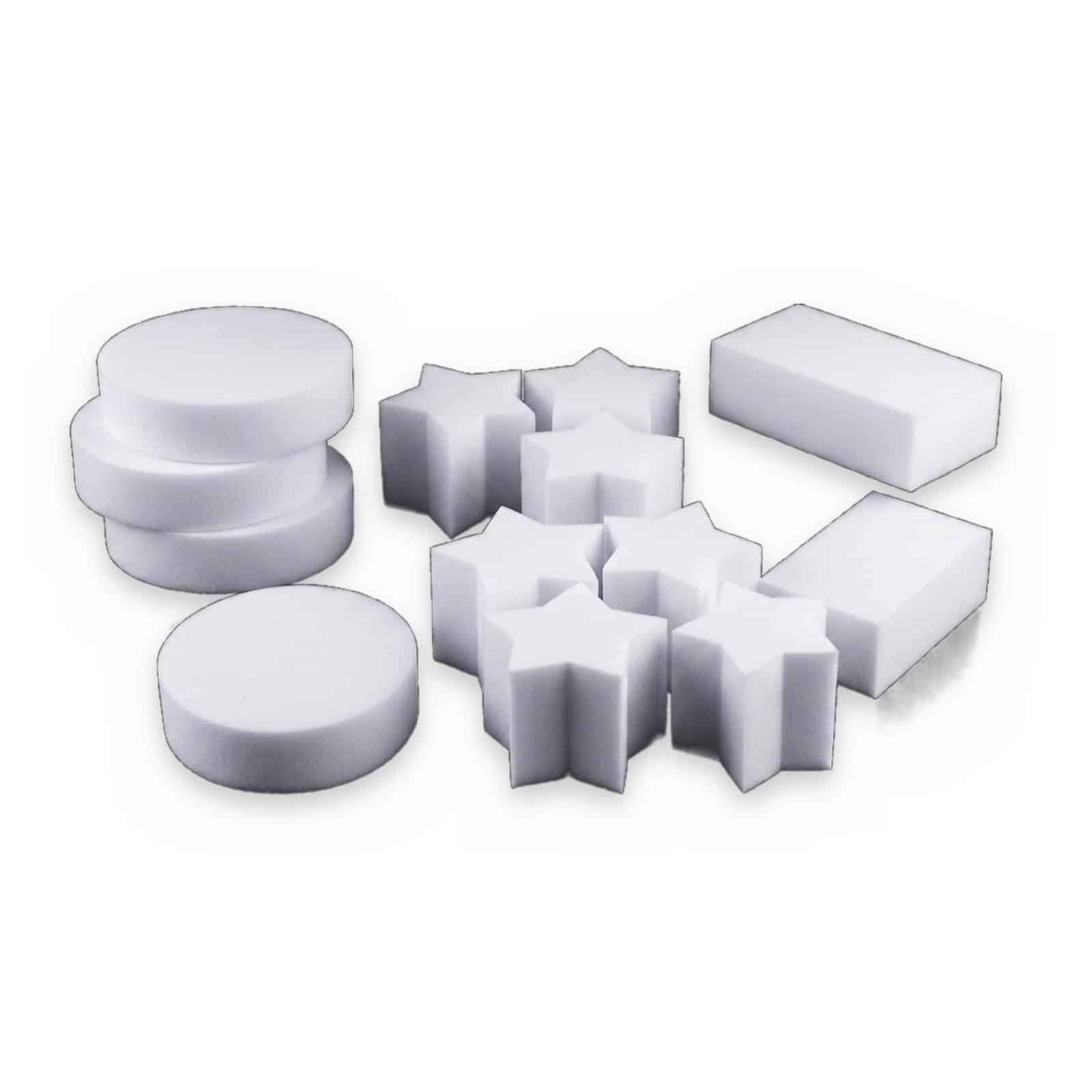
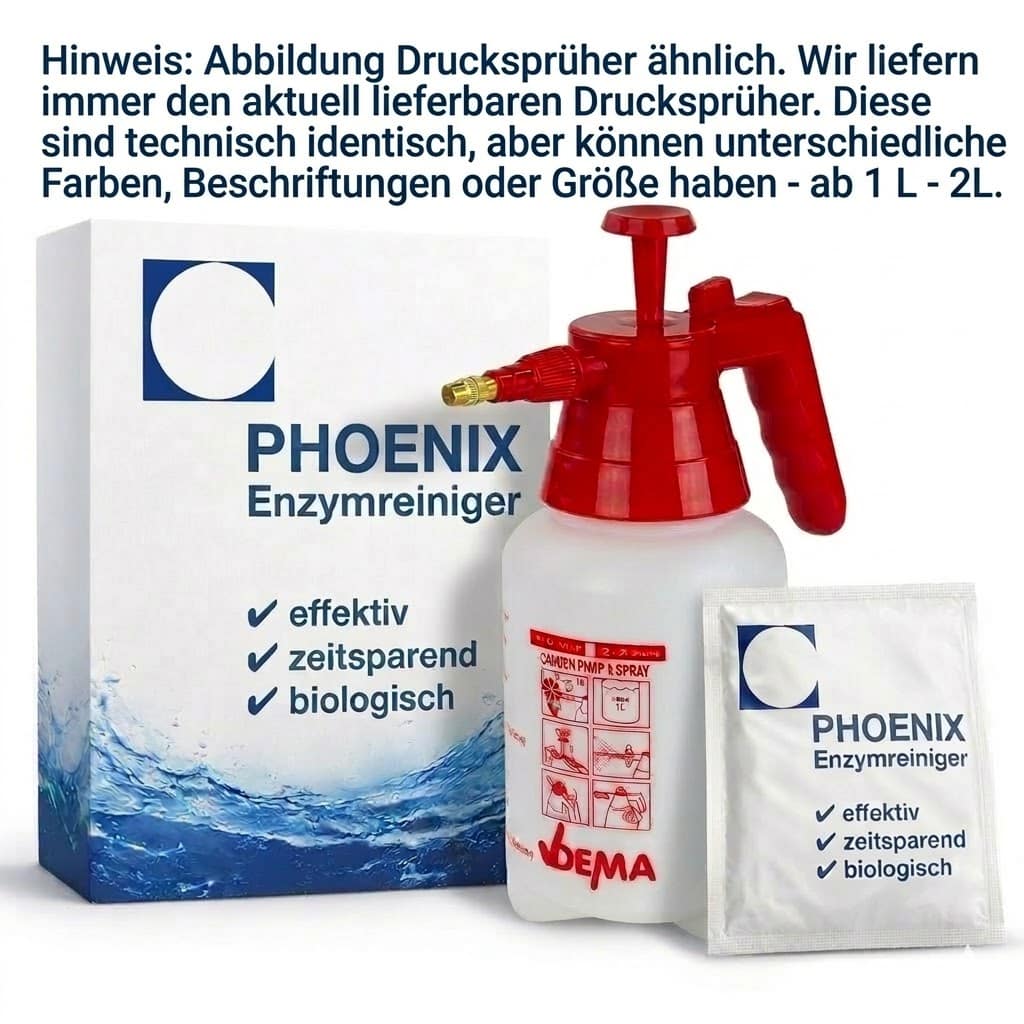
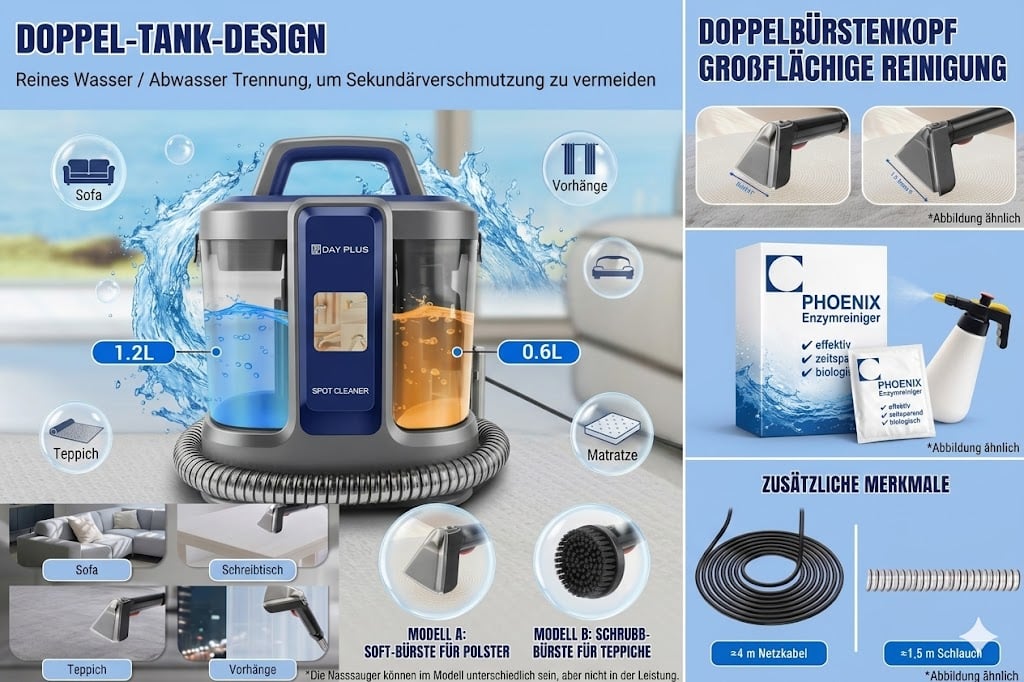
For breeders, animal shelters & high-volume households
Anyone who lives permanently with multiple cats knows the problem of frequent urination: constant marking, soiled areas, and a constant need for cleaning products. Phoenix granules are designed for this – economical and ready to use immediately.
💰 Cost-effectiveness for frequent users
Out of 100 g Phoenix granules arise up to 5 liters High-performance enzyme cleaner (mixing ratio 1:50). The granules only activate when mixed — you only mix what you need, no loss of potency in the bottle.
Large containers of 250 g and 1000 g are especially designed for breeders, animal shelters, pet boarding facilities and multi-cat households — where daily cleaning is necessary.
⚡ Immediate help for acute marking — the 10g sample
Just discovered a fresh marking? The small 10g sample Makes 500 ml of ready-to-use solution — enough for a quick upholstery or carpet treatment. Ideal for on-the-go use or as a test before switching to larger containers.
For regular use, it is worth switching to 80 g, 250 g or 1000 g.
Granules instead of liquid — the crucial difference
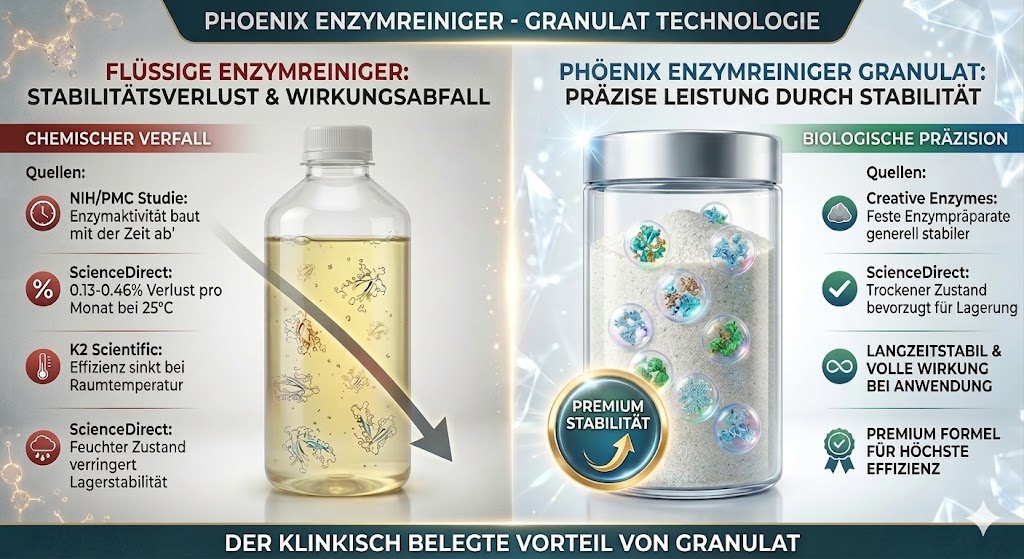
Liquid enzyme cleaners lose active ingredient from the day of bottling. Phoenix Enzymreiniger as granules Remains stable when dry — you mix it fresh, and the enzymes work at full power. Made in Germany, biodegradable, gentle on materials.
Ready to use for up to 20 days after mixing. No chemical mixing, no dosing in the dark.
Phoenix Enzymreiniger — usable everywhere
🎯 Play along: How many cats can you find?
In the picture above, cats are hiding at classic marking hotspots—some obvious, some only noticeable upon closer inspection. Whoever finds them all wins. 10% discount on the first bundle purchase.
Tip: Neutralize it just like with cat urine — patience pays off. Some stains are only visible upon closer inspection.
Frequently asked questions about neutralizing cat urine
How quickly can I neutralize cat urine with Phoenix?
For fresh urine, a 30-minute application time is sufficient. For dried urine or deep stains, you will need an application time of 2-12 hours (occlusion method with foil overnight). In areas with suspected screed or previous tenant contamination, 2-3 treatment cycles may be necessary.
Does Phoenix also work on very old cat urine stains?
Yes. The uric acid crystals are chemically identical—whether they are 3 days old or 3 years old. However, older areas require more Phoenix solution and a longer application time. The occlusion method (covering with cling film and leaving overnight) is crucial here because the enzymes remain moist longer and can penetrate deeper into the fibers.
Can I combine home remedies and Phoenix?
Do not use Phoenix simultaneously — acids like vinegar or citric acid denature the enzymes and render it ineffective. If you have previously used home remedies: rinse thoroughly with clean water and allow the surface to dry completely before applying Phoenix.
Is Phoenix Enzymreiniger safe for cats and other pets?
Phoenix Enzymreiniger is harmless to humans and animals when used correctly. During the application time and until completely dry, animals and children should not have direct access to the treated area. After rinsing with clean water, the area is clear for use again—no toxic residues remain after application and wiping (according to Dr. Mang's expert opinion).
How much Phoenix granulate do I need?
Rule of thumb 1:50 — that is, 20 g of granules to 1 liter of water. For a carpet area of 1 m², you'll need approximately 0.5-1 liter of solution. A car upholstery area requires about 200-300 ml. For screed or heavily used large areas, plan on 2-3 liters per m².
Why does my apartment smell like cat urine again after 2 weeks?
This is the classic wicking effect: You've probably treated the surface, but the uric acid crystals are embedded deeper in the material (upholstery foam, screed under laminate, wood fiber). They are reactivated by moisture or heat. Solution: Treat deeper (more solution, longer exposure time, occlusion method); if screed contamination is suspected, remove the flooring.
Can I use Phoenix in the washing machine?
Yes. For cat urine on textiles, we recommend pre-treating for 30 minutes in a bowl with a Phoenix solution (1:50), then washing normally at 60°C with detergent. If the washing machine smells: run an empty cycle at 60°C with 30 g of Phoenix granules in the drum – this removes felinine residue from the seal and drum.
Does Phoenix also help with marking behavior in intact male cats?
Phoenix completely neutralizes the marked areas—including the pheromone-containing secretions that attract cats. This significantly reduces the likelihood of the cat marking the same spot again. Important: Neutralizing cat urine treats the symptom—the underlying cause (stress, competition, medical condition) must be determined by a veterinarian or behaviorist. Neutering performed by a veterinarian drastically reduces marking behavior in most cases.
⚠️ Safety notice: Keep out of reach of children and animals. Even if there is no danger, children and animals should not have direct access to the product.
Produced by Consulting & Sales Service Schmidt · Small business owner according to §19 UStG · Made in Germany
2 responses
Hi everyone. I tried this and I want to thank you all. You saved my sofa! 😂 My cat unfortunately has kidney disease and had an accident on the sofa. I couldn't get rid of the smell with other products.
This product is also fantastic for general cleaning around and beyond my cats. I wouldn't want to be without it anymore, thank you! 😍
If I could, I would give it 8 stars. Thank you so much!.
Best regards, Diana
Hello dear Diana,
Thank you so much for your incredibly kind words! They really brightened our day here on the team. ❤️
I'm so happy we were able to save your sofa. But even more importantly, I'm thrilled we can make everyday life a little easier for you and your furry friend. We know firsthand how much heart and soul you put into your pets – especially when they're sick. Phoenix taking the stress out of dealing with unpleasant smells is exactly why we do this!
The fact that you would give us 8 stars is truly the greatest compliment for us. Thank you for your immense trust, even with your daily cleaning.
I wish you and your cat all the very best and continued joy in your new home! 🐾✨
Very best regards,
Your Phoenix Team – Dieter Schmidt