Cleaning upholstery without scrubbing — from family sofas to hospitality cleaning
Why your sofa smells musty again after every cleaning, what baking soda and shaving foam can really do, and when a spray extractor becomes indispensable. Includes a material chart for fabric, leather, bouclé, and velour.
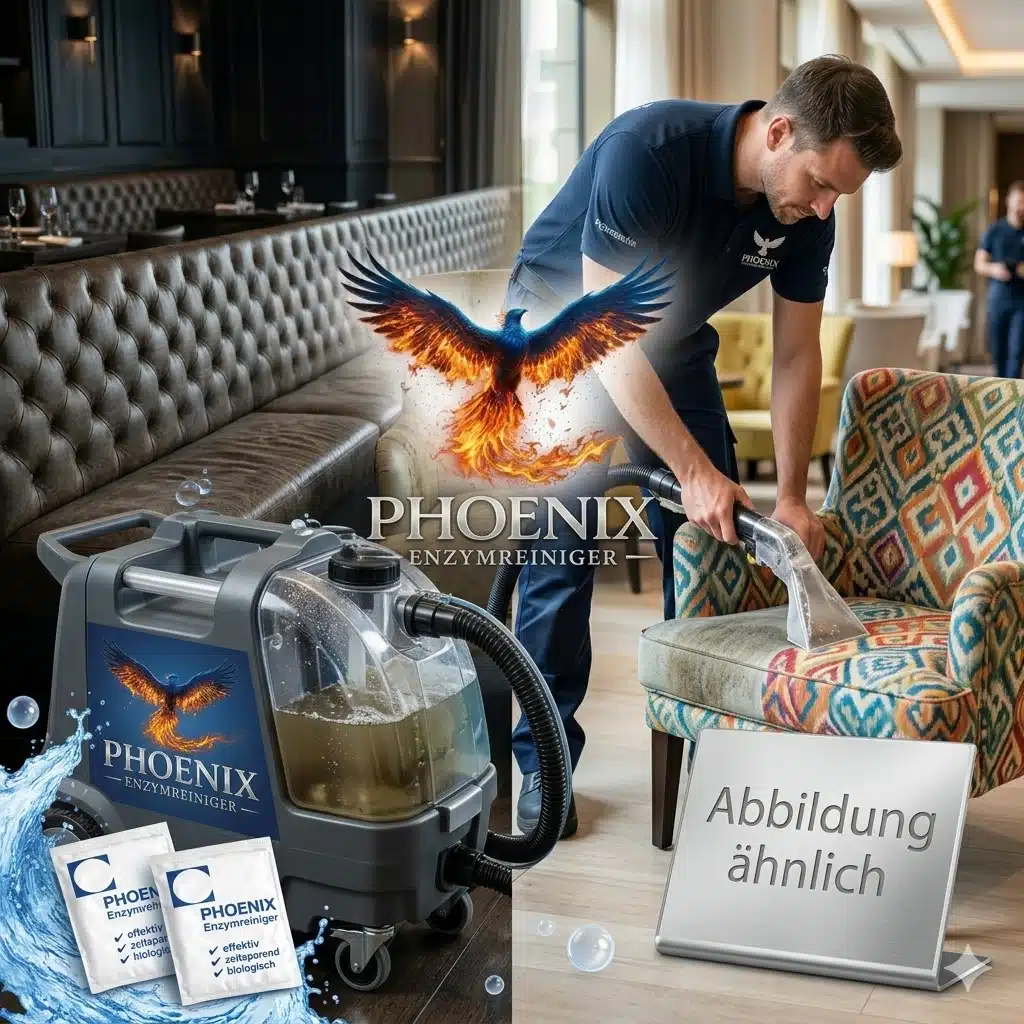
You want Cleaning upholstery And you think to yourself: this can't be rocket science. And it isn't—until you're treating the same sofa for the third time because the dog smell keeps coming back as soon as someone sits on it. Or because your cleaning lady uses surfactant-based cleaners when preparing the hospitality space, and the restaurant smells like a cleaning product warehouse the next morning. Cleaning upholstery This is not trivial, because organic contaminants are not located on the surface. They are deep within the foam, at the foam-cover interface, and in the seams. Simply wiping the surface is a mistake. However, those who use Phoenix Enzymreiniger can... Cleaning upholstery via pressure sprayer, cloth or spray extractor — and the result remains.
This Upholstery Cleaning Guide shows you the complete process: why your upholstery smells in the first place, why home remedies fail, what makes the Phoenix method different, and how the application differs for six very different market segments — from family sofas to premium leather to upholstery cleaning service providers with spray extraction equipment.
Upholstery Cleaning Guide — What to Expect (10 Chapters)
- Why cushions are odor reservoirs — science
- How Phoenix cleans upholstery — enzymes plus surfactants
- Cleaning upholstery in 4 steps — the Phoenix method
- Home — Cleaning upholstery in everyday family life
- Pet Household — Cleaning upholstery with a dog and cat
- Leather & Premium — Cleaning upholstery with care for the material
- Hospitality & Professional — Upholstery cleaning with a spray extractor
- Special — antique, vintage, bouclé, designer furniture
- Material compatibility — the table
- Home remedies fact check — baking soda, shaving foam, vinegar & co.
1. Why cushions are odor reservoirs — the science
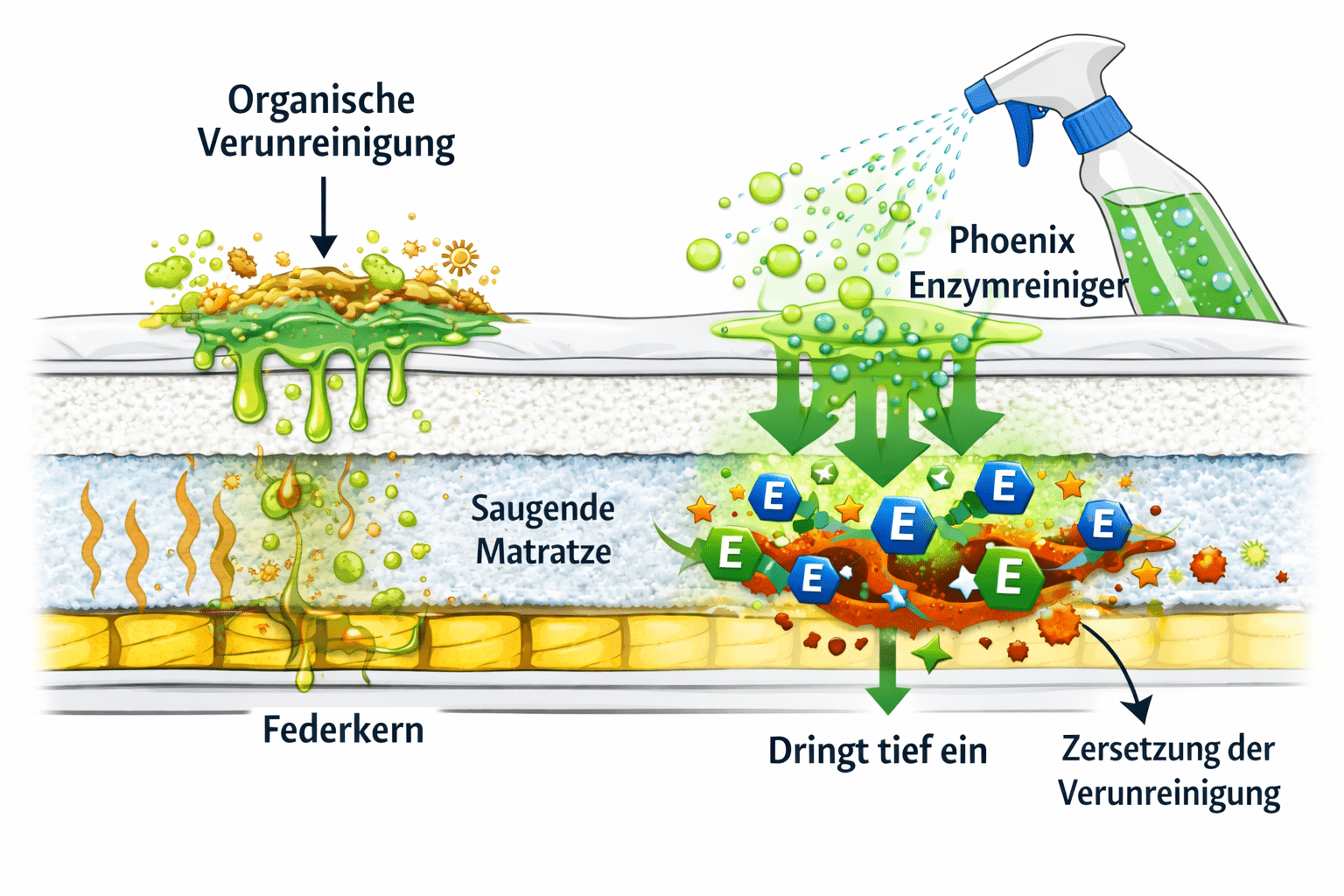
Upholstered furniture is a layered system. On top is the cover fabric (woven, microfiber, velour, leather, bouclé), underneath is a layer of padding, then a foam core, sometimes a spring core, sometimes non-woven fabric. Organic substances migrate into these deeper layers over the lifespan of a piece of furniture. We're talking about skin oils from the head area, sweat on warm summer days, traces of saliva from laughing and coughing, pet urine and sweat, vomit, and food residue. Each of these substances leaves behind molecules that don't simply evaporate but become embedded in the fiber structure.
In addition, MVOC — microbial volatile organic compounds such as geosmin. Bacteria produce these odor molecules as soon as they find organic matter in the upholstery fibers. Even the slightest residual moisture is enough to trigger MVOC production. This is why upholstery starts to smell again cyclically in winter (heated air) or summer (sweat), even when it is "clean".
Traditional upholstery cleaners use surfactants. Surfactants loosen dirt particles from the fiber surface and keep them suspended in a water solution so they can be wiped or vacuumed away. However, they don't chemically break down the odor-causing molecules. These return as soon as moisture or heat is present again. This isn't a marketing myth; it's polymer and surfactant chemistry.
More background information on the structure of enzymatic cleaning via the Spray extraction on Wikipedia — the process that Phoenix uses as a tank solution for professional use is also explained there.
2. How Phoenix cleans upholstery — enzymes plus surfactants
Phoenix Enzymreiniger combines two enzyme classes with surfactants, each with a clear area of application:
- Protease Breaks down protein chains. Effective on blood, sweat, saliva, animal urine, protein stains, and vomit.
- surfactants Dissolves grease. Effective on skin oil (head oil), sebum, cooking fats, and animal fat secretions.
- Amylase Breaks down starch and sugar. Effective on food residue, traces of puree, and sticky sugar stains (cola, juice, ice cream).
The chemical reaction is a hydrolysisThe enzyme binds to the substrate, incorporates a water molecule, and breaks the bond. What remains are small, water-soluble breakdown products—the original odor is no longer chemically present. You can then remove these residues with a cloth or spray extractor. Unlike surfactant cleaning, the odor molecule is not only dissolved and transported, but... chemically destroyed. It won't come back because it simply no longer exists.
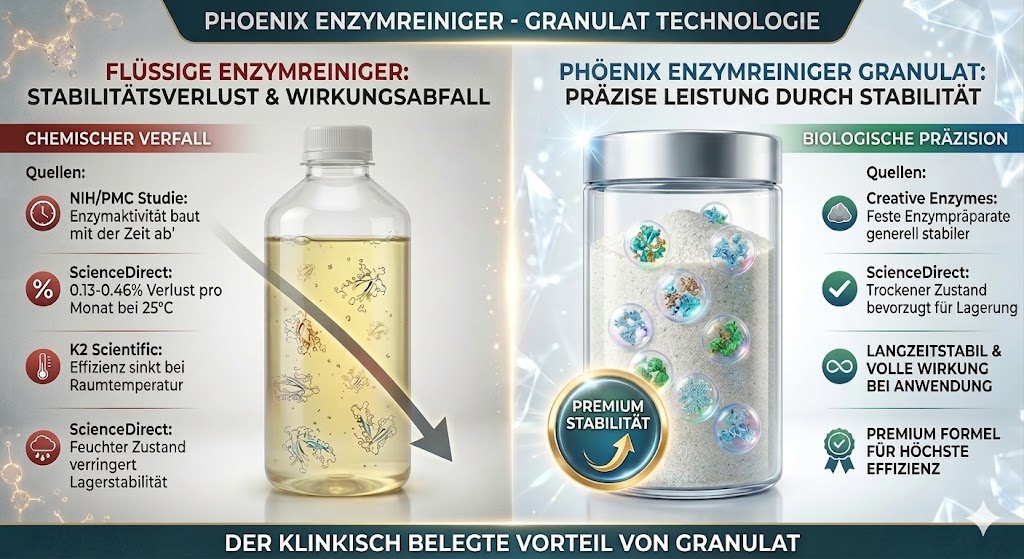
Important regarding duration of action: Phoenix is supplied as granules. The enzymes are only activated when mixed. Full power for 48 hours after mixing, followed by a slow degradation of the enzymes. Ready for use for up to 20 days. Freshly mixed = maximum hydrolysis power. For old, dried-out loads, it is worthwhile to work in two passes — the first mobilizes the substrates, the second completes the splitting.
3. Cleaning upholstery in 4 steps — the Phoenix method
Mix
Dissolve 20 g of granules in 1 L of warm water (approx. 30 °C, pressure sprayer up to 30 °C / professional device up to 50 °C). Pour into a pressure sprayer or spray extractor tank.
Apply generously
Thoroughly wet the upholstery – cover, seams, edges, and back. For odor issues: allow the solution to penetrate as far as the odor source has penetrated. Skimping will only result in incomplete solutions.
Let it take effect — and keep your hands off
At least 30 minutes. In cases of heavy soiling, 60–120 minutes or overnight. Do not wipe or vacuum during the application time—the enzymes are working deep within the tissue. Extracting too early removes the enzyme solution before it can take effect.
Dehydrate or extract
Home use: Wipe with a clean microfiber cloth. Professional use: Now run the spray extractor and completely vacuum up the loosened material. Then allow to dry with good air circulation.
⚠️ Most common mistake — and how to avoid it
Vacuum or wipe immediately.This removes the enzyme solution before it can hydrolyze. Result: a wet, superficially cleaned cushion that will smell musty again in a week.
Correct: Use the spray extractor and enzyme solution separately. First spray with Phoenix, then wait. Only then proceed with the suction pass.
Can you find all the hidden cats? — Get a 10% discount
Join in the living room hidden picture game — whoever finds all the cats immediately receives a personal discount code.
To the search game →4. Home — Cleaning upholstery in everyday family life
The family sofa is the final resting place for everything that happens in the living room: sebum from the head area, sweat on summer weekends, a spilled coffee, a child eating porridge on the sofa, a dog lying down for a bit, a glass of red wine at the wrong time. Each incident individually isn't tragic—the accumulation It's been going on for years. That's precisely why 5-year-old sofas smell different than new ones, even if they are regularly "cleaned".
Phoenix Method for families: a complete treatment twice a year. In spring (after the heating season) and in late summer (after the hottest weeks of summer). In between, apply spot treatments for specific incidents – red wine, coffee, or urinary accidents. Do not rub; first absorb the affected area, then spray on Phoenix, allow it to take effect, and remove.
5. Pet Household — Cleaning upholstery with a dog and cat
Pet odors in the sofa are the toughest problem for upholstery. Dog sweat contains lipids that migrate into the foam. Dog saliva has protein components that stick to the fibers. Cat urine contains uric acid crystals that solidify when dry and reactivate with every change in humidity. Puppy urine on the sofa is a problem in itself: a thin stream immediately seeps through the cover into the foam, and housetraining fails as long as the puppy can still smell it.
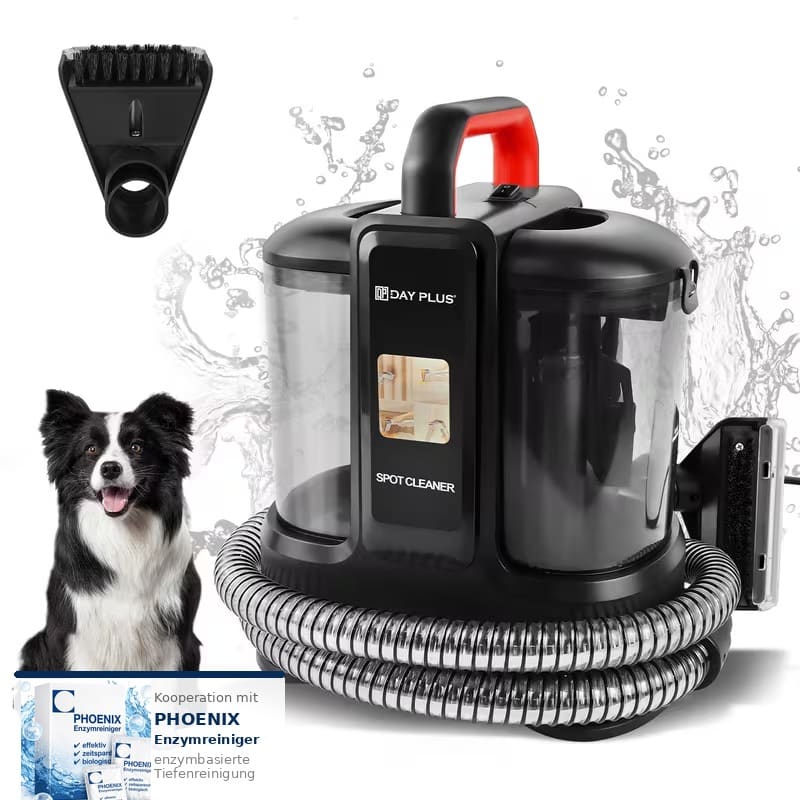
The Phoenix effect works in two ways here: protease breaks down the protein component, and the surfactants dissolve the fat component. A special rule applies to cat urine: only freshly mixed solution It has enough enzyme power to remove dried-on urine residue. A solution that has been standing for 5 days is sufficient for normal sofa maintenance, but not for old cat urine stains.
6. Leather & Premium — Cleaning upholstery with care for the material
With genuine leather, a different rule applies: leather is absorbent but sensitive to degreasing. Skin oils from the head, sebum from hands, sweat on warm days—genuine leather soaks these up like a sponge and darkens at points of contact. Phoenix removes these organic deposits because the surfactants dissolve the fatty compounds. Danger: Phoenix also removes the natural leather grease that keeps the fibers supple. Without subsequent re-oiling, the leather dries out.
⚠️ Leather cleaning — the three critical mistakes
1. Too much water at once: Genuine leather must not be soaked. Moisten a cloth with Phoenix solution, wipe sparingly, do not spray or flood.
2. Material sample forgotten: With aniline-dyed leather (dyed through, soft feel), color bleeding can occur. Test on the underside of the sofa back — observe for 24 hours.
3. Forgot to re-oil: Treat the leather with leather grease or conditioning lotion after cleaning. Otherwise, the leather will become brittle and crack over time.
Different rules apply to Alcantara and suede/nubuck. Alcantara likes to be treated in the direction of the nap—spray it with Phoenix solution, like velour, then dab it in the direction of the nap and, after it dries, raise it with a soft brush. Do not rub suede, but dab it, let it soak in, and, after it dries, use a suede brush to raise the surface.
7. Hospitality & Professional — Upholstery cleaning with a spray extractor
In a commercial context, the focus is on hygiene standards, odor-free conditions between guest cycles, and cost-effectiveness. Hotel lobby cushions are used daily by a changing cast of guests. Restaurant benches accumulate cooking grease, cola splashes, and sweat. Waiting room chairs (doctor's offices, hairdressers, veterinarians) are high-frequency furniture heavily contaminated with organic matter. Cinema seats retain layers of popcorn and cola for years.
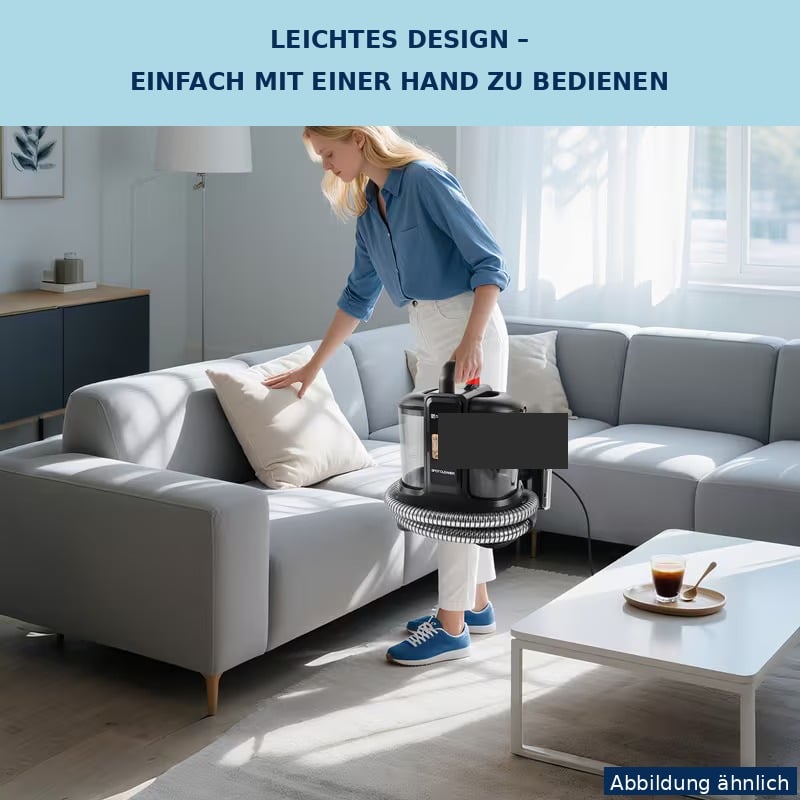
Phoenix, in its concentrated granule form, is more economical than ready-to-use cleaners when purchased in bulk (500 g, 1 kg). For flush extraction cleaning, Phoenix is dissolved in the fresh water tank and applied to the upholstery. After a contact time of 30+ minutes, the vacuum cleaner takes over the extraction process. The result is a chemically decomposed organic load — not just extracted surface pollution.
Spray extractor instructions — the sequence
- Dissolve Phoenix granules in the fresh water tank (mixing ratio 20 g / 1 L). Adjust the quantity accordingly for larger orders.
- First spray without vacuuming — generously wet upholstery surfaces, do not press the brush head down too hard.
- Let it rest for 30–60 minutes. This break is non-negotiable. Anyone who cuts corners here will cut short the outcome.
- Second pass with the suction device switched on — now the device extracts the dissolved material and the remaining water.
- Dry with the door open, a fan, or air conditioning. Stand upright upright where possible.
- UV lamp inspection in case of suspected animal traces (hotel allergens, taxi cleaning).
8. Special — Antique, Vintage, Bouclé, Designer Furniture
Bouclé armchairs in a creamy white wool blend have been the ultimate furniture trend since 2024. Vintage corduroy sofas from the 70s have acquired their value. Designer furniture from Vitra, B&B Italia, and Cassina are investments that must not be damaged by improper cleaning. The following applies to all these materials: Phoenix works more gently than surfactant cleaners, because it works enzymatically and has no aggressive solvent effect.

Specific rules for each material:
- Boucle: spray on and dab, Do not brush. The looped structure is sensitive to friction — brush pressure will pull threads out of the fabric.
- Corduroy (Vintage 70s): Work in the direction of the grooves. Rubbing across the grain will damage the cord and produce unwanted shiny spots.
- Velour: Pay attention to the direction of the nap, as with corduroy. After drying, use a soft brush to straighten the nap of the velour.
- Designer furniture: Always check the manufacturer's instructions. Some premium manufacturers include care recommendations that prescribe specific cleaning products (warranty-relevant).
- Antique with real wood frame: Cover the frame or use a cloth sparingly. Avoid using Phoenix solution on untreated wooden elements.
9. Material compatibility — the table
| material | Phoenix-compatible | Professional tip |
|---|---|---|
| polyester blend fabric | ✅ uncritical | Standard application, spray bottle or spray extractor. |
| microfiber | ✅ uncritical | Smooth the stroke direction with a brush after drying. |
| Velour | ⚠️ Pay attention to the line | Work in the direction of the lines, stand upright after drying. |
| Cord | ⚠️ Pay attention to the grooves | Spray in the direction of the grooves and vacuum up. |
| Boucle | ⚠️ sensitive | Spray and dab on, do not brush. Be careful with loops. |
| chenille | ✅ uncritical | Standard, smooth the line after drying. |
| Woven fabric (hemp/linen) | ⚠️ Material sample | Some natural fiber fabrics are colorfast. A sample is essential. |
| Genuine leather, pigmented | ⚠️ degreased | Use sparingly; after cleaning, re-oil with leather grease. |
| Genuine semi-aniline leather | ⚠️ be careful | Very economical, damp cloth. Re-oiling is essential. |
| Genuine leather, aniline dyed | ⚠️ delicate | Treat a small area first, observe for 24 hours. |
| Suede / Nubuck | ⚠️ dab | Do not rub. Dab, let it soak in, brush after drying. |
| Artificial leather (PU/PVC) | ✅ uncritical | Standard. Treat several times if graying occurs. |
| Alcantara | ⚠️ Pay attention to the line | The direction of the nap should be like velour. Use sparingly. |
| Foam core (open) | ✅ Phoenix wanders deep | Odor absorber No. 1. Apply generously, leave on for a long time, dry thoroughly. |
10. Home remedies fact check — baking soda, shaving foam, vinegar & co.
Every other household tip video says: "Just sprinkle baking soda on it, leave it for an hour, then vacuum it up." Some swear by shaving foam or vinegar. Glass cleaner is supposed to work too. Steam cleaners are the ultimate solution. Here, we're doing a fact check—honestly, without the Phoenix marketing hype.
| Home remedies | What it can do | What it cannot do | Verdict |
|---|---|---|---|
| Baking soda | Binds light surface odors, neutralizes acid traces in specific spots. | It does not penetrate deeply and does not break down organic molecules. It acts purely through adsorptive mechanisms. | Emergency solution |
| shaving foam | It works with mild surfactants on the surface. It visibly foams, suggesting effectiveness. | Leaves surfactant residue in the fabric; does not break down odor molecules. Ineffective against sweat and pet urine. | myth |
| Vinegar (diluted) | Temporarily masks the odor with the vinegar's own scent. Chemical neutralization is possible in the case of trace amounts of alkaline substances. | It damages delicate upholstery and can discolor natural fibers. Odor molecules remain intact. | high-risk |
| All-purpose spray cleaner | Surfactant effect on the surface, slight improvement in appearance. | No depth of field. Leaves preservative residue. Odor returns after 3 days. | Symptom treatment |
| Steam cleaner without cleaning agents | Heat has a short-term effect against house dust mites and reduces surface germs. | Does not dissolve organic structures. Uric acid crystals remain intact and reactivate upon exposure to moisture. | Hygiene effect without odor effect |
| Upholstery spray (drugstore brands) | Surfactant effect with fragrance masking. | That's precisely the problem: it's masked instead of being broken down. After 3–7 days, the original odor returns. | Marketing promise |
| Phoenix Enzymreiniger | Enzymatic hydrolysis: Protease and amylase break down organic molecules, surfactants dissolve the fat. | It does not help with inorganic stains (rust, some inks, burn marks). | Deep solution |
💸 Phoenix vs. Upholstery Cleaning Service — The Bill
Professional upholstery refurbishment by a service provider currently costs between 200 and 400 euros per seating group (Vary regionally, depending on the degree of soiling and sofa size). For recurring orders (hotels, restaurants), this quickly adds up to four- or five-figure annual sums.
Phoenix as a self-application for a 3-seater:
- 1× spray bottle or pressure sprayer (one-time purchase 20–35 euros)
- 20–40 g of Phoenix granules for treatment (economic costs under 5 euros)
- Optional spray extractor (one-time purchase) for regular use
At two treatments per year Over 5 years of sofa lifespan: roughly €50 in consumables versus approximately €2,000 in service costs. Phoenix is particularly worthwhile if you clean regularly rather than only in emergencies.
🛡️ Safety Notice
Keep out of reach of children and animals. Even if there is no danger, children and animals should not have direct access to the product.
Phoenix Enzymreiniger is not subject to labeling requirements, lowest water hazard class, surfactants are at least 90% biodegradable. Suitable for cleaning in the food industry (expert opinion by Dr. Mang). Slight inherent odor that dissipates quickly to ensure neutrality.
Ready to clean upholstery like a pro?
In the Upholstery Cleaning Guide You've seen everything — now all you need is the tool. The Phoenix Enzymreiniger is available in 9 sizes and 5 bundle variants — from the home pressure sprayer to the professional UV+ spray extractor set.
To the Phoenix upholstery enzyme cleaner →