Guide · Home remedies · Walls · Windows · Textiles
Removing mold: walls, windows, textiles and home remedies
The complete guide in four parts: which home remedies are effective, what the color on the wall means, why the window is the most common location, and how to remove mildew stains from textiles.
From Dieter Schmidt · Holder Phoenix Enzymreiniger · August 2026 · Approx. 25 min. reading time

How do you properly remove mold? Phoenix Enzymreiniger enzymatically dissolves organic mold residues from the material instead of bleaching them. 20 g of granules make 1 liter of solution. Spray the surface until saturated, leave to work for 30 to 120 minutes, wipe off while damp, and dry completely. Home remedies like vinegar are ineffective on lime plaster because the lime neutralizes the acid. On walls, the substrate is the determining factor, not the color of the covering. On windows, condensation in the seal is the cause. On textiles: wash in cold water and do not place in the sun, otherwise the stain will set. And in approximately 60 percent of cases, the underlying cause is structural, which no cleaner can remedy.
Home remedies for mold They're listed in every cleaning guide—vinegar, washing soda, baking soda, rubbing alcohol. Most of them don't live up to expectations, and two of them actually make things worse. This guide tells you what actually happens with each material.
The discussion then turns to everyday problems: black spots on window frames, stains on the exterior wall behind the wardrobe, a musty basement smell without visible infestation, silicone sealant in the bathroom, mildew on the mattress, and the tent before the season. It covers safe procedures, color identification, and clearly defines where DIY solutions end.
Table of contents — four parts
Basics
- How does enzymatic cleaning work?
- Self-protection while working
- Step by step — here's how to proceed
The four areas
- Part 1 — Home remedies for mold
- Part 2 — Mold on the wall · Colors · Substrates · Ceiling · Thermal bridge
- Part 3 — Mold on the window Frame · Seal · Condensation
- Part 4 — Mildew stains on textiles · the three mistakes · continue in your own guide
Further cases and conclusion
Phoenix Enzymreiniger — Short & sweet
- Enzymatic deep-penetrating action: Amylase and protease break down organic mold residues and odor molecules into odorless, water-soluble fragments.
- Not a biocide according to EU Regulation 528/2012: No licensing requirement, no self-service ban since the tightening of regulations in 2025.
- Gentle on materials: Plaster, concrete, OSB wood, silicone, wallpaper, plastic window frames, textiles and tent fabric can tolerate the gentle application (pH 8.5–9)
- Made in Germany: Lowest water hazard class, surfactants at least 90% biodegradable (%)
How does enzymatic cleaning work?
From a chemical perspective, mold residues are complex organic structures — Proteins, lipids, polysaccharides. Mildew stains on textiles consist of precisely these building blocks. The molecules that carry the musty smell are also organic. Geosmin and other volatile metabolic products, in technical terms MVOCs — microbially produced volatile organic compounds.
Specific Enzymes are the body's own tools of nature: Amylase splits starch compounds, Protease It breaks down proteins. It decomposes organic residues and odor molecules into odorless, water-soluble fragments—amino acids and free sugar molecules. The substrate disappears, and the odor goes with it.
For clarification, because it is often confused: Phoenix does not kill anything and is no biocide after EU Regulation 528/2012. It removes organic matter purely enzymatically. Therefore, it is not subject to the self-service ban that has applied to biocidal mold removers since 2025. More information about its mode of action can be found on the page. How does an enzyme cleaner work?.
How do you protect yourself properly while working?
Self-protection applies against the stirred-up spores, not against the cleaner. As soon as you work on infested surfaces, spores are released into the air.
- FFP2 or FFP3 respirator, not a simple surgical mask
- Wear protective goggles, because spores irritate the conjunctiva.
- Wear rubber gloves; do not touch the surface with bare hands.
- Ventilate during work, then dispose of the cloths instead of washing them.
- For infestations larger than 0.5 m² or in sleeping areas: contact a specialist company.
Step by step — here's how to proceed
- Mixing: First, completely dissolve 20 g of granules in approximately 250 ml of hot water – this activates the enzymes. Then fill up to 1 liter and pour into the pressure sprayer.
- Put on self-protection gear as described above.
- Spray until the material is saturated. — also treat the inconspicuous edge area, as the infestation is usually already located there before you can see it.
- Let absorb: 30 to 60 minutes for superficial infestation, 2 to 4 hours for deep infestation after water damage.
- Remove while damp: Use a microfiber cloth and wipe in one direction, do not rub. Dispose of the cloth afterwards.
- Allow to dry completely, only then can new paint be applied or furniture returned.
How long does the mixed solution remain effective?
Full power for 48 hours after mixing, followed by a slow degradation of the enzymes. Ready for use for up to 20 days.
Home remedies for mold
Vinegar, soda, alcohol, chlorine — what actually happens and where every remedy fails.
Which home remedies for mold actually work?
Each of these Home remedies for mold It's in some guidebook. Here's what actually happens chemically — and why two of them make the situation worse.
| Medium | What it does | Where it fails |
|---|---|---|
| Vinegar | Acetic acid lowers the pH value; it is effective in the short term on smooth surfaces. | On lime plaster, concrete, and masonry, the lime neutralizes the acid within minutes. Even worse: vinegar contains organic matter and itself becomes a breeding ground for bacteria. Therefore, it is counterproductive on mineral surfaces. |
| Baking soda and washing soda | Binds odor molecules to the surface, has a slightly abrasive effect. | It doesn't penetrate the material. As soon as moisture returns, the smell is back. White streaks remain on wallpaper. |
| Denatured alcohol, alcohol 70 % | It dries the surface, removes visible deposits, and leaves no residue. | It evaporates within seconds before penetrating plaster or wood. It can damage painted surfaces, plastic, and acrylic glass. On larger surfaces, the risk of fire is real. |
| Chlorine cleaner | Bleaching the pigments makes the surface look clean afterwards. | The organic matter remains entirely within the material. In bathrooms, bedrooms, and basements, the fumes irritate the respiratory system. Since 2025, biocidal mold cleaners have been subject to a self-service ban. |
| hydrogen peroxide | It bleaches similarly to chlorine, but with less odor and without chlorine fumes. | Only an optical effect. Fading is possible on textiles, wallpaper, and colored paintwork. In higher concentrations, it is corrosive to skin. |
| Tea tree oil | Frequently recommended, has a strong smell. | It masks the odor with another. On porous surfaces, it leaves an oily film that attracts dust. It has no effect on the organic matter. |
| Phoenix Enzymreiniger | It enzymatically decomposes the organic substance deep within the material, splitting the odor molecules. | Does not bleach — pigments that have migrated into silicone may remain visible. Does not correct any structural cause. |
The two that make it worse: Vinegar on lime plaster and tea tree oil on porous surfaces both introduce organic material that later serves as a breeding ground. If you've used vinegar before and the infestation returned, this is a possible explanation.
Removing mold from the wall
What the color means, which substrate can tolerate what, and why the thermal bridge is the actual cause.
Black, green, or yellow mold on the wall — what does the color mean?
The color reveals the type of coating and the substrate it's attached to. It says nothing about how easily the coating can be removed—that depends solely on the material. This overview helps you classify what you see on your wall.
| Paint on the wall | Where she typically appears | What you need to know |
|---|---|---|
| Black mold on wall | Room corners on the exterior wall, behind cabinets, window reveals, silicone joints in the bathroom, ceiling | Der häufigste Fall und meist der mit der klarsten Ursache: eine kalte Stelle. Auf Putz gut lösbar, in Silikon können dunkle Pigmente sichtbar bleiben. |
| Green mold on wall | Wallpaper, woodchip wallpaper, plaster, damp basement wall, areas behind pictures and shelves | It often covers a larger area than black deposits. It is easy to treat on absorbent surfaces because the solution can penetrate deeply. |
| Yellow mold on wall | Wallpaper, plaster behind furniture, wood paneling, wall areas above radiators | Often mistaken for mildew or watermarks. Yellowish edges without a raised texture are usually traces of moisture, not a coating. |
| White mold on wall | Basement wall, earth-contacting masonry, inside of exterior walls, behind baseboards | Be careful when identifying: White, fluffy efflorescence on cellar walls is often salt, not mold. Salt wipes off easily when dry, mold does not. |
| Brown mold on wall | Wooden paneling, wooden window frames, old wallpaper, sloping ceilings | Often found on wood-containing substrates. Superficial infestations can be treated, but deep-seated infestations in the wood require professional treatment. |
| Blue and grey coating | Wood, roof truss, beams, damp basement ceilings | Blue stain fungi live within the wood itself and can only be removed superficially. A grey coating on plaster is usually an early black infestation. |
| Red or pink coating | Bathroom grout, shower walls, areas with constant moisture | Usually a moisture-loving bacterial coating, not a fungus. It dissolves particularly easily enzymatically. |
No health assessment can be derived from the color. If the infestation covers more than 0.5 m², if it occurs in the bedroom or children's room, and if residents have respiratory problems, the assessment should be carried out by a professional — regardless of the color of the coating.
Plaster, wallpaper or concrete — what can each surface tolerate?
This is where it's decided whether the treatment works. An absorbent surface soaks up the solution and allows the enzymes to work deeply. A dense surface doesn't do this; instead, the coating only sits on the surface.
| Subsoil | Proceed | What to look out for |
|---|---|---|
| Lime plaster, gypsum plaster | Spray until saturated, leave on for 1 to 2 hours, remove while damp. | It's highly absorbent; a second pass is almost always worthwhile. Vinegar doesn't belong here: the limescale neutralizes the acid immediately. |
| Washable wallpaper | Spray on with a damp cloth, leave on for 30 to 60 minutes, then remove in one direction. | Do not soak, otherwise the paste will dissolve and the track will blister. |
| Textured wallpaper, paper wallpaper | Use sparingly — or remove the strip and clean the plaster underneath | Paper wallpaper rarely withstands moisture. If there is visible infestation, re-wallpapering is usually necessary anyway. |
| Concrete, sand-lime brick | Apply generously, leave on for 2 to 4 hours. | The substrate is denser, the coating is more superficial. The cause here is almost always a thermal bridge. |
| Dispersion paint | Spray on, leave on for 30 minutes, remove. | The paint seals the plaster. If there's a buildup underneath, the paint has to be removed. |
| Wood cladding, panels | Apply a thin layer, leave on briefly, remove with a damp cloth | Water causes wood to swell. Use sparingly, avoid soaking. |
| silicone joint, sealant | Work in, leave on for 30 minutes, remove | The organic residue disappears, but migrated pigments remain visible. Only renewal will achieve a clean appearance. |
Where mold typically grows in apartments
It's always the same spots, and they all have the same characteristic: the wall is colder there than the rest of the room.
| position | Why there of all places? | What you can change |
|---|---|---|
| Corner of room on the outside wall | The corner has more surface area on the outside than on the inside and therefore cools down more. | Heat and ventilate by opening windows wide for short periods. Don't put anything directly in the corner. |
| Behind the cupboard | Furniture prevents warm room air from reaching the exterior wall. | Five centimeters of distance to the wall. That often changes everything. |
| Above the window lintel, reveal | That's usually where the insulation is thinnest. | Ventilate by opening windows fully for short periods instead of tilting them open; wipe condensation from the seam. |
| Bedroom behind the bed | Two people release a significant amount of moisture at night, and the room is often kept cooler. | Ventilate thoroughly in the morning. Do not keep the bedroom significantly colder than the rest of the room. |
| Bathroom, ceiling and grout | Showering introduces a lot of moisture into a small room in just a few minutes. | Ventilate immediately after showering, wipe grout dry. |
| Behind baseboards | Indicates rising damp from the masonry | Nothing. This is a job for a specialist company. |
Mold on the ceiling — what's different?
Working overhead means overspray will bounce back. Safety goggles are essential. Apply several thin coats instead of one wet one; otherwise, the solution will drip before it's absorbed. Cover the floor.
If you find mold on the ceiling, it's also worth looking upwards: Is there an unheated attic, a flat roof, or a bathroom above it? Mold growth on ceilings is more often caused by a leak than by the room air.
Exterior wall and thermal bridge — why exactly there?
One cold bridge This is a point in the building component where heat dissipates to the outside faster than in the surrounding area. Concrete ceilings, window lintels, balcony connections, uninsulated corners. The surface temperature drops below the dew point, and the humidity condenses as water.
This explains why the infestation is precisely localized in one spot while the rest of the wall is clean. And it explains why it reappears in the same place after cleaning if nothing structural changes.
💡 What you can change yourself
Move furniture five centimeters away from the exterior wall. Ventilate by opening windows wide for a few minutes several times a day, instead of tilting them open. Don't keep the bedroom significantly colder than the rest of the apartment—cold walls plus humid night air is exactly the combination that causes infestations.
Removing mold from the window
Frame, sealing rebate and reveal — and why condensation is almost always the cause.
Mold on the window frame and in the window seal — what to do?
Mold almost always forms on windows due to condensation, which remains in the sealing rebate. At night, the window cools down, the humid room air condenses, the water runs into the lower rebate and doesn't dry there. After a few weeks, the first black spots appear in the rubber.
- Window seal: Work the solution into the rubber seal using a narrow brush, let it soak in for 30 minutes, then remove it with a cloth over a spatula. Afterwards, wipe the seal dry.
- Plastic frame: The material-friendly solution is easily tolerated. Also treat the rebate between the frame and the sash.
- Wooden frame: Apply sparingly, do not soak. Water causes wood to swell; there is no guarantee against swollen edges.
- Window reveal: The area between the frame and the wall is a classic thermal bridge. Treat the entire area.
- Thereafter: When ventilating, ensure that any residual water can dry. Use short bursts of ventilation instead of tilting the room; otherwise, the residue will return in four weeks.
Can you find all the hidden cats? — Get a 10% discount (%)
Join in the living room hidden picture game — whoever finds all the cats immediately receives a personal discount code.
To the search game →Removing mildew stains from fabric
Clothes, mattress, tent and books — and the three mistakes that make the stain stick.
Mildew stains are the textile form of the same problem: yellowish-brown discolorations that occur when fabric has been stored damp or in an airtight container for too long. Examples include shirts taken from suitcases, laundry left overnight in the washing machine, wool sweaters taken from basement closets, and mattresses left unused for an extended period.
Three things make the stain irreparable, and all three are well-intentioned: lay in the sun fixes the discoloration in the tissue, Wash hot It bakes the protein components together with the fiber, and Chlorine bleach It takes the color of the fabric with it. The correct procedure is: pretreat enzymatically, wash in cold water or at 30°C, and dry in the shade.
Material by material — cotton, wool, synthetics, mattress, tent, leather and books — including the washing machine process and the distinction between mildew and mold infestation, is explained in detail in the dedicated guide. Removing mildew stains from clothing, fabric and mattress.
Why does the basement smell musty even though there's nothing to see?
Because the smell consists of molecules that are deeply embedded in plaster, brickwork, wooden beams, and old cardboard boxes. The most well-known is Geosmin — the same substance that smells like rain on dry ground. In addition, there are other MVOCs, i.e., volatile compounds from microbial metabolism. They are below the threshold of visibility, but significantly above the olfactory threshold of the nose.
Therefore, ventilation alone is not enough. It dilutes the room air but does not remove anything from the material. Enzymatic treatment breaks down the molecules at their point of attachment.
💡 The most common ventilation mistake in summer
In summer, with the basement window open, warm, humid outside air flows into the cool basement and condenses on the cold walls. So you're ventilating in moisture, not out. The correct way is to ventilate from October to March, when the outside air is cooler than the basement. Keep the window closed in summer.
Silicone joints and tile joints in the bathroom — what is realistic?
Silicone is a special case. The residue isn't just on the surface, but migrates into the material over time. Enzymatic cleaning reliably removes the organic matter and the odor—but it does not bleach. If the pigments have penetrated deeply, the dark discoloration remains visible.
Honestly, if appearance is important to you, renewing the silicone sealant is the only complete solution. Treat the surface beforehand so the new sealant doesn't immediately adhere to it again. Cement tile grout, on the other hand, can be completely cleaned, as the residue is more superficial.
Tent, caravan and awning before the season
Damp tent material is a classic problem. After winter, it smells musty, and mildew stains appear on the seams and in the groundsheet. Pitch the tent, treat it inside and out, paying particular attention to the seams, groundsheet, and any folds where the material overlapped. Polyester and coated nylon can tolerate this solution. Afterward, allow it to dry completely before packing it away—otherwise, the whole process will start again.
Refreshing musty cabinets and wooden furniture
The smell from the old wardrobe comes from the wood itself and the cardboard backing. Empty the wardrobe, lightly spray the interior surfaces, let it soak in, wipe it off while still damp, then leave it open for several days. Water causes wood to swell—apply sparingly, do not soak. There is no guarantee against swollen edges.
After water damage — the smell remains even though it's dry?
If the musty smell persists even after technical drying, organic residues and odor molecules are still present in the material. Drying removes water, not the organic matter that formed during the damp weeks.
Apply the solution generously to all previously affected areas—screed edges, wall bases, drywall OSB, skirting boards. Allow it to soak in for 2 to 4 hours. This effort is worthwhile before installing new floor coverings.
The 60 percent rule: When is cleaning no longer enough?
Approximately 60 percent of all mold cases These problems have a structural cause—thermal bridge, rising damp, leak, or insufficient drying after damage. In these cases, cleaning is merely a follow-up measure. No cleaner in the world, not even one containing chlorine, can replace professional remediation.
We say this openly because it's the point where most advice remains silent. If the infestation returns in the same spot after four to six weeks, it's no longer a matter of cleaning.
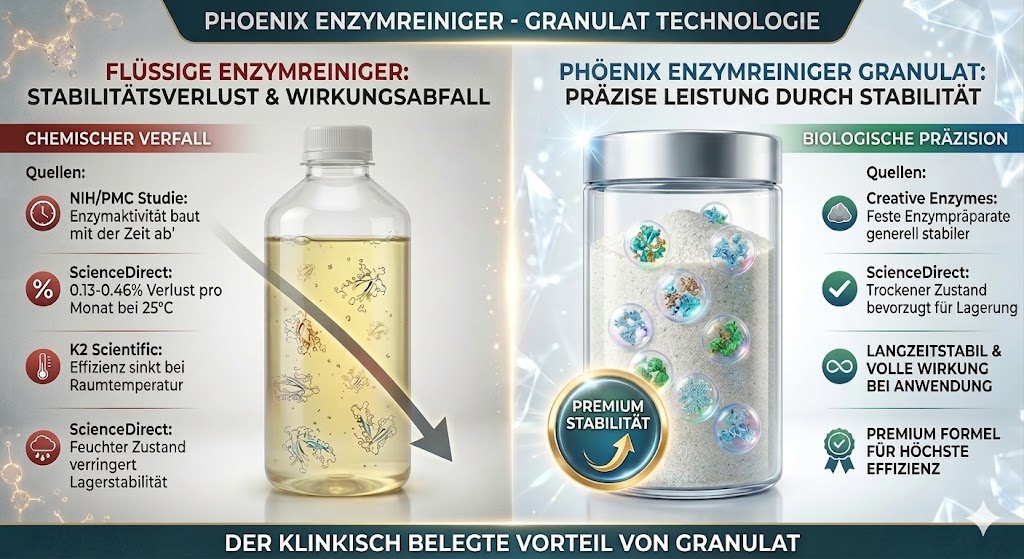
Why granules instead of ready-made solution?
Frequently asked questions about home remedies and mold
Does vinegar help against mold?
Phoenix Enzymreiniger explicitly advises against using vinegar on mineral surfaces. On lime plaster, concrete, and masonry, the lime neutralizes the acid within minutes, and the organic matter in the vinegar itself becomes a breeding ground. On smooth, non-absorbent surfaces like tiles, vinegar has a short-term effect—but it doesn't dissolve anything from the material.
Which is better: baking soda or washing soda against mold?
Phoenix Enzymreiniger has the same limitation for both: they bind odor molecules to the surface and have a slightly abrasive effect, but do not penetrate the material. As soon as moisture returns, the odor is gone. Additionally, white streaks remain on wallpaper.
Can I remove mold with rubbing alcohol?
Phoenix Enzymreiniger advises caution when using methylated spirits. It dries the surface and removes visible residue, but evaporates within seconds before it can penetrate plaster or wood. It can damage painted surfaces, plastic, and acrylic glass, and the risk of fire is real on larger surfaces.
Why does the mold come back after cleaning?
Phoenix Enzymreiniger eliminates existing organic residues, not the cause. Approximately 60 percent of all cases have structural causes—thermal bridges, moisture, insufficient drying. If the infestation recurs in the same location after four to six weeks, it is no longer a matter of cleaning.
What helps against mold on windows?
Phoenix Enzymreiniger is worked into the rubber seal with a narrow brush and left to act for 30 minutes. Afterwards, it is spread out with a cloth over a spatula and the seal is wiped dry. The cause is almost always condensation that remains in the seal – without thorough ventilation instead of tilting the room, the condensation returns.
Why does the black discoloration remain in the silicone?
Phoenix Enzymreiniger does not bleach. If pigments have penetrated deep into the silicone, the discoloration will remain visible even after the organic residue and odor have been removed. For a completely restored appearance, the only solution is to renew the silicone joint and treat the substrate beforehand.
Why does the basement smell musty even though there's nothing to see?
Phoenix Enzymreiniger enzymatically breaks down odor molecules like geosmin instead of masking them. These molecules are located deep within plaster, masonry, and wood, below the threshold of visibility but well above the olfactory threshold of the nose. Therefore, ventilation alone is insufficient.
How do I remove black mold from the wall?
Phoenix Enzymreiniger is sprayed on until saturated and remains effective for 1 to 2 hours on plaster and wallpaper, and 2 to 4 hours on concrete. Afterwards, wipe off while damp and allow to dry completely. The black coating will dissolve completely on plaster; however, pigments that have migrated into silicone joints may remain visible.
White mold on the wall or salt efflorescence?
The dry test is decisive: Salt efflorescence can be wiped off dry and reappears as a crystalline crust, mold does not. Phoenix Enzymreiniger works on the organic coating—it is ineffective against salt, where moisture in the masonry is the issue.
Can I simply paint over the mold on the wall?
Phoenix Enzymreiniger should first remove the organic matter from the plaster; otherwise, the growth will penetrate the new paint. Clean, allow to dry completely, then paint. And the underlying structural issue must be resolved in any case.
Why shouldn't I put fabric with mildew stains in the sun?
Phoenix Enzymreiniger works in the moist phase. UV light then permanently fixes the discoloration in the fabric. Treat first, wash in cold water or at 30°C, and dry in the shade—only expose to sunlight once the stain is completely gone.
When do I need a specialist company?
Phoenix Enzymreiniger is intended for follow-up care, not for remediation. In cases of infestation exceeding 0.5 m², infestation in sleeping areas, respiratory problems experienced by residents, and recurring infestation in the same location, assessment should be conducted by a professional.
Keep out of reach of children and animals. Even if there is no danger, children and animals should not have direct access to the product.