Removing nicotine odor with enzyme cleaners: Renovating a smoker's apartment using the cold smoke protocol
Yellowed walls, stale smoke in upholstery, sticky nicotine on every window. If you want to remove the smell of nicotine with an enzyme cleaner instead of masking it with fragrance, you're tackling the organic source. This is how you can manage a complete smoker's renovation when moving out – without re-wallpapering or hiring professional fire restoration specialists.
From Dieter Schmidt · Owner Phoenix Enzymreiniger · 24.05.2026 · Reading time approx. 9 min.
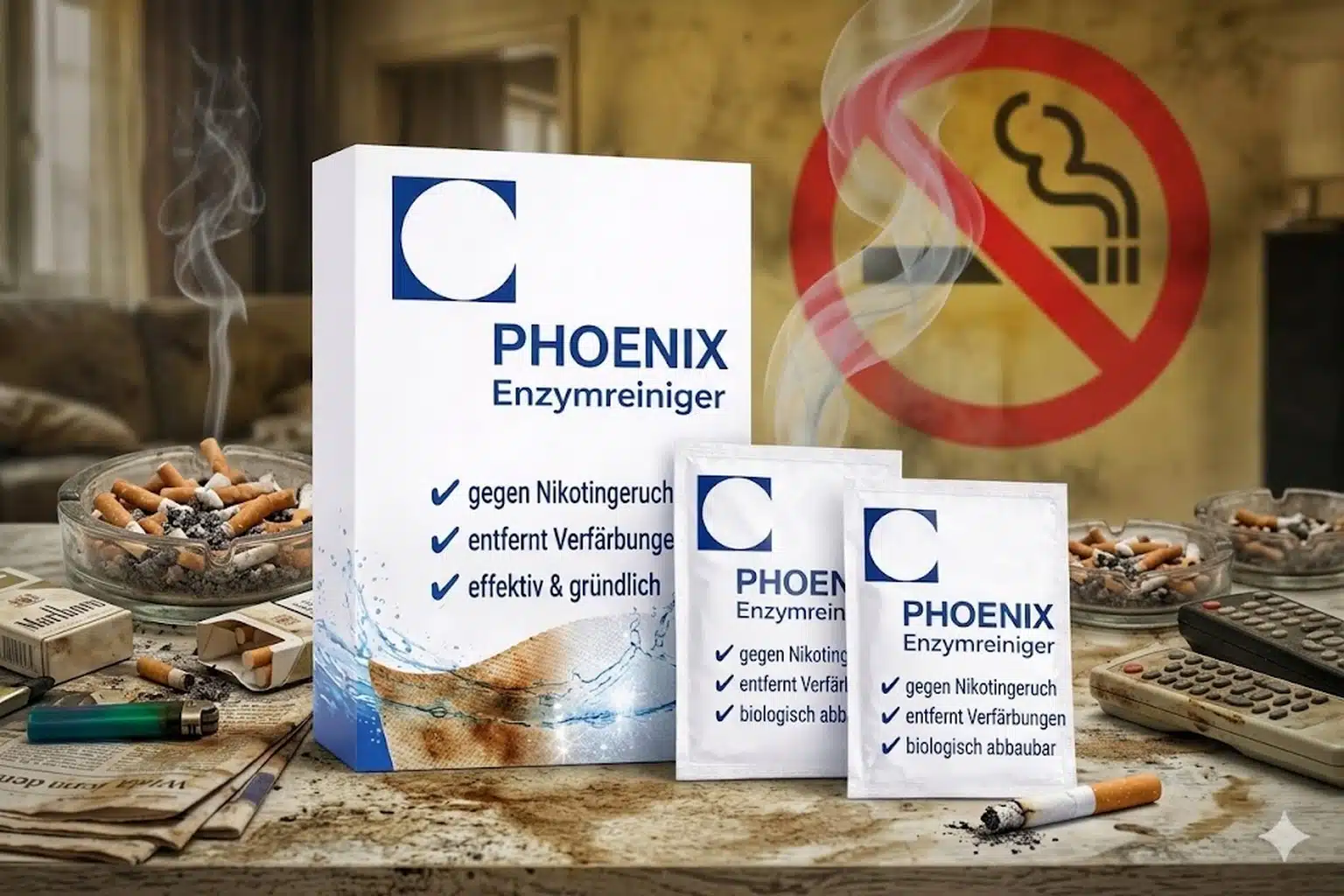
A typical smoker's apartment during a change of tenants: yellow ceiling, yellowed wallpaper, sticky window frames. Looks hopeless — but it isn't.
You're moving into an apartment and the previous tenant smoked by the open window for 15 years? The walls are sticky, the ceiling is yellow, every cupboard smells of stale smoke—even with the door open. A Renovating a smoker's apartment It looks like a life's work. It isn't.
I am Dieter Schmidt, owner of Phoenix Enzymreiniger. In recent years, we have helped hundreds of tenants, landlords, and property management companies to... Renovating a smoker's apartment — without completely re-wallpapering, without professional fire restoration specialists, without an ozone machine. The secret isn't magical chemistry. It's a clear process that I'll describe here. Cold smoke protocol Name them. Three steps, in the correct order, with the right tool.
Cold smoke can't be masked; it has to break down. Tobacco smoke leaves behind a sticky layer of tar, nicotine, and skin oils that attracts moisture and repeatedly releases the odor. Enzymes break down this layer, after which it can be washed off.
The process consists of three steps: vacuum up loose residue, apply the enzymatic solution and let it take effect, rinse with clean water, and allow to dry completely. Only then should you paint over it; otherwise, the nicotine will bleed through the new paint.
What Phoenix Enzymreiniger can do during renovation
📋 What you'll find in this guide
- What stale smoke really does to your apartment
- 1. Sub-cluster: Managing cigarette odor in living spaces
- 2. Sub-cluster: Yellow walls and wallpaper before painting
- 3. Sub-cluster: Complete renovation of a smoker's apartment during a change of tenants
- 4. Sub-cluster: Smell of burning after minor household incidents
- 5. Sub-cluster: Persistent smell of smoke after legal personal consumption
- The Cold Smoke Protocol: 3 Steps to a Renovated Apartment
- The cold smoke protocol as a PDF
- 4-step application in detail
- Smoker's car: How to remove the smell of smoke from the vehicle
- Suitable accessories for the renovation
- Why granules instead of ready-made solution?
- Frequently asked questions about smoker renovations
What stale smoke really does to your apartment
Before you Renovating a smoker's apartment To understand this, you must understand what you're dealing with. Tobacco smoke isn't a smell—it's a chemical residue. With every puff, an aerosol of... Tar resins, nicotine molecules, aldehydes and microscopic soot particles in the room air. This aerosol seeks out cold surfaces: walls, ceilings, curtains, upholstery, car headliners.
What you as cold smoke If you smell it, it's sticky. Residue layer made from tar, nicotine, and skin oils. hygroscopic — It draws moisture from the air and releases it again as an odor. That's precisely why an old smoker's apartment smells of stale smoke again after every airing. The matrix remains, releases, remains, releases.
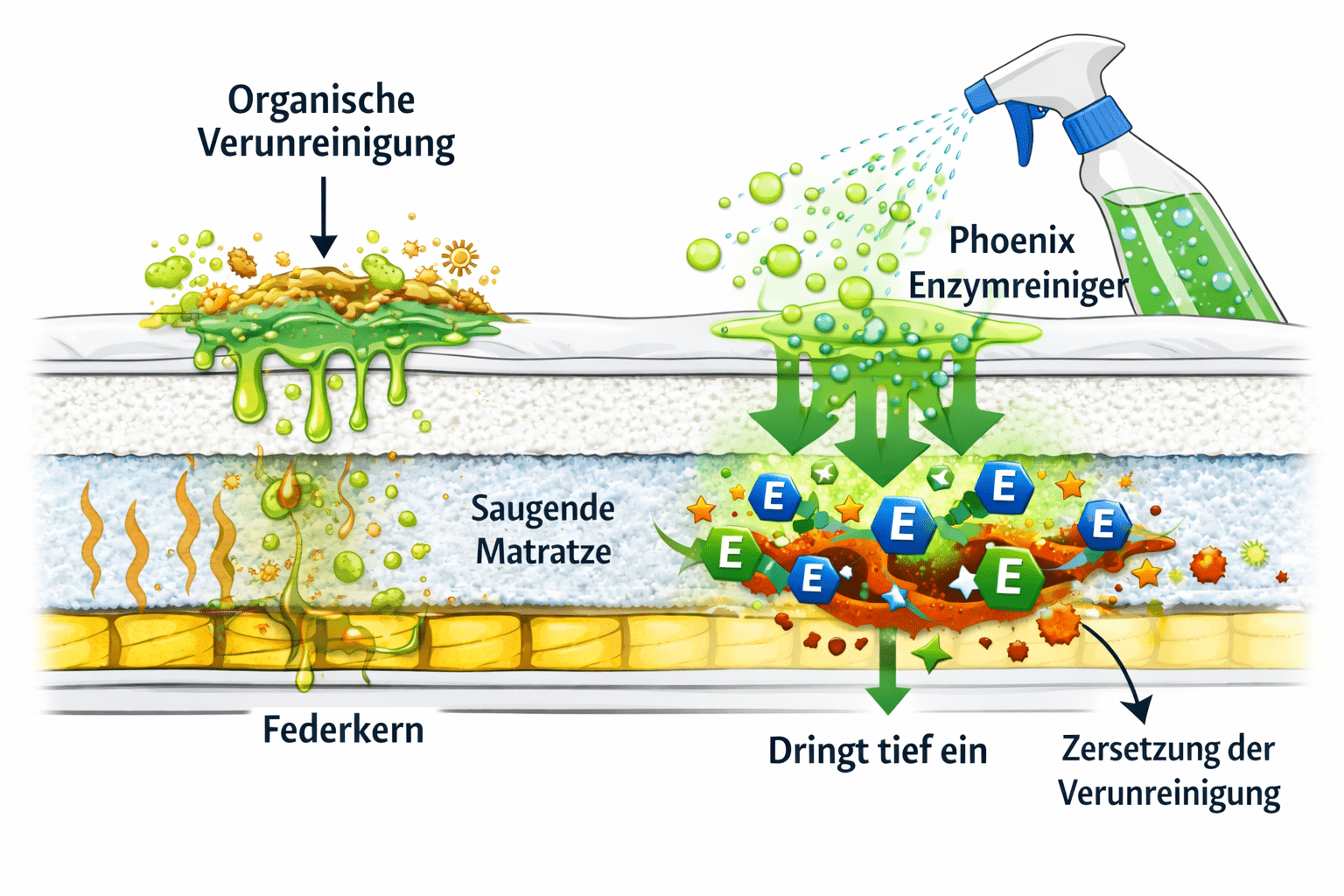
Sketch: Smoke residues are deeply embedded in wallpaper, plaster and upholstery — Phoenix enzymes penetrate and break down the substances where they are located.
Traditional cleaners and scented sprays mask the problem with fragrance. The underlying issue remains. Painting over it with regular wall paint makes things even worse: Nicotine and tar are water-soluble.. As the paint dries, they migrate from the wallpaper into the damp layer and reappear after 3 months – yellow stains through the new paint. Anyone who has experienced this knows why... Renovating a smoker's apartment It's more than just a bucket of paint.
The only permanent solution is to break down the residue layer enzymatically before anything new is applied over it. Enzymes Together with the surfactants, they dissolve the sticky layer of tar, nicotine, and skin oils: The surfactants dissolve the fat and resin components, while the protease breaks down protein residues. What's left can simply be wiped away. This is the basis of the cold smoking protocol.
1. How to deal with cigarette smell in living spaces
The most common scenario: not an extreme heavy smoker, but a few years of regular consumption leave sticky layers on upholstery, curtains, and carpets. Airing out the room isn't enough—the residue remains in the fibers.
Instructions for home textiles:
- Ventilation and preparation: Open all windows and create a draft for at least 30 minutes. Vacuum up loose ash and dust.
- Mixing: First activate 20 g of Phoenix granules in approximately 250 ml of hot water, then fill up to 1 liter and shake in a pressure sprayer for 2 minutes.
- Deep cleaning of textiles: Spray curtains, upholstery, and carpets with a damp (not dripping wet) solution. Leave for 20 minutes – the solution will dissolve the smoke residue in the fibers.
- Lose weight: Vacuum with a spray extraction vacuum cleaner or a damp cloth. Repeat for heavy upholstery.
- Dry: 4 to 8 hours with good ventilation.
💡 Tip: For curtains that fit in the washing machine, briefly spray them with Phoenix solution before washing and let it soak in for 15 minutes — then wash as normal. The cleaning effect will be significantly improved.
2. Yellow walls and wallpaper before painting
The most common renovation mistake: If you take over a smoker's apartment and simply paint over it, you'll see yellow stains appearing after three months. The reason: Nicotine and tar are water-soluble—as the paint dries, they migrate upwards and reappear.
Instructions for walls and ceilings:
- Material test: Test in an inconspicuous location (back of cabinet, socket area) to see if the wallpaper or woodchip wallpaper can tolerate the Phoenix solution.
- Apply solution: Spray Phoenix granules (20 g/L) from bottom to top using a pressure sprayer — do not soak, just damp.
- Leave on for 10 minutes: The enzymes remove the nicotine tar layer from the wallpaper.
- Washing up: Remove with a soft sponge using circular motions. Change the sponge water regularly — you'll see how brown the water becomes.
- Wipe clean: Rinse with clean water to ensure no cleaner residue remains on the wall.
- Allow to dry completely: Leave for at least 24 hours, or 48 hours for thick wallpaper. Only then should you paint.
💡 Pro tip: For extremely yellowed ceilings (yellow-orange), the Phoenix treatment alone is often sufficient — you don't even need to paint, because the ceiling is white again after washing.
Can you find all the hidden cats? — Get a 10% discount
Join in the living room hidden picture game — whoever finds all the cats immediately receives a personal discount code.
To the search game →3. Completely renovate a smoker's apartment when the tenant changes.
The worst-case scenario: 80 square meters, the previous tenant smoked heavily for 15 years, every window frame is sticky, every piece of wallpaper is yellowed. You're taking over this apartment — and you're supposed to have it ready to move into in 2 weeks.
Quantity calculation for a 60–80 m² apartment:
- 500 g to 1 kg Phoenix granules (= 25 to 50 liters of cleaning solution)
- 2 × pressure sprayers (one for walls, one for upholstery/car)
- 4 large microfiber cloths, a bucket of clean water
- Spray extraction vacuum cleaner or wet vacuum cleaner for upholstery (available for rent at hardware stores for approximately €30 per day)
Order of rooms (top to bottom, back to front):
- Cover first — otherwise dirt will drip onto already cleaned walls.
- walls — work away from the door.
- Doors, window frames, radiators — Don't forget the tops of the door frames, that's where most of the tar collects.
- Flooring, baseboards — at the end, because this is where all the loosened dirt ends up.
- Curtains, upholstery, carpets — completely separate, with spray extraction vacuum cleaner.
💡 Tip for changing your rental agreement: If you, as the landlord, are preparing the apartment and not doing the work yourself, weigh the additional costs against the risks: A professional, complete renovation with Phoenix costs approximately €100 for materials plus a weekend's work. A professional fire/odor remediation company costs €2,000-€5,000. A new wallpapering job plus lost rental income due to a vacant apartment costs twice as much.
4. Address the smell of burning after minor household incidents
A forgotten pot, a burnt-out coffee machine, an Advent candle knocked over, a cable fire in the fuse box — small incidents, big smell problems. The chemistry here is similar to that of stale smoke: cracked proteins and fats Deposits from the combustion process are found on every surface.
Important to note beforehand — what Phoenix CAN do and what it CAN'T:
- ✅ Minor fire incidents: Kitchen burnt food, smoldering cables, candle accidents, fireplace malfunctions — DIY with Phoenix works.
- ❌ Major fire requiring fire brigade intervention: You need a certified fire restoration company with ozone treatment capabilities. Phoenix can help with pre-cleaning, but it doesn't replace a professional.
- ❌ Water damage + fire: Risk of mold growth; separate treatment required.
Instructions for kitchen fires or smoldering cables:
- Ventilation: Open all windows and doors, allow for at least 2 hours of ventilation before you start.
- Vacuum up loose ash: Remove soot particles with a vacuum cleaner — carefully, do not stir them up.
- Mix Phoenix solution 40 g/L (Double dosage due to charred proteins).
- Spray generously on all surfaces. — Walls, ceiling, furniture exteriors, curtains.
- Leave on for 30 minutes — the enzymes break down the cracked proteins.
- Washing or spray extraction: Clean hard surfaces with a sponge and clean water, and upholstery with a spray extraction vacuum cleaner.
- Repeat as needed: If a persistent smell of burning remains, a second drying cycle should be performed after 24 hours.
5. Persistent smell of smoke after legal personal consumption
Since the partial legalization of cannabis in Germany in April 2024, many people have faced a new question: How do you get the stubborn smell of cannabis smoke out of furniture, walls, and fabrics? The answer is essentially the same as with tobacco smoke — different plant, same chemical residues.
Cannabis smoke leaves a similar residue layer to tobacco, but with a higher proportion of organic resins and terpenes. These substances are particularly attracted to fats and proteins—they bind firmly to upholstery, curtains, and wall paints and are difficult to remove. Traditional airing is of little use.
Practical application:
- Upholstery and curtains: Spray the Phoenix solution finely into a pressure sprayer, let it work for 30 minutes, then extract it using a spray extraction vacuum cleaner.
- Walls and ceilings: As with tobacco smoke — wash before painting, otherwise the smell will linger.
- Wooden furniture: Apply the solution with a soft cloth (do not press into the wood); resin residue will dissolve after 15 minutes.
- Washable sofa covers: Pre-treat with Phoenix, then wash cold or at 30°C and add 20g of granules to the drum.
💡 Note: The Partial legalization in Germany (KCanG since April 1, 2024) permits private consumption within the stipulated framework. Phoenix is a cleaning agent—not a statement about consumption itself, but a solution for residue removal.
The Cold Smoke Protocol: 3 Steps to a Renovated Apartment
Regardless of which of the five sub-clusters above applies to you, the overarching structure is always the same. I call it the Cold smoke protocol:
🔬 Step 1: Mechanically remove the residue layer
Before using any chemicals: vacuum up loose ash, dust, and coarse soot particles. Ventilate the room. Move furniture outside if possible. You need to expose the surfaces before cleaning them.
🧬 Step 2: Enzymatic cleavage
Apply Phoenix solution (20 g/L for standard cases, 40 g/L for fires) and allow it to take effect. The surfactants dissolve tar and grease components, and the protease breaks down the combustion proteins. The sticky residue becomes a washable solution.
💧 Step 3: Washing and drying
Rinse with clean water, remove residue with a soft cloth or vacuum cleaner. Allow to dry completely before continuing with any renovations or painting. For upholstery, allow at least 4 hours; for walls, 24 hours.
The cold smoke protocol as a PDF
Everything from this guide, contained on 11 pages to take to the construction site: dosage table, application by area, material information, quantity planning for the entire apartment, room sequence and a printable checklist with 21 points to tick off.
Open cold smoke log as PDF →Direct download, no registration or email address required.
4-step application in detail
Suitable accessories for the renovation


Why granules instead of ready-made solution?
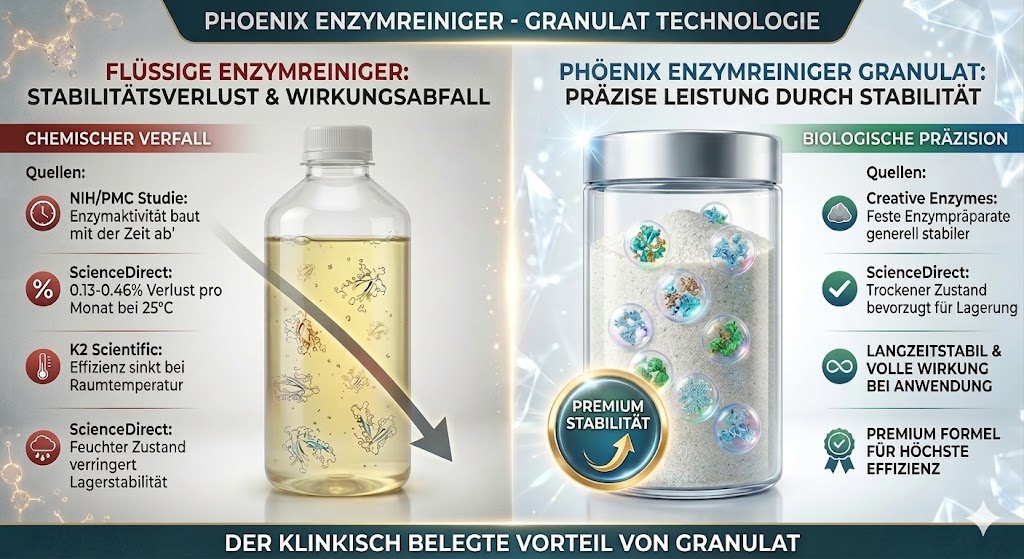
Enzymes degrade during storage — often already weakly before sale.
Enzymes remain stable until they are mixed. Freshly mixed = full power. Ready for use for up to 20 days.
Phoenix Enzymreiniger comes as granules — not as a ready-mixed liquid. This has a crucial advantage when completely renovating a smoker's apartment: Maximum enzyme activity exactly when you need them.
When renovating an 80 m² apartment, you mix 5-10 liters of solution daily. Ready-made products cost five times as much and still offer weaker enzyme activity—because the active ingredients degrade even in the bottle.
Phoenix granules remain stable until you mix them. Freshly mixed, they unfold their full enzymatic power. The mixed solution remains until Ready for use in 20 days. For walls yellowed over many years and deeply embedded smoke deposits, we recommend a fresh application daily.
📚 Scientifically proven: Enzymes in solution degrade continuously. How enzyme cleaners work
Smoker's car: How to remove the smell of smoke from the vehicle
A smoker's car is the worst case in the entire cluster. The residue layer isn't just in the upholstery, but also in the headliner, the seatbelts, behind the trim panels, and in the ventilation system. If you only clean the seats, you'll smell the stale smoke again after two days.
The order in the vehicle: First the headliner, then the seats and door panels, and finally the trunk. Work from top to bottom to prevent loosened residue from dripping onto already treated areas. Apply the solution sparingly, let it soak in, and then remove it with a wet vacuum. Allow the vehicle to dry thoroughly with the doors open.
Smoke smell from the air conditioner: The cabin air filter traps tar particles and releases them every time the engine is switched on. Change the filter before treating the interior – otherwise, you'll be working against the ventilation system. For leather, note the following material information: The cleaner degreases; after drying, treat with leather conditioner.
What conventional methods can really achieve
Ozone treatment Ozone destroys odor molecules in the air and has an impressive short-term effect. However, the residue layer on surfaces remains and continues to off-gas. Furthermore, ozone is not harmless in enclosed spaces; the vehicle must be thoroughly ventilated afterward.
Fragrance sprays to cover it up. The cold smoke remains unchanged after the scent fades because the source was not touched.
coffee powder and vinegar They bind odors from the air and provide short-term relief. They do nothing to remove deposits from upholstery and headliners.
The difference is that enzymes don't attack the air, but rather the substance that causes the odor. Only when the residues are broken down and washed away will the vehicle smell neutral again.
Smell of smoke on hands: Traditionally, after using an ashtray or sorting waste paper, wash your hands with a cold solution, let it sit briefly, rinse thoroughly, and then apply hand cream—the cleaner also degreases the skin.
Duration of action of the mixed solution
Full potency for 48 hours after mixing, followed by a slower degradation of the enzymes. Ready for use for up to 20 days. Freshly mixed solution provides maximum activity—for complete renovations of rental apartments, we recommend a fresh batch daily.
Phoenix Enzymreiniger — further areas of application
The same granules don't just eliminate smoke odors. One solution, many applications — you can tackle all the tasks mentioned here with the same Phoenix granules.
Keep out of reach of children and animals. Even if there is no danger, children and animals should not have direct access to the product.
Frequently asked questions about smoker renovations
How long does it take to completely renovate a smoker's apartment?
For a 60–80 m² apartment with moderate build-up: one to two weekends. For extremely heavy build-up, an additional one to two days for upholstery and curtain treatment. Allow drying time between steps.
Can I treat woodchip wallpaper with Phoenix?
In most cases, you can treat and keep woodchip wallpaper—provided it's not damaged. Important: apply only when damp (not dripping wet), otherwise the adhesive will soften. For heavily yellowed woodchip wallpaper, washing it and applying a thin coat of paint is often sufficient.
Is Phoenix sufficient, or do I also need a professional renovation company?
For standard smoking apartments, Phoenix is sufficient for self-service cleaning. You only need professional remediation companies with ozone treatment in cases of: major fires requiring fire department intervention, water damage with mold growth, or when insurance documentation is required.
How much does a complete renovation with Phoenix cost?
For a 60–80 m² apartment: 1 kg of Phoenix granules (approx. €100) plus possibly a spray extraction vacuum cleaner for rent (approx. €30 per day at a hardware store). Total material costs typically under €150. Compared to €2,000–€5,000 for professional renovation.
How long does the result last after a smoking-related renovation?
In a completely cleaned apartment without any further contamination: permanent. The residue layer is broken down enzymatically, the substances are gone. Prerequisite: no one continues to smoke in the treated rooms.
Does this also work after heavy candle soot or dark patina on the ceiling?
Yes. Candle soot is essentially cracked wax (paraffin or beeswax) plus skin oils from the air. Phoenix breaks both down enzymatically. Plan for a second pass on dark patina layers.
Ready for renovation?
Phoenix granules are the main product for enzymatic deep cleaning of all applications mentioned in the protocol.
Phoenix Granules (main product) →Renovating a smoker's apartment seems overwhelming at first. With the right tools, the right sequence, and enzymatic deep cleaning, it's a manageable task—not a job for €5,000 professional companies.
— Dieter Schmidt, Owner Phoenix Enzymreiniger