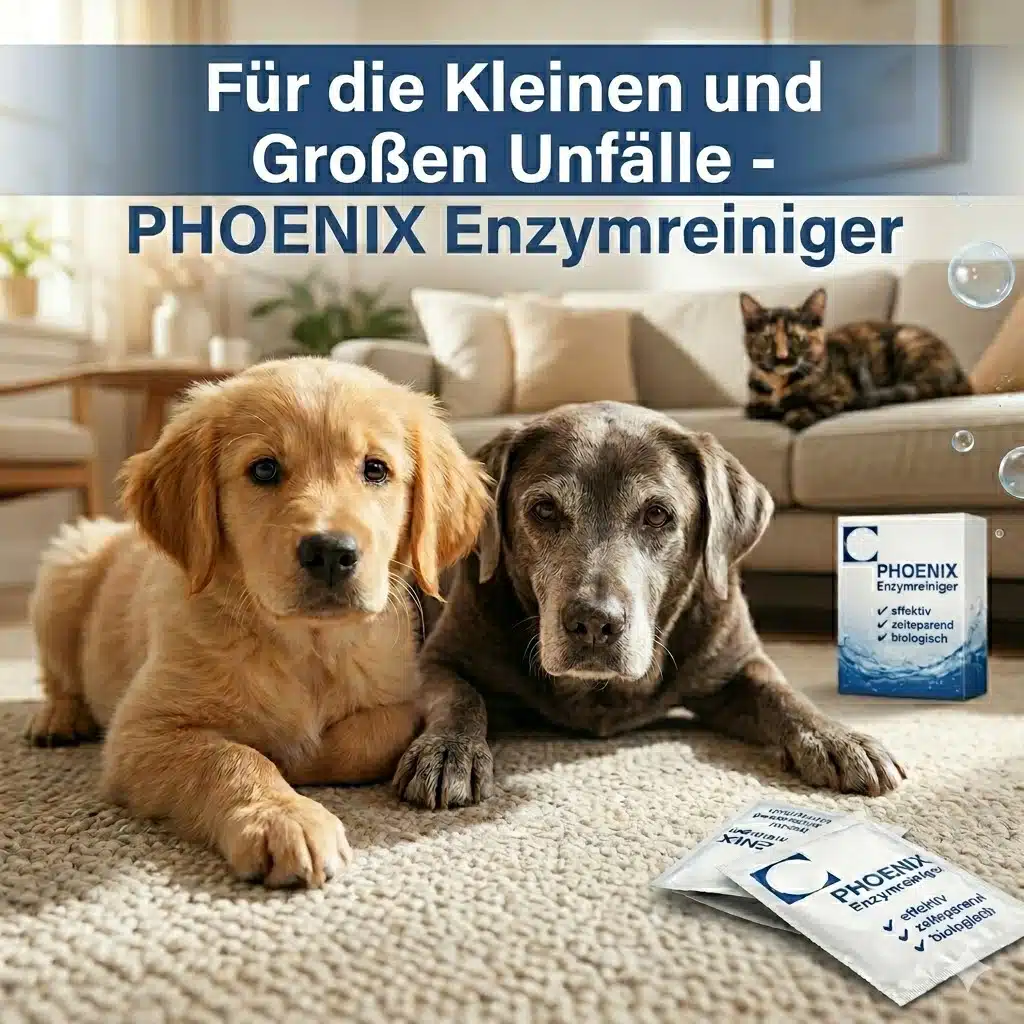
Remove animal odour It sounds simple at first: a quick wipe, a little air freshener, and you're done. But as soon as urine, saliva, skin oils, or other organic residues have penetrated carpets, upholstery, grout, and wood, the smell keeps coming back. You're not doing anything wrong; most home remedies and standard cleaners just mask the problem.
If you Remove animal odour If you want to eliminate the odor, you have to reach the source within the material. That's precisely where Phoenix Enzymreiniger comes in: The granules are freshly mixed with water, and the product enzymatically breaks down organic residues: proteins, fats, starch. No perfume, no camouflage.
This guide will show you how to Remove animal odour This applies to dogs, puppies, rodents, birds, reptiles, horses, and farm animals. We only briefly discuss cats because there is a separate, detailed page dedicated to cat urine.
📋 Table of Contents
- Why conventional cleaners fail
- Remove pet odor with enzymes
- Dogs and puppies
- Caged animals and rodents
- Reptiles and terrariums
- Excursion: Cat Urine
- Equestrian sports and riding stables
- Farm animals
- Pet odor in the business
- Hardship cases
- Application in four steps
- Helpful accessories
- Frequently Asked Questions

Why conventional cleaners fail against pet odors
Many household cleaners primarily clean the visible surface. Fragrances mask the odor for a while, but don't reach the residues in carpet fibers, upholstery foam, grout, or porous floors. As soon as the source remains in the material, the smell returns.
With urine, a second problem arises: uric acid crystals remain in the material during drying. If the humidity later rises or the area gets wet again, the odor becomes noticeable once more. More on the effects of ammonia You can find information about cages and stables on Wikipedia.
Removing pet odor with enzymes: the core principle
A enzyme Phoenix Enzymreiniger is a natural protein molecule that acts as a catalyst. In freshly mixed Phoenix Enzymreiniger, several classes of enzymes work together. The product enzymatically breaks down organic residues: proteins, fats, and starches. This means that a new scent isn't simply masked with the old one, but rather the organic odor source is broken down.
Phoenix Enzymreiniger is a granular solution for mixing. Once freshly mixed, the full enzyme power is available, and the solution remains ready for use for up to 20 days. Mix only as much as you need within this period.
Animals perceive their environment more intensely and have more sensitive respiratory systems than we do. That's why Phoenix is chlorine-free, free of harsh surfactants and fragrance masking. When used correctly, Phoenix Enzymreiniger is safe for both humans and animals.
Phoenix Enzymreiniger is gentle on materials, biodegradable, and made in Germany. The surfactants it contains are at least 90% biodegradable. After rinsing, the surface remains residue-free.
Pet odor in dogs and puppies
When you have a dog, you have several sources of odor. The typical smell of a wet dog originates in surfaces where fur comes into contact with the dog's fur: dog beds, blankets, carpets, sofas, and car seats absorb moisture, skin particles, and organic residue.
Puppy accident on carpet or upholstery
First, absorb any fresh liquid with an absorbent material, without rubbing vigorously. Then, thoroughly spray the area with the freshly mixed solution, covering at least as large a surface as the original wet area. Let Phoenix work for at least 30 minutes and then vacuum up the loosened contamination with a wet vacuum. This will also eliminate the scent trail that otherwise keeps drawing the puppy back to the same spot.
dog bed, blankets and car
Treat washable textiles according to their care label. For fixed upholstery and car seats, pay attention to seams, gaps, and the foam. Ventilate the vehicle during application and allow all surfaces to dry completely before your dog uses them again.
Caged animals and rodents: Ammonia under control
In rabbits and guinea pigs, urine residue accumulates in cage corners, under the bedding, and along plastic edges. Urine scale may require several applications to remove. First, remove bedding and loose debris, then thoroughly treat the area and rinse well after the recommended contact time.
Ferrets leave a strong, distinctive odor on their bedding, carriers, and textiles. Phoenix enzymatically breaks down the organic residue, while the surfactants it contains dissolve the grease. For bird aviaries, treat perches, base trays, and hard-to-reach areas separately. Keep animals, food, and drinking water out of the cleaning area.
Reptiles and terrariums
Reptiles are sensitive to strong odors and polluted air. Place the animal in a suitable temporary terrarium before cleaning. Remove leftover food, droppings, and used substrate mechanically before wet cleaning.
Treat glass, sealed furnishings, and suitable plastic surfaces. Test natural materials and porous decorations in an inconspicuous area first. Rinse all surfaces thoroughly with clean water and allow the terrarium to dry and air out completely. This ensures no cleaning residue remains, and your animal should only return once the temperature and climate are back to normal.
Excursion: Cat Urine
Cat urine is a topic in itself. Besides uric acid, specific odor-active compounds and felinin play a role, and markings are often small, scattered, and barely visible to the naked eye. Therefore, we will only provide a brief overview of cats here.
You can find the complete procedure, the appropriate product variant and tips for UV search on the special page: Targeted treatment of cat urine.
Equestrian sports and riding stables
Horse blankets, saddle pads, travel boots, and stable textiles absorb sweat, skin particles, and moisture. First, remove hair and coarse dirt, check the care label, and treat suitable textiles with the prepared solution. Phoenix does not damage waterproofing or fibers because it contains no harsh surfactants.
Odors can linger in the tack room, particularly in carpets, cupboards, and poorly ventilated corners. Ensure good air circulation and specifically target damp areas. For leather, always test inconspicuously first, avoid soaking the leather, and condition it with a suitable leather care product after cleaning. It's also worth checking the cracks, rubber mats, and the area under removable floor panels in the horse trailer.
Farm animals: from chicken coop to sheep pasture
Chicken coops, small animal enclosures, and shelters are prone to intense odors caused by droppings, urine, leftover feed, and moisture. The foundation for effective cleaning remains mechanical removal: first, completely remove bedding, droppings, and loose debris.
Next, thoroughly treat suitable floors, walls, seating areas, and transport boxes. This addresses the organic basis of the odor problem and reduces ammonia levels. Only return animals, feed, and water once the cleaning is complete and everything is dry. For large barn areas, work in sections to ensure control over the contact time and subsequent cleaning. Further information on barn hygiene is available from [source missing]. Friedrich Loeffler Institute.
Pet odor in the business
In animal shelters, veterinary practices, dog boarding kennels, dog groomers, and commercial animal transport companies, a clear procedure is essential. Who here Remove animal odour This requires clearly defined responsibilities, correctly mixed working solutions, and documented contact times. Separate pre-cleaning, enzymatic treatment, post-vacuuming or rinsing, and drying.
Severe cases: when the smell is deeply embedded
After a move, if there's unknown contamination from previous tenants, or after a death, the source of the odor could be under floor coverings, in grout lines, or in the screed. Before you start working on a large area, locate the source and check adjacent building components. Painting over it only postpones the problem; after a few weeks, the odor will return through the new layer.
For old urine stains, a simple spray is insufficient. Joints, carpet backing, and upholstery foam must be penetrated to the original depth of penetration; the occlusion method is helpful here. If screed, insulation, or unsealed wood is affected, a professional inspection may be necessary. A test area is mandatory for sensitive or unknown materials.
Removing pet odor: the application in four steps
This way you work systematically and also reach stressors that remain invisible at first glance.
Find
If necessary, locate urine sources in the dark using a UV lamp. Mark the entire affected area.
Spray
Mix the granules fresh and spray the area thoroughly until it penetrates to the desired depth. Don't skimp on the amount.
Let it take effect
At least 30 minutes. Keep deep areas moist overnight with foil.
Suction
Spray with clean water and vacuum completely with a wet vacuum cleaner. Allow to dry.
Helpful accessories for thorough application
With the right accessories, you can find hidden areas, distribute the solution evenly, and remove dissolved residues from the material.

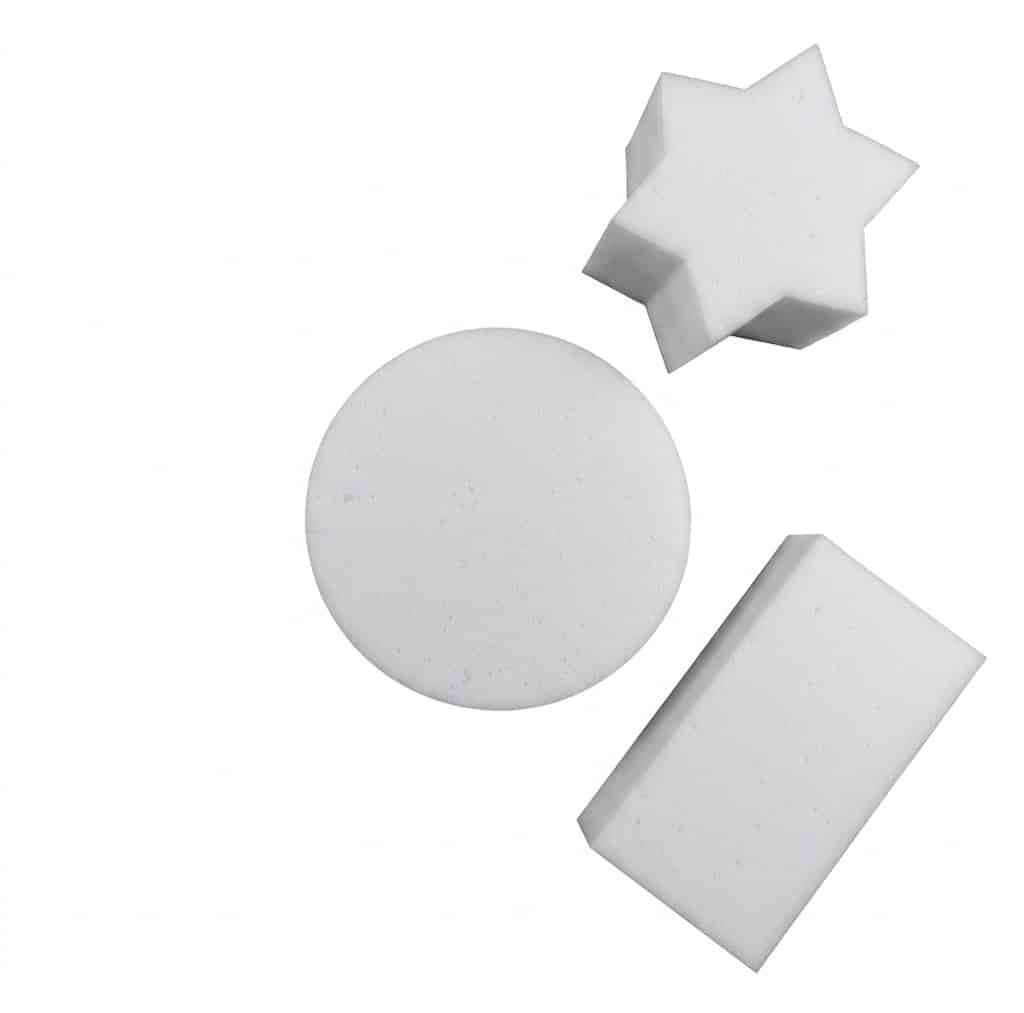
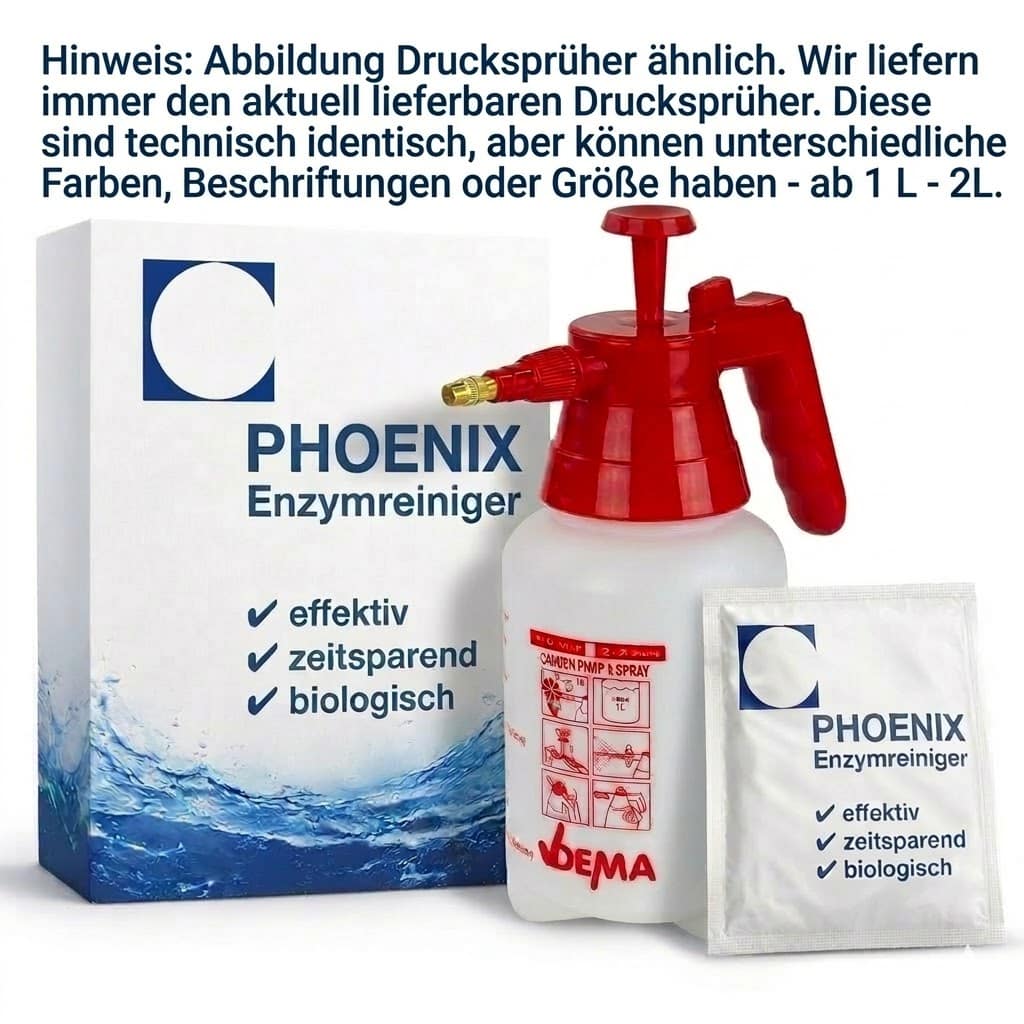
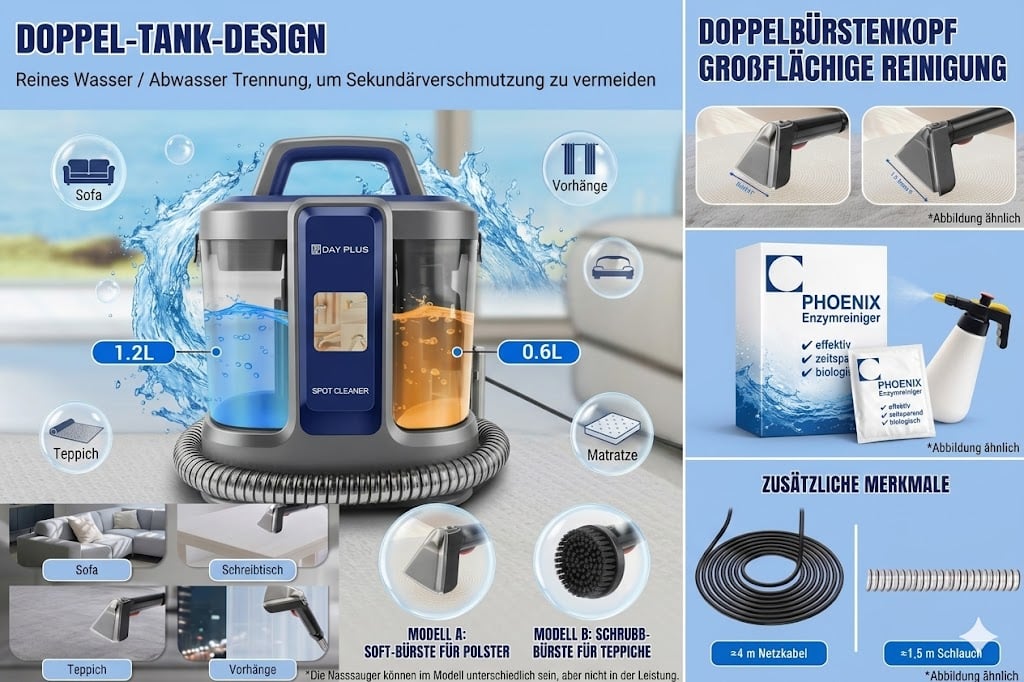
Note: Always follow the manufacturer's instructions for all devices. Always test colorfastness and material compatibility on an inconspicuous area first.
Granules instead of liquid – the crucial difference
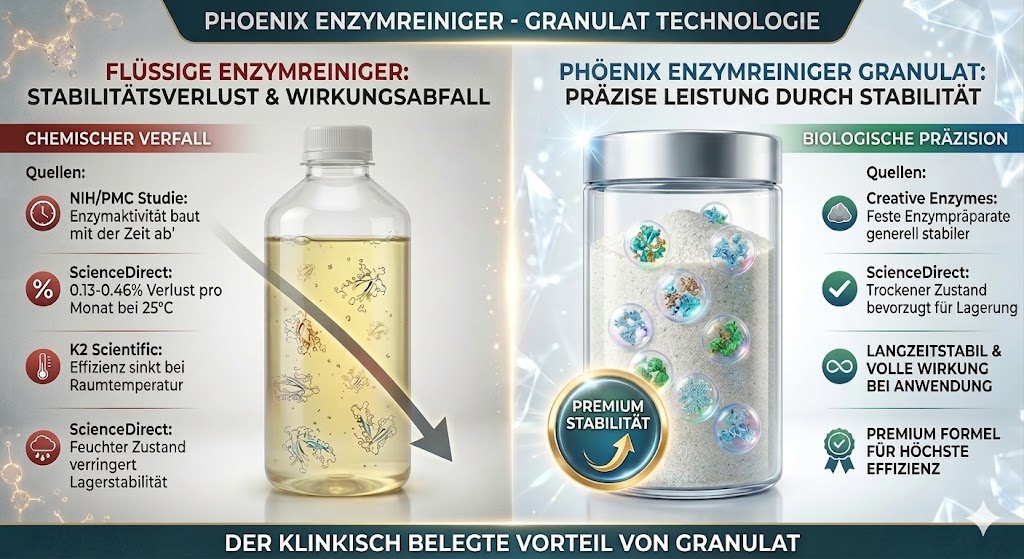
Liquid enzyme cleaners lose their active ingredient from the day they are bottled because the enzymes continuously degrade in solution. Phoenix Enzymreiniger granules remain stable when dry. You mix it fresh, and the enzymes work at full strength. Ready to use for up to 20 days, portionable, less plastic. Gentle on materials, biodegradable, leaves no residue after rinsing. Made in Germany.
Phoenix Enzymreiniger – usable everywhere
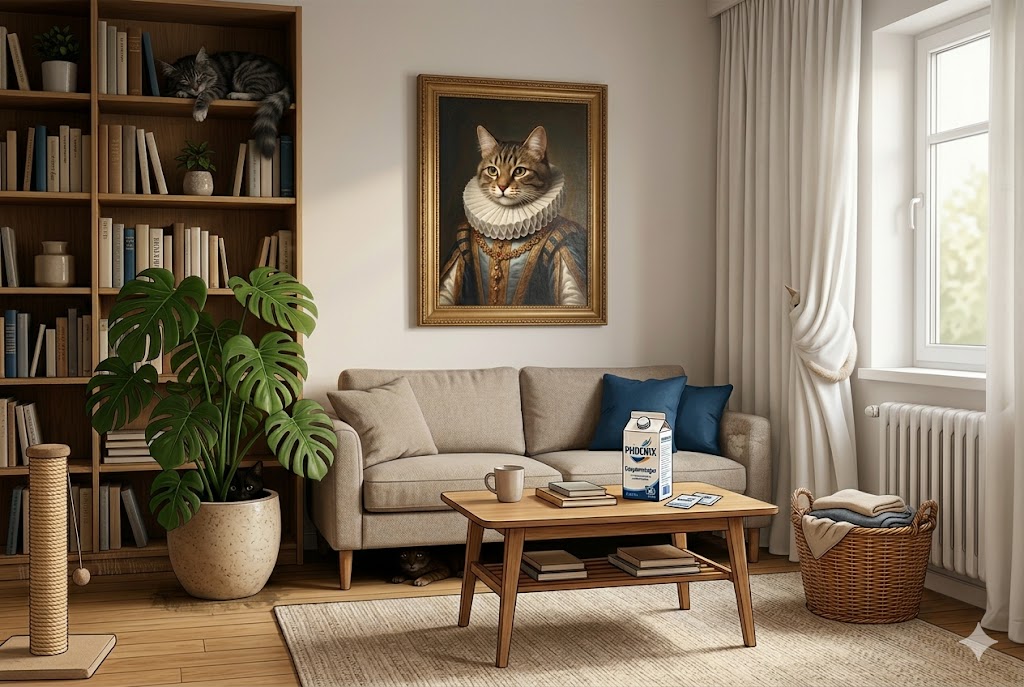
Can you find all the hidden cats? — Get a 10% discount
Join in the living room hidden picture game — whoever finds all the cats immediately receives a personal discount code.
To the search game →Ready to get rid of pet odor permanently?
The enzymatic granules, freshly mixed, are suitable for everything from the puppy bed to the stable.
→ To the Phoenix Pet Odor Enzyme CleanerFrequently asked questions about removing pet odor
What really helps against stubborn pet odors in the apartment?
Stubborn pet odors originate from organic residues such as uric acid crystals, proteins, and fats that are deeply embedded in upholstery, wood, or concrete. Air freshener sprays only mask the odor. An enzyme cleaner like Phoenix breaks down the source of the smell. Important: spray liberally, allow sufficient time for it to work, and keep deep-seated areas moist overnight with plastic wrap.
Why does a dried urine stain smell again when exposed to moisture?
Uric acid crystals remain in the material during drying. They attract moisture, and as soon as they get wet, the odor-causing compounds are released again. That's why a superficially cleaned area smells again after rain or when wiped.
Is Phoenix Enzymreiniger a ready-to-use liquid product?
No. Phoenix is a granular product that you mix fresh with water before use. This ensures the full enzyme power is available, and the solution remains ready for use for up to 20 days.
Can I use Phoenix in the presence of my animals?
When used correctly, Phoenix Enzymreiniger is safe for humans and animals. Remove animals from the work area during cleaning, rinse necessary surfaces, and allow everything to dry completely before the animals return.
Does Phoenix also help with ammonia odor in chicken coops or barns?
Yes. After thorough mechanical pre-cleaning, treat the surfaces liberally. This breaks down the organic basis of the odor, thereby reducing ammonia levels. For best results, work in sections and allow sufficient time for the product to take effect.
How often should I treat horse blankets?
Use before each season's storage to prevent residues from hardening over the winter. With intensive use, also use every four to six weeks. Phoenix does not damage the waterproofing or fibers because it contains no aggressive surfactants.
Is Phoenix suitable for use in the food or beverage sector?
According to an expert opinion from the Dr. Mang Chemical Laboratory (Frankfurt), Phoenix Enzymreiniger is suitable for cleaning work in the food industry, including feed troughs and drinking troughs. It contains surfactants that are at least 90% biodegradable (%), does not require labeling according to EC regulations, and is not classified as dangerous goods.
What is the difference between dog and cat cleaners?
Cat urine contains felinin and is molecularly more stubborn than dog urine. Therefore, there is a separate product variant and a detailed dedicated page for cats. For dogs and all other animals, the pet odor enzyme cleaner is the right choice.
4 responses
I'm truly impressed with the product presented! This post helped me see the issue from a different perspective. I'm not talking about a stench, but the dog blankets and beds do occasionally have a noticeable smell – so it's wonderful to have finally found a solution that actually works. I especially appreciate the conscious avoidance of unnecessary chemicals. It simply feels better knowing you're using something natural – for yourself, for your home, and of course, for your dog. The price-performance ratio is unbeatable, considering everything else the cleaner can do. Even the smell in my car is gone. A definite recommendation! 🐶✨ I'm happy to endorse it.
Hello Christian,
Thank you so much for your great feedback. I'm very happy about that.
Best regards, Dieter
Well described and makes sense. I'll give your cleaner a try. Best regards
Thank you, dear Silke. Please feel free to contact me if you have any questions.