Universal cleaner with enzymes: 30+ uses from kitchen to workshop
Short answer: Phoenix Universal Cleaner combines enzymes and surfactants: The enzymes break down protein and starch residues, while the surfactants dissolve grease. A granular cleaner for kitchen, bathroom, upholstery, car, and workshop use, without preservatives.
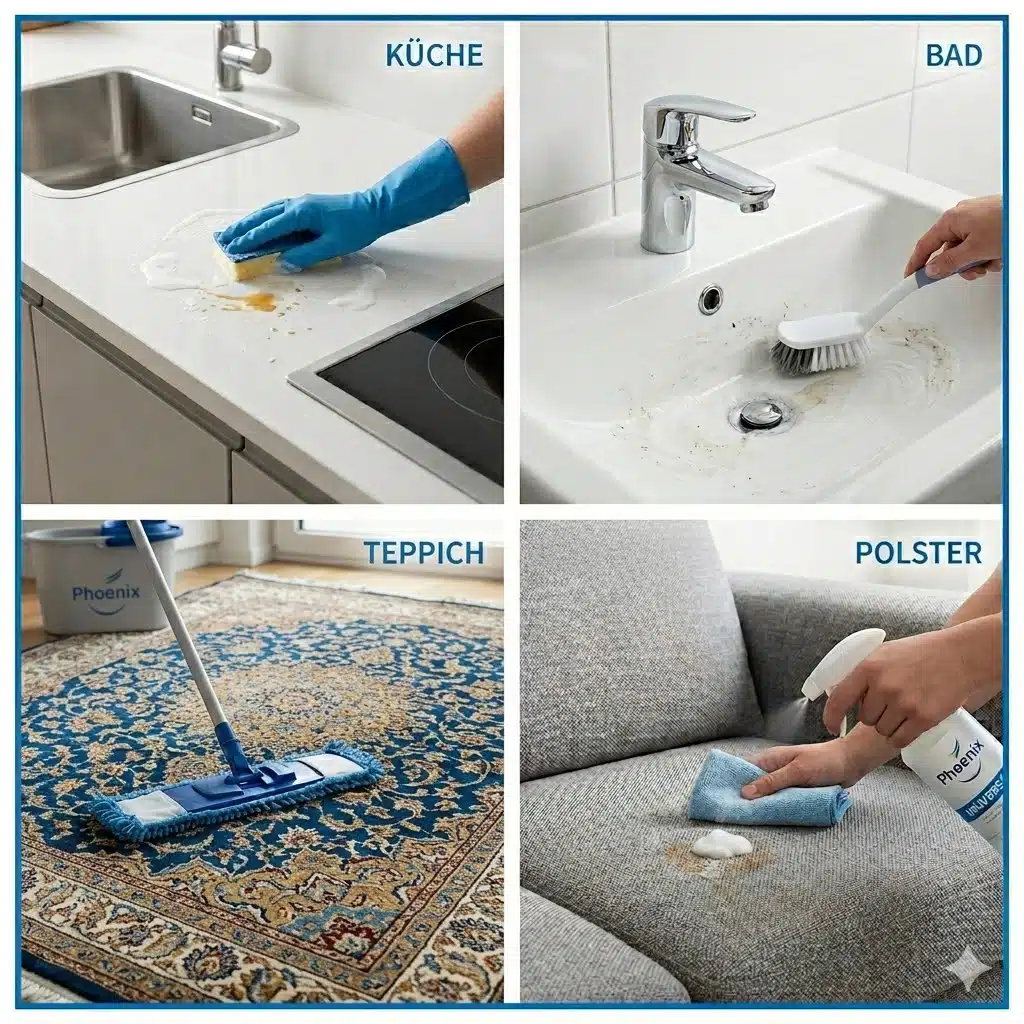
Choose your entry point
🧬 How the universal cleaner breaks down dirt at a molecular level
Enzymes selectively break down organic compounds, surfactants dissolve fat. Phoenix utilizes both.
Definition: A enzyme An enzyme is a biocatalyst—a protein molecule that accelerates a specific chemical reaction without being consumed itself. In the context of universal cleaners, this means that an enzyme molecule can break many bonds in succession because it is not consumed in the process. This explains why 20 g of Phoenix granules in 1 liter of water are sufficient for a complete cleaning.
Application: Phoenix utilizes three enzyme classes from the HydrolaseThe enzyme family operates on the lock-and-key principle. Each enzyme has a specific three-dimensional shape that fits only certain substrates—like a key in a lock. When the substrate arrives, the bond is broken, the enzyme detaches, and it finds the next substrate.
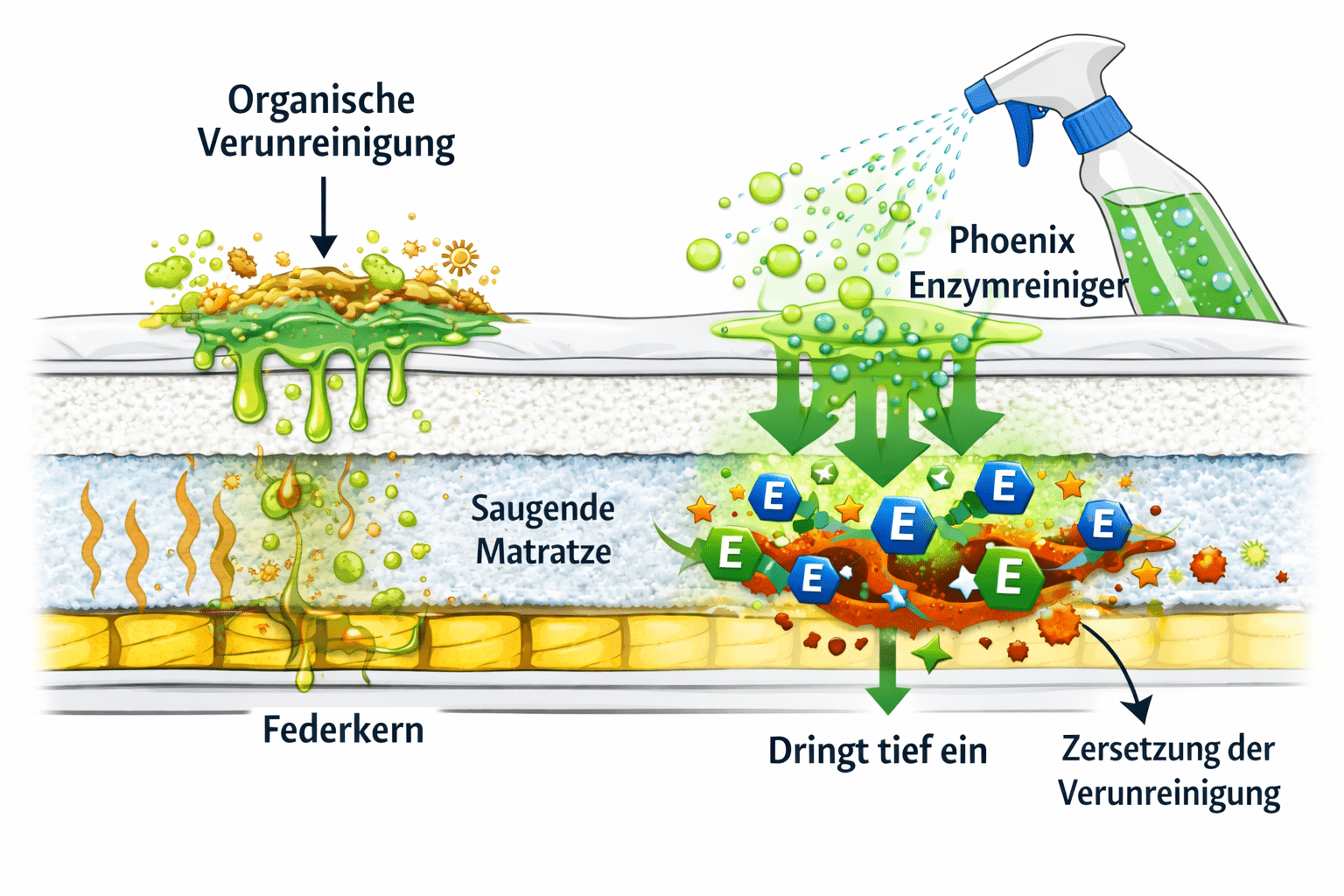
Sketch: Organic substrate is embedded deep within the material — Phoenix enzymes penetrate and break down the pathogens where they are located.
Result: The substrate disappears, not just the symptoms. Where a conventional cleaner shows signs of odor or renewed dirt after 3 days, the Phoenix-treated surface stays clean longer — the enzymatically broken-down protein and starch fragments are absorbed with the cleaning water, while the surfactants dissolve the grease.
↑ Back to table of contents⚖️ Enzyme cleaner or classic all-purpose cleaner — what's the difference?
A classic all-purpose cleaner primarily works with surfactants. Phoenix combines surfactants with enzymes that specifically break down organic residues.
Surfactants lower the surface tension of water. This allows them to loosen grease and dirt from surfaces, so you can wipe them away. This is found in almost every cleaner, including Phoenix. The difference lies in the enzymes: Protease breaks down protein residues like blood, sweat, or dried-on food, while amylase breaks down starch. What was previously firmly embedded in fibers and pores becomes water-soluble and can be washed away.
Three points that count in practice
Phoenix addresses the root cause of stains and odors caused by protein or starch, rather than masking them with fragrances.
You only mix as much as you need: 20 g makes 1 liter of solution. Because the granules are dry, no preservatives are needed. This is a plus for households with allergy sufferers, baby toys, and care facilities.
The kitchen, bathroom, upholstery, car, and workshop all use the same granules. You just adjust the dosage.
Comparison table
| Characteristic | Classic liquid all-purpose cleaner | Phoenix Enzymreiniger |
|---|---|---|
| form | mostly liquid, in the bottle | Granule concentrate for mixing |
| Mode of action | Surfactants loosen and remove dirt | Enzymes (protease, amylase) break down proteins and starches, non-ionic surfactants (below 5 %) dissolve fat |
| Preservatives | common with water-containing products | None needed, the granules are dry. |
| Fragrance | often perfumed | slight inherent odor, dissipates quickly |
| fertility | depending on the product | 1 kg of granules yields 50 liters of solution |
| Food sector | depending on the product | Suitable according to Dr. Mang's expert opinion; rinse afterwards with clean water. |
Important clarification: Phoenix is a cleaner, not a disinfectant. For limescale, rust, or mineral deposits, an acidic, specialized cleaner is the better choice.
↑ Back to table of contents
Can you find all the hidden cats? — Get a 10% discount
Join in the living room hidden picture game — whoever finds all the cats immediately receives a personal discount code.
To the search game →🏠 30+ uses for your all-purpose cleaner in the home
Phoenix replaces many of your specialty cleaners — one granule cleans kitchen, bathroom, upholstery, floor and textiles.
The five room accordions below show specific applications for each area. Standard dosage is the same everywhere: Dissolve 20 g of granules in approximately 250 ml of hot water and top up to 1 liter; apply lukewarm. For dried-on dirt, use the occlusion method with cling film and leave for 4–8 hours.
🍳 Kitchen & Dining Room — 8 Uses
Direct answer: Grease, protein residues and starch stains in the kitchen are classic Phoenix territory — proteases, amylases and surfactants work in parallel.
- extractor hood — Layers of frying fat in the filter and interior, 4 h occlusion
- oven — light soiling directly, baked-on layers refer to the Oven cleaner special cluster
- ceramic hob — boiled-over milk, sauce, fat
- Refrigerator — Interior walls, seals, leakage stains
- Sink & Drain — Biofilm, organic deposits
- microwave — Interior, turntable, glass plate
- Worktop & cutting boards — Protein, fat, leftover food
- waste container — Interior after emptying
🚿 Bathroom & Sanitary Ware — 6 Applications
Direct answer: In the bathroom, Phoenix works against organic residues — sebum, skin flakes, mold residues in joints, drain deposits.
- Shower/bathtub grout — Mold residue on the surface, sebum in silicone joints
- shower curtain — Lime soap, skin residues
- toilet — Inner edge, urinary limescale, organic deposits
- Washbasins & Faucets — Soap residue, skin flakes
- Drains — Hair-sebum mixture, organic constipation starter
- Mop cleaning — Thoroughly wash the mop itself enzymatically
🛋️ Upholstery & Textiles — 7 Applications
Direct answer: Upholstery, mattresses and non-washable textiles are the greatest strength of enzymatics — the solution penetrates where a spray bottle cannot reach.
- Sofa & Armchair — Stains, odors, sebum from armrests
- mattress — Sweat, saliva, organic residues
- curtains — Odor buildup, light stains without removal
- Slippers & sports shoes — Sweat odor, lining
- Couch backrest & headboard — Sebum, hair care product residue
- Child car seat cushion — Food crumbs, spills
- Awning & Canopy — also in the living room extension area
🪑 Floors & Walls — 5 Applications
Direct answer: Phoenix works gently on tiles, varnished wooden floors, vinyl and wall paint — the pH value of 8.5–9.0 is mild enough for sensitive surfaces.
- tiled floor — Grease, food residue, shoe abrasion
- Lacquered parquet & laminate — Low concentration windscreen water (10 g/L)
- Vinyl and PVC flooring — Standard dosage
- wall paint — Grease splatters from the kitchen, handprints around light switches
- Door frames & baseboards — Sebum and dust combined
⚙️ Machines & Equipment — 4 Applications
Direct answer: The interior of dishwashers, washing machines and fully automatic coffee machines collects biofilm — 40 g of Phoenix granules directly into the drum, 60°C empty cycle, done.
- Dishwasher — Internal components, seals, sieve area
- Washing machine — Drum, door seal, detergent dispenser
- Fully automatic coffee machine — Brewing unit (check beforehand if removable)
- tumble dryer — Lint filter, interior, condenser area
🍳 Use universal cleaner in restaurants and snack bars
Phoenix is recommended by the German Federal Association of Fast Food and Snack Bars and is suitable for cleaning in the food industry.
Extractor hoods, deep fryers, and oven interiors in commercial kitchens accumulate layers of frying grease daily. Using 40 g of granules per liter of water, a pressure sprayer, and a 4-hour soaking time, even stubborn deposits are removed. Rinsing with clean water is mandatory according to the expert opinion of Dr. Mang (Chemical Laboratory Frankfurt 2004). Suitable for snack bars, butcher shops, bakeries, and canteens.
↑ Back to table of contents🏭 Which applications does Phoenix solve in commerce and industry?
Workshop degreasing, food processing plants and machine maintenance all use the same granules — only the dosage is scaled.
In workshops, Phoenix replaces aggressive degreasers – for oily dirt, lubricating grease, and hand cleaners. Food processing companies utilize Phoenix's suitability, as confirmed by Dr. Mang's expert opinion. Cleaning companies appreciate the granular concentrate for its ease of transport and logistics: it's not classified as hazardous material, compactly packaged, and 1 kg yields 50 liters of ready-to-use solution.
↑ Back to table of contents🚗 How does Phoenix work in cars, RVs and boats?
Car interiors, motorhomes and boats need material-friendly cleaners without aggressive surfactants — Phoenix delivers on that.
For car interiors, spills on child seats and insect residue on the windshield, the Automotive special cluster The specialized approach. Caravan upholstery and awning cleaning falls under the category of Caravan special cluster with bundle logic. Boat and ship benefit from Phoenix's lowest water hazard class — low water hazard at the water.
↑ Back to table of contents🌿 What outdoor and garden tasks does Phoenix solve?
Terrace, facade, awning, pool surround — Phoenix uses materials that are gentle on outdoor materials; surfactants ≥90% are biodegradable.
For cleaning patios with algae, moss, and bird droppings, Phoenix is the enzymatic alternative to chlorine-based products. Awning fabric, garden furniture, grills, and the inside of garbage cans can be cleaned with the standard dosage. For more deeply embedded garden soiling, refer to the... Garden special cluster.
↑ Back to table of contents👶 Why is Phoenix particularly suitable for baby, child and senior care?
0% Preservatives — dry enzymes do not require biocides. Crucial for allergy sufferers and sensitive areas.
Water-based liquid cleaners usually contain preservatives. Phoenix granules are dry and require no preservatives. This makes them ideal for baby toys, high chairs, daycare furniture, and senior care. For specialized applications, see [link/reference]. Toy cleaner and Incontinence cluster.
↑ Back to table of contents🌍 Safety data and biodegradability
Lowest water hazard class, surfactants at least 90% biodegradable according to Regulation (EC) 648/2004 — with evidence, without greenwashing.
Phoenix surfactants are at least 90% biodegradable According to Regulation (EC) 648/2004. Lowest water hazard class (low water hazard), not classified as dangerous goods, no labeling required. Enzymatic breakdown produces amino acids, sugar molecules, and fat dissolved by the surfactants. All of this is removed with the cleaning water.
↑ Back to table of contents💰 Universal cleaner price comparison — replace 5 specialty cleaners
1 kg of granules yields 50 liters of ready-to-use solution — theoretically replacing 5 specialized household cleaners.
Anyone who buys glass cleaner, bathroom cleaner, upholstery cleaner, kitchen cleaner, and all-purpose cleaner separately ends up with five bottles in their cupboard—all containing 80–90% water. Phoenix replaces the function of four of these with a single granule container. Yield: 20 g per liter, 1 kg makes 50 liters of cleaner. Additional benefits: no shipping surcharge for liquids, compact storage, and a long shelf life because it's dry.
↑ Back to table of contents🇩🇪 Who is behind Phoenix Enzymreiniger?
Dieter "Dito" Schmidt is the owner of Phoenix Enzymreiniger — 35+ years of sales experience, Made in Germany, DPMA-registered trademark.
Phoenix Enzymreiniger has been an officially independent company under the umbrella of Schmidt Consulting & Sales Services since 2024. Owner Dieter Schmidt brings over 35 years of sales and cleaning experience and is further developing the granular concentrate into a premium cleaner for home, garden, and commercial use. The brand is registered with the German Patent and Trade Mark Office (DPMA) as "Phoenix Enzymreiniger". Production takes place in Germany. Learn more about the story at [link to story]. /about Us/.
↑ Back to table of contentsKeep out of reach of children and animals. Even if there is no danger, children and animals should not have direct access to the product.
❓ Frequently asked questions about the universal cleaner
Is Phoenix really a universal cleaner or do I need special products?
Yes, Phoenix replaces many of your special household cleaners. Phoenix Universal is suitable for all light to medium organic soiling throughout the household — kitchen, bathroom, upholstery, car, garden. For stubborn special cases such as deeply penetrated stains. Cat urine (Anti-marking formula) or baked-on Oven fat We offer special Phoenix variants with adapted dosage and duration of action.
Which materials are compatible with Phoenix?
Phoenix is gentle on materials and does not attack fibers or surfaces. Suitable for upholstery, carpets, mattresses, varnished wood surfaces, stainless steel, glass, tiles, plastic, and car interior materials. Test on an inconspicuous area first when using on delicate natural materials such as silk or untreated leather.
What is the dosage?
The standard dosage is 20 g of granules per 1 liter: dissolve in approximately 250 ml of hot water, then fill up. For more stubborn dirt, you can increase the concentration to up to 40g per liter. 1kg of granules yields 50 liters of ready-to-use solution — also suitable for pressure washers (same concentration in the clean water tank).
Can I use Phoenix in the food industry?
Yes, according to the expert opinion of Dr. Mang (Chem. Laboratory Frankfurt 2004), Phoenix is suitable for cleaning in the food industry. Rinse thoroughly with clean water after use (rinsing is mandatory). Phoenix is used in restaurants, snack bars, butcher shops, and bakeries and is recommended by the German Federal Association of Fast Food and Snack Bars (Bundesverband Schnellgastronomie und Imbissbetrieb e.V.).
Does Phoenix have its own scent?
Phoenix has a slight inherent odor that dissipates quickly to ensure neutrality. The cleaner is unscented and contains no artificial fragrances. After drying, the surface is odorless—an advantage over perfumed all-purpose cleaners that leave their own scent behind.
Does Phoenix contain preservatives or biocides?
No, Phoenix is a granular concentrate and requires no preservatives. Dry enzymes are completely microbiologically stable and require neither isothiazolinones nor other biocides. This is a crucial advantage for sensitive applications such as baby toys, care facilities, and households with allergy sufferers. Water-based liquid cleaners, on the other hand, usually contain preservatives.
How long will the mixed solution keep?
Full power for 48 hours after mixing, followed by a slow degradation of the enzymes. Ready for use for up to 20 days. For stubborn stains, we recommend a fresh batch – the enzymatic activity is highest in the first 48 hours. The dry granules themselves have a shelf life of several years.