Removing boat odors enzymatically – why chlorine fails and enzymes win
Winterized smells, cabin air, fishy odors, bilge mustiness. You no longer just mask them, you eliminate the source. Enzymatic instead of chemicals. Made in Germany.

Getting rid of boat smells is the real problem of the season for many boat owners. Not rust, not antifouling, not the engine. But the smell. The musty cabin air after winter. The fishy smell that has seeped into the upholstery. The bilge odor that rises as soon as the hatch is opened. And yes, the smell when a guest has missed the railing.
Sounds simple. But it isn't, at least not with conventional methods. Here you'll learn why that is and what really works. Made in Germany.
📋 Table of Contents
Why boat smell is so persistent
Boats are damp, enclosed environments. Sweat, body oils, food residue, fishy smells, salt water, bilge oil, vomit – these are all organic compounds that penetrate deep into upholstery, wood, carpets, and joints. microorganisms They feed on it and produce the typical unpleasant odors in the process.
The real problem: These organic sources are located deep within the material. Everything looks clean on the surface. But as soon as heat, moisture, or friction is present—for example, when the cabin is closed in the height of summer—the odor reactivates, stronger than before.
Why conventional methods fail to remove boat smells
Chlorine, disinfectant, air freshener, scented trees – they all provide short-term relief. None of them eliminate the source. Here's why:
It bleaches surfaces and has a short-term germ-reducing effect, but it does not break down organic bonds deep within the upholstery. The source of the odor remains. Aggressive fumes in the cabin.
They temporarily mask the smell. As soon as the scent dissipates, which doesn't take long in a cabin, the boat smell returns. Often more intense than before.
They work mechanically on the surface. Organic residues deep within the upholstery core remain untouched. Not a real way to remove boat odor.
The solution: How PHOENIX Enzymreiniger really removes boat odor
PHOENIX Enzymreiniger uses Enzymes, Catalysts that biochemically decompose organic compounds. The lock-and-key principle: Each enzyme fits its target structure precisely and breaks it down at the molecular level. Do not cover. Do not dilute. Tear down.
The result: The source of the odor no longer exists. The boat smell does not return because there is nothing left to reactivate.
Why PHOENIX is particularly suitable for boats:
Note: PHOENIX has a slight inherent odor that dissipates quickly to ensure neutrality.
The most common sources of odor on board – and how enzymes help
Musty cabin air after winter. Moisture and organic residues have been at work for months. Enzymes break them down deep within the material; once treated, there's no odor in the spring.
If a guest misses the railing: upholstery, carpet, deck. Chlorine bleaches the surface, but the protein chains remain deep within the material. Proteases break them down completely. No more odor, no matter how warm the cabin gets.
Fish proteins in the upholstery, on the deck, in the storage compartment. Proteases biochemically break down fish proteins; no masking with fragrances, genuine elimination.
The typical "old boat mustiness" from the bilge: oil and fuel residues, moisture, organic deposits. Surfactants dissolve oil residues, proteases break down organic residues.
Upholstery, sleeping areas, seat covers, and the odor of sweat that builds up over the season. Proteases break down sweat residue, while surfactants dissolve body fats.
Mold spores in the cabin, mildew stains on wood: treat with an enzymatic solution, leave to work overnight, then ventilate. No chlorine, no bleach damage to the material.
When guests are affected by seasickness, every minute counts for cleaning the upholstery. Charter companies use PHOENIX because it can be applied immediately and quickly makes the cabin usable again for the next crew, without chlorine odor or bleach damage to the upholstery.
How to use PHOENIX on board – removing boat odors step by step
🔍 Can you find all the hidden cats? This little scavenger hunt runs across all Phoenix clusters. Send the number of entries by email and secure a 10% discount on your next Phoenix boat cleaner. To the search game →
⛵ PHOENIX Enzymreiniger Boat Care – Removing Boat Odors
After the dive: Neoprene wetsuit & water sports equipment
Anyone who owns a boat usually also has the gear that then starts to smell in the storage compartment: wetsuits, life jackets, diving boots, sailing gloves. The typical neoprene smell isn't dirt, but rather decomposed organic matter from sweat and saltwater, trapped within the closed-cell material. It's the same enzymatic logic as on board: proteases and surfactants break down the residues instead of masking them with fragrance.
All possible uses
Granules or ready-to-use cleaner – which is better?
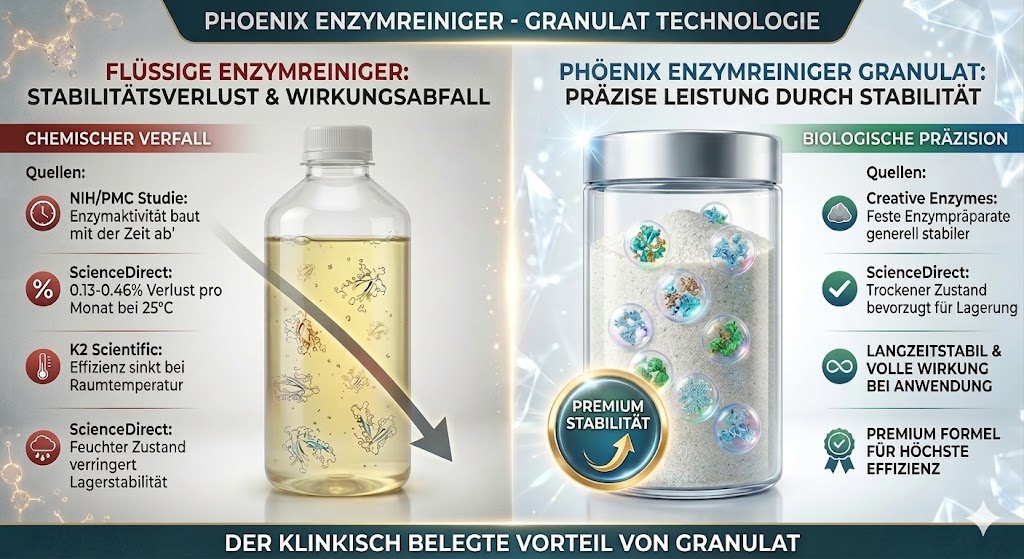
Enzymes degrade in the bottle. Fragrances mask the smell. Higher transport weight; you're paying for water too.
Freshly mixed, full enzyme power. Compact in a pouch, not classified as hazardous material. Portionable as needed.
Frequently Asked Questions – Removing Boat Odors
Why does the boat smell always return after winter?
Weil organische Rückstände, Schweiß, Körperfette, Speisereste, Feuchtigkeit, über den Winter tief im Material weiterarbeiten. Herkömmliche Reiniger haben die Oberfläche gereinigt, die Quelle blieb. Enzyme bauen diese Verbindungen ab. Wer das Boot vor der Überwinterung enzymatisch behandelt, öffnet die Luke im Frühjahr mit frischer Luft.
How compatible is PHOENIX with the water body?
According to the safety data sheet, PHOENIX is classified in the lowest water hazard class, and the surfactants it contains are at least 90% biodegradable. Nevertheless, always clean responsibly and adhere to the regulations of your local area and port.
Does PHOENIX also help against bilge mustiness?
Yes. Bilge oil, fuel residues, organic deposits; surfactants dissolve oils, proteases break down organic residues. Spray with PHOENIX, let it work, then pump out.
Is PHOENIX safe in the cabin and galley?
According to the safety data sheet, PHOENIX does not require labeling and is suitable for use in the food industry (expert opinion by Dr. Mang), which also covers galleys and sleeping areas. It has a slight inherent odor that dissipates quickly. Ventilate well and allow to dry after use.
On which materials can I use PHOENIX?
For all water-resistant materials: upholstery, carpet, wood, gelcoat, PVC, rubber, plastic, metal. For high-gloss surfaces, wipe with clean water after treatment. Not suitable for genuine leather without prior testing.
How do I remove the smell of vomit on a boat?
Feste Reste aufnehmen, dann die Stelle großzügig mit PHOENIX einsprühen. Die enthaltenen Proteasen zersetzen Eiweißverbindungen biochemisch, tief im Polster oder Teppich, nicht nur an der Oberfläche. Mind. 30–60 Min. einwirken lassen, dann abtupfen. Kein Chlor nötig, kein Bleichschaden, der Geruch ist an der Ursache gelöst.
Bootsgeruch entfernen – mit PHOENIX an der Ursache
Enzymatic · Lowest water hazard class · Suitable for the food industry (expert opinion by Dr. Mang) · Made in Germany
⛵ To the product →⚠️ Safety notice: Keep out of reach of children and animals. Even if there is no danger, children and animals should not have direct access to the product.