Carpet cleaning, odor removal — the complete guide
From a fresh emergency to a 50-year-old Persian rug: here's how to eliminate carpet odors at their source — and which home remedy myths you can ignore.
11 min read · Phoenix Enzymreiniger
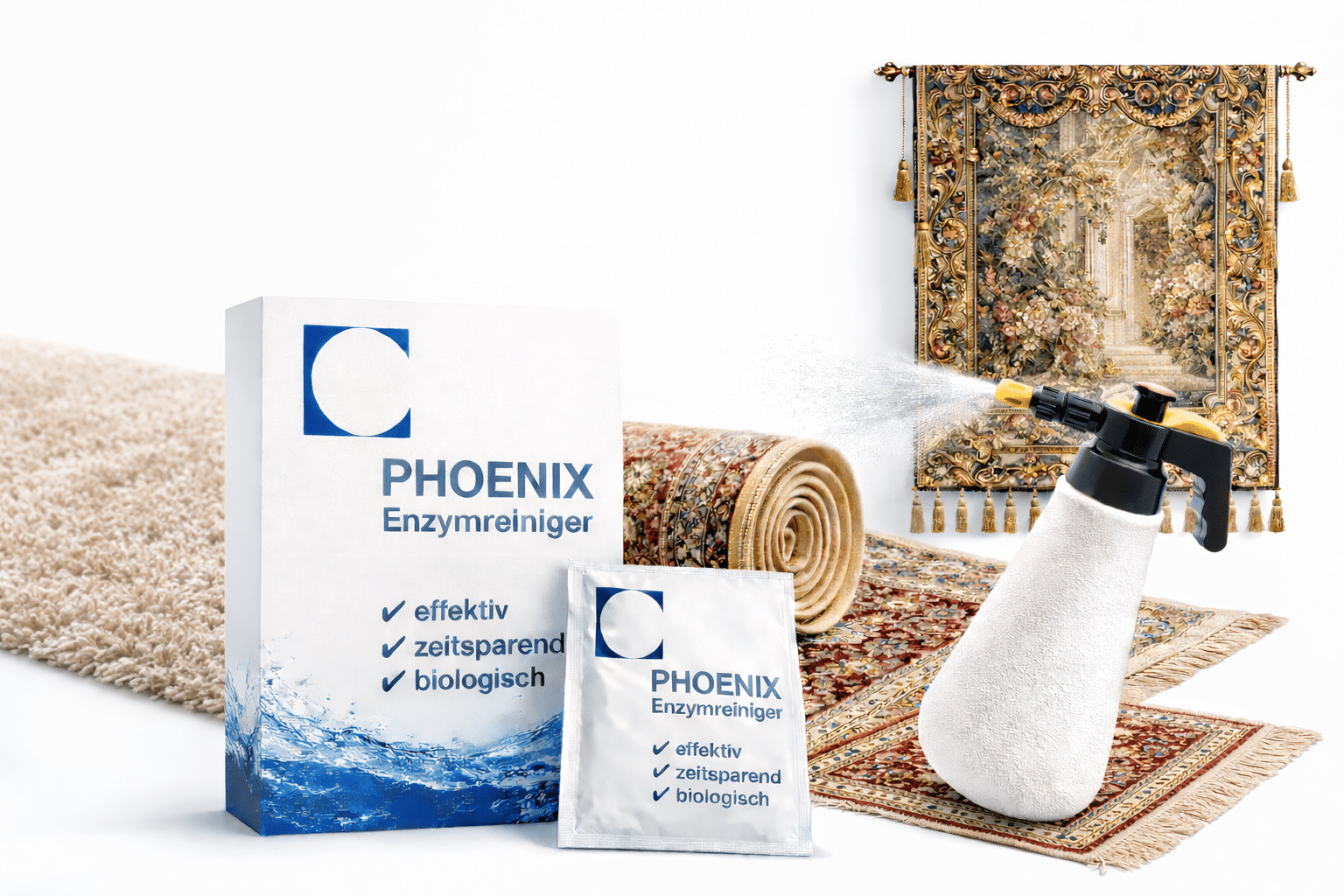
Carpet odors are tricky. You vacuum, you foam, you spray — and three days later the musty, sour, or animal smell returns. Carpet cleaning, odor removal This doesn't mean treating the surface. It means splitting the odor core within the fiber. Precisely where drugstore foam and home remedies can't reach.
In this article, we'll show you why classic cleaners are no longer suitable for use in cleaning. Carpet cleaning, odor removal fail, how to treat tapestries and Persian rugs without damaging the material, what home remedies can really do (and what they can't), and how the professional method with enzyme cleaner and wet vacuum cleaner works.
- Why normal cleaning methods fail to remove odors from carpets
- Fresh stain: Clean carpet, remove odor in 5 minutes
- Cleaning a tapestry and removing odors — without taking it down
- Gently clean Persian, Oriental and designer carpets
- Getting curtains white without chlorine
- Cleaning pet urine from carpets and removing odors — addressing the root cause
- High pile, Berber, Kelim — Material specifications
- Throw it away or save it: Cost comparison
- Home remedies for carpet cleaning and removing odors — what really helps
- Carpet cleaning and odor removal with Phoenix and wet vacuum cleaner
Briefly shown in the video
Why normal cleaning methods fail to remove odors from carpets
Traditional carpet cleaners work with surfactants. Surfactants are dirt-displacing agents: they bind grease and protein to water molecules and draw the dirt out of the fibers. This works on the surface. It doesn't work deep down. The odor-causing substances—uric acid crystals, marker proteins, mercaptans, old protein residues—are located several fiber layers deeper than the surfactant foam can reach.
Even worse: many cleaners loosen dirt, but then pull it back up as they dry. This is the infamous... Wick effect. The stain disappears briefly, the carpet smells of cleaner for two days—and then it's all back again. Baking soda, washing soda, and vinegar have the same problem: they mask the surface but leave the substrate untouched.
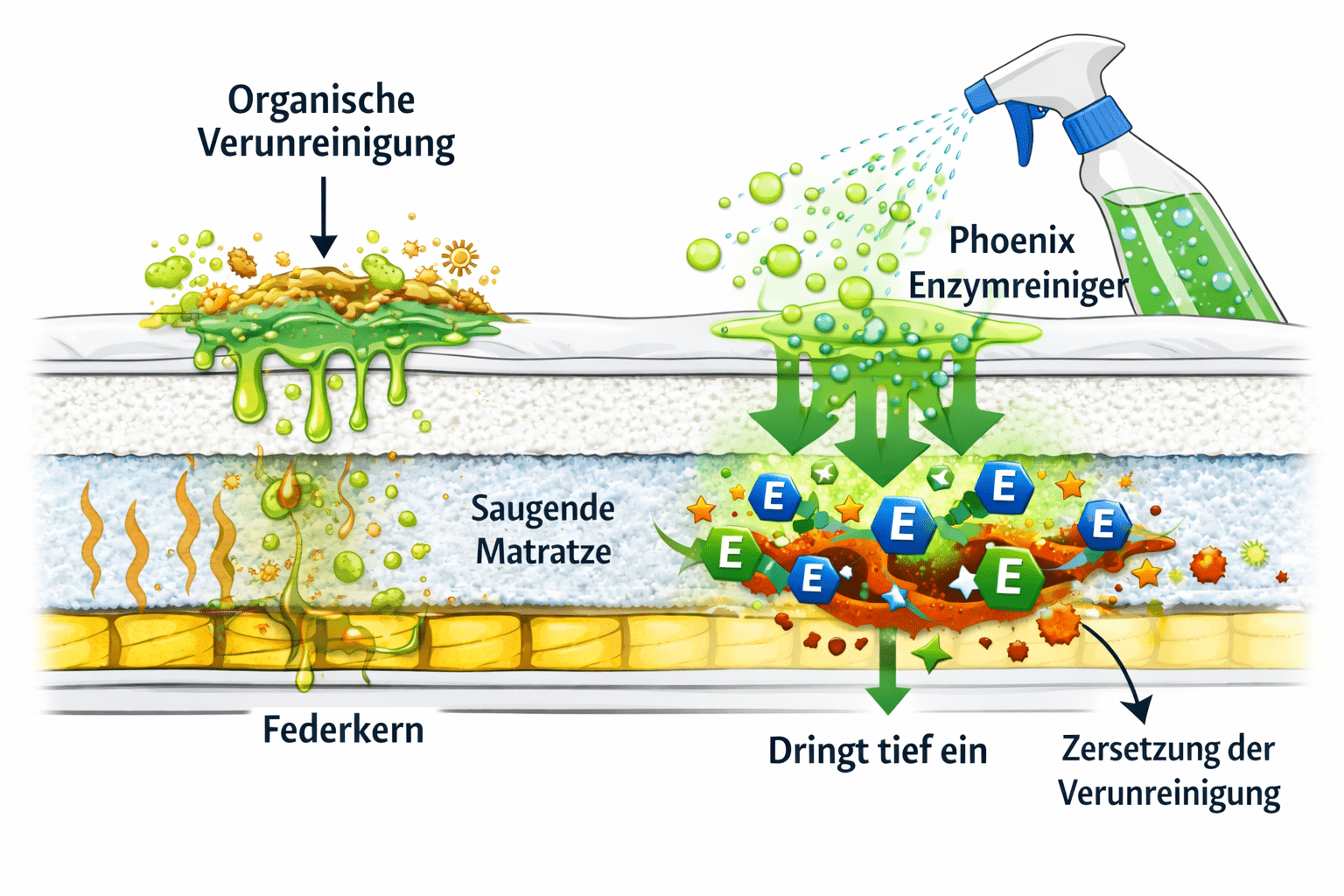
Sketch: Impurities are embedded several fiber layers deep — the wicking effect pulls them back to the top during drying.
Phoenix works differently. Enzymatic means that the organic residues from which the odor originates are broken down. Proteases break down proteins., surfactants They break down fat, amylases break down carbohydrates. What's no longer there can no longer smell. No masking. No fragrance masking.
That is precisely the reason why old carpet smells suddenly return during the heating season Or it resurfaces on the first warm spring day: dry or warm air activates hygroscopic salts and mercaptan residues, which release the odor again. Those who have only cleaned superficially are living in a core of stale odor every time they turn on the heating.
Fresh stain: Clean carpet, remove odor in 5 minutes
In the case of a recent incident—red wine, vomit, animal marking, coffee—the first few minutes are crucial. The longer the liquid has to soak into the surrounding tissue, the more difficult the treatment will be later.

Emergency spot cleaning on a fresh stain (left) and material comparison of pile heights: high pile / Berber / kilim (right). Phoenix granule concentrate with pressure sprayer: 20 g to 1 liter of lukewarm water.
- Dab immediately, do not rub. Dab from the outside in with kitchen paper or a microfiber cloth. Rubbing will push the stain deeper into the fibers.
- 20g of Phoenix granules per 1 liter of lukewarm water Mix in a pressure sprayer. For smaller areas, 5g to 250ml is sufficient.
- Spray on generously. Better too much than too little. The solution must penetrate, not just wet the surface.
- Leave on for 15–30 minutes. For deep-seated stains (old animal urine, dried red wine), cover with cling film and leave overnight.
- Rinse with clean water, then vacuum or wipe with a microfiber cloth. When working with carpeting, use a wet vacuum cleaner — this prevents water stains.
In the case of vomit or red wine: organic proteins are the perfect prey for the enzymes. Phoenix penetrates the fiber via capillary action, where mechanical brushes fail. For animal markings, be sure to examine the area with a UV lamp—markings glow under UV light, even where the naked eye cannot see them.
Cleaning a tapestry and removing odors — without taking it down
Tapestries, kilim wall hangings, and Persian wall decorations are often heavy, old, and have complex hanging systems. Taking them down, beating them out, washing them professionally, and rehanging them is almost never feasible in a private household. Most wall hangings go decades without being cleaned. They absorb odors, dust from heating systems, and nicotine.
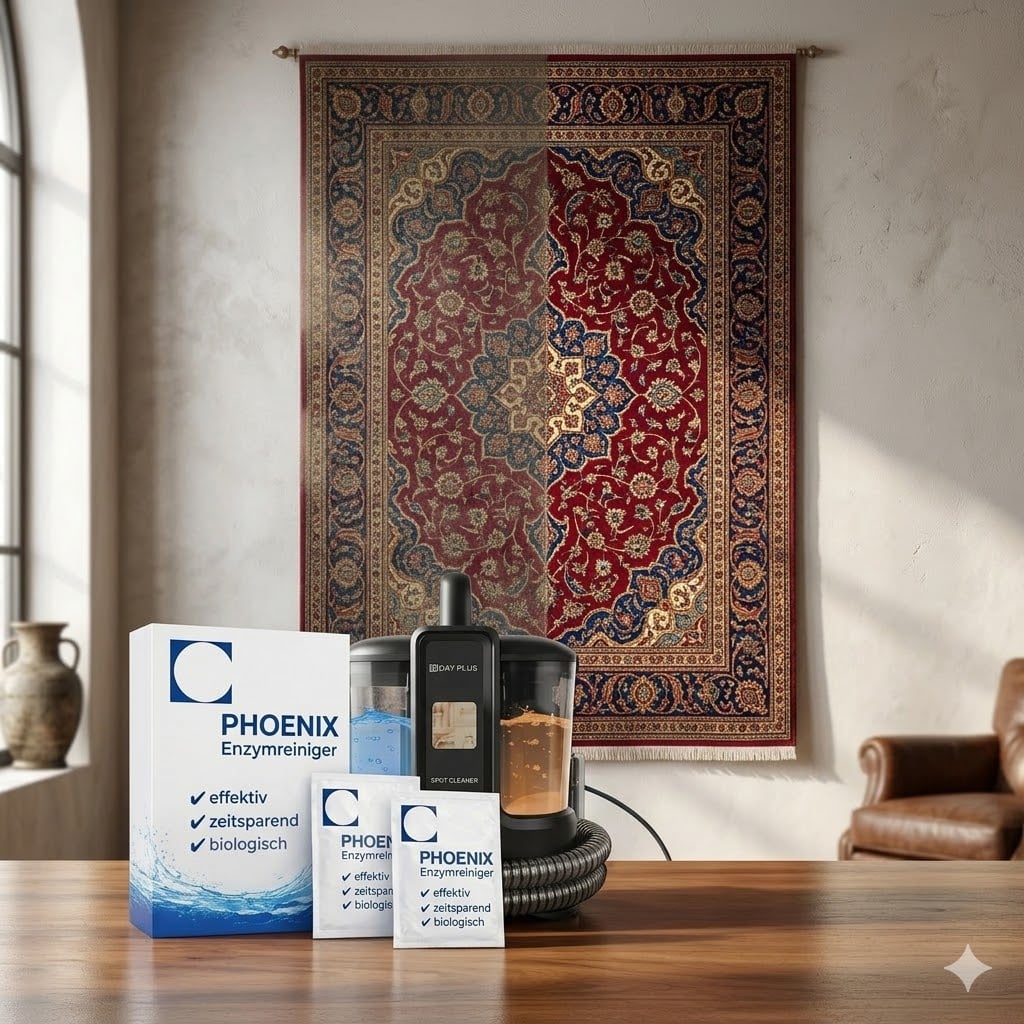
To restore a wall tapestry while it is still hanging: Apply Phoenix solution finely using a pressure sprayer, allow it to take effect, then wipe in the direction of the pile.
With Phoenix you can restore tapestries while they are still hanging:
- First, remove the coarse dust with a furniture brush or soft vacuum cleaner attachment.
- Apply Phoenix solution (10g to 500ml) finely and evenly in a pressure sprayer — no drips, no runs.
- Leave on for 20–30 minutes. For natural wool, do not leave on longer than 45 minutes — conserve lanolin.
- Wipe with a damp microfiber cloth in the direction of the pile. Do not scrub.
- Allow to dry. Repeat after 24 hours if necessary, until the smell is completely gone.
For very old tapestries with unfixed plant dyes: first test the material on a barely visible area (back or bottom corner). Phoenix is only slightly alkaline (pH 8.5–9), but old natural dyes can react sensitively to any contact with water.
This hanging application is precisely what makes Phoenix so appealing for hotels, galleries, and medical practices: wall hangings in reception areas, tapestries in conference rooms, wall hangings in lobby areas—all without dismantling or needing an external cleaning company. A 1 kg container is sufficient for 50 liters of cleaning solution; no hazardous materials shipping is required. Because the odor source is eliminated rather than masked, you clean thoroughly, not just frequently.
Gently clean Persian, Oriental and designer carpets
Before you write off a hand-knotted Persian rug worth €10,000 or send it to the dry cleaners (with an uncertain outcome): there's an intermediate option. Phoenix is material-tested for natural wool (virgin wool, yak), plant fibers (kilim), and silk. The solution is slightly alkaline (pH 8.5–9), gentle on materials, and preserves the natural lanolin content in wool. No surfactants, no bleach, no harsh solvents.
What applies to collectibles:
- A material sample is mandatory. For every high-quality item, test on a corner first—not the center. Leave on for 30 minutes, then remove with a damp cloth, let dry, and check for discoloration. The 20g version is sufficient for several test areas and costs less than any professional pre-test.
- Use sparingly. For collectors' items, 5-10g per 500ml is usually sufficient. Two light coats are better than one heavy, wet one.
- No scrubbing. Deep capillary cleaning without mechanical stress. Phoenix works chemically, not mechanically.
- Work in the direction of the pile. Never sew hand-knotted items against the pile — the knotting may loosen.
- Document valuable pieces. Take before-and-after photos of collectible carpets. Documented personal care is relevant in the event of insurance claims.
Long-tail applications: Cleaning oriental rugs without matting, removing odors from silk rugs with enzymes, deep cleaning valuable heirlooms without a professional cleaning service. For complete appraisals or restoration needs, a specialist company remains the first choice — Phoenix is the ideal solution for in-home preparatory and maintenance care.
Getting curtains white without chlorine
Heavy curtains—velvet, brocade, blackout fabrics, theater curtains—often don't fit in the washing machine. And chlorine bleach damages the fibers, makes fabrics yellowish and brittle, and ruins colored edges. Phoenix offers the alternative: a spray solution applied while hanging, enzymatic dissolution instead of chemical bleach.
Application for white curtains that have yellowed:
- Leave the curtain hanging and smooth it out.
- Spray Phoenix solution (15g per 1L) evenly on both sides using a pressure sprayer.
- Leave on for 30–60 minutes. For severe yellowing, leave on overnight.
- Rinse with clean water (pressure sprayer) and wipe with a damp microfiber cloth.
- Allow to air dry, preferably with a light draft.
For hotel and theatre curtains with bulk cleaning requirements, a 1kg container of Phoenix is sufficient for 50 liters of cleaning solution — no hazardous goods shipping, no storage problems, no curtain dismantling necessary.
Cleaning pet urine from carpets and removing odors — addressing the root cause
Pet urine is the ultimate culprit when it comes to carpet odors. Cats mark their territory with felinine proteins, which, through mercaptan sulfur compounds, produce the characteristically pungent cat urine smell. Dogs and puppies produce less odorous but protein-rich urine. Both leave uric acid crystals in the carpet fibers. These crystals are hygroscopic — they attract water whenever there is moisture and release the odor. That's precisely why the smell keeps returning whenever someone sweats, the dog comes in wet, or the heating season begins.
Home remedies are particularly ineffective here. Vinegar can damage wool and doesn't neutralize the mercaptans. Baking soda leaves residue. Odor-eliminating sprays mask the smell for a few hours, then it returns.
Phoenix enzymatically breaks down protein-containing urine residues and marker proteins. Procedure for dealing with animal urine in carpets:
- In a darkened room, use a UV lamp to search for all areas – even where you can't smell anything. Markings are often much more widespread than what is visible.
- Apply Phoenix solution (20g/1L) generously and thoroughly. Double the amount for multiple markings in the same location.
- Cover with cling film overnight. The occlusion prevents evaporation and gives the enzymes time to penetrate deep into the supporting tissue via capillary action.
- In the morning, rinse thoroughly with a wet vacuum cleaner and clean water, then vacuum completely. Allow to dry.
- For very old markings, repeat the process after 24 hours.
We offer specialized products for specific and recurring animal problems: How to remove cat urine odor and Remove animal odour (Dog, puppy, small animal). For extensive soiling across multiple rooms, the TEP variant with UVSS bundle (UV lamp + wet vacuum cleaner) remains the most effective complete solution.
High pile, Berber, Kelim — Material specifications
Not every carpet can withstand every treatment method. Phoenix itself is material-tested and gentle, but the application technique differs:
Long pile strands, plenty of space for dirt to accumulate. Spray thoroughly with a pressure sprayer, work it into the pile with your fingers, a wet vacuum is essential for rinsing.
Natural wool from Morocco. Contains lanolin — use sparingly. Do not rub, only wipe. Plant dyes can react sensitively — a material test is essential.
Flat weave, no pile. Dirt gets trapped between the warp and weft threads. Phoenix penetrates the open weave. Both sides can be treated.
Polyester, polypropylene, polyamide. Robust, all contact times OK, wet vacuum recommended. This is the easiest material to work with.
Do not leave water standing — natural fibers swell. Use sparingly, wipe quickly, and ventilate well while drying. Do not cover overnight.
Extremely delicate material. Use sparingly, short exposure time, and testing the material is absolutely essential. If in doubt, consult a conservator.
Throw it away or save it — a cost comparison
Before you throw away a carpet because of the smell, it's worth doing a little math:
Option 1 — New carpet. A high-quality wool rug costs from €800, a designer piece €2,000–€10,000, a hand-knotted Persian rug often costs five figures. Plus disposal fees. Plus delivery. Plus installation.
Option 2 — Cleaning service. On-site cleaning with professional machinery starts at €8/m², for wool and collectibles €25–50/m². Specialist restorer for Persian rugs: from €200/m², plus travel and insurance. Tapestries often require dismantling and rehanging at an additional cost.
Option 3 — Use Phoenix itself. 100g of Phoenix costs from €26.98 and is sufficient for 5 liters of cleaning solution — typically enough for 8–12 m² of carpeting or 3–5 medium-sized rugs. One application takes 30–45 minutes plus soaking time. If the first treatment is insufficient, it can be repeated at any time.
The mathematics is usually unambiguous — especially with valuable pieces, where self-restoration with a material-friendly enzyme cleaner is often the only sensible escalation step before contacting a restorer.
Home remedies for carpet cleaning and removing odors — what really helps
Dozens of home remedy tips are circulating on the internet. Here's the honest assessment:
It masks the smell briefly and neutralizes ammonia on the surface. However, it attacks natural wool, is ineffective against mercaptans (sulfur odor), and does nothing to change uric acid crystals.
It binds moisture, masks the surface. Leaves mineral residues in the fiber. Does not reach the odor core.
A common trick. Surfactants loosen dirt on the surface. Completely ineffective against protein, fat, and uric acid residues deeper down.
It absorbs fresh liquid. This makes sense as a quick fix for red wine, but it doesn't replace deep cleaning. Any residue must be completely vacuumed up.
Sodasan, Frosch, Dr. Beckmann — gentle, but with surfactant limitations. Often ineffective against deeply penetrated proteins. Suitable for spot treatment, but not for larger areas.
It breaks down organic matter — eliminating the source of the odor instead of masking it. Phoenix granules = full enzyme power, freshly mixed, gentle on materials.
Home remedies are useful immediate measures for the first few minutes after an incident—salt on red wine, dabbing with kitchen paper. For actual odor removal, there's no substitute for enzymatic cleaning.
Carpet cleaning and odor removal with Phoenix and wet vacuum cleaner
The professional method combines enzymatic pretreatment with a mechanical wet vacuuming process. This is how cleaning companies and hotel cleaning services work — and you can do the same at home:
- Prepare. Thoroughly vacuum the carpet to remove any loose dirt so the enzymes can penetrate the fibers.
- Mix. 20g of Phoenix granules per 1 liter of lukewarm water in a pressure sprayer. For heavily soiled carpets, use 30g per 1 liter.
- Apply. Spray generously, working in sections to ensure even coverage. It's better to use too much than too little – the solution needs to soak in.
- Influence. 20–30 minutes for normal soiling, up to 12 hours for old odor cores (covered with foil).
- Rinse. Use a wet vacuum and clean water: apply briefly, vacuum immediately, in strips. Prevents watermarks.
- Dry. Ventilate. Set up fans during large-scale renovations. Do not place furniture on the carpet until it is completely dry.
⏱️ Duration of action of the mixed solution
After mixing 48 hours full power, followed by a slower breakdown of the enzymes. Up to Ready for use in 20 days. So you can safely have some solution left over — it won't expire overnight.
For all Phoenix models: the UVSS bundle (UV lamp + wet vacuum) is the complete kit for pet urine remediation. For treating wall coverings, a vacuum isn't necessary—a pressure sprayer and microfiber cloth are sufficient. Those planning to remediate carpeting in multiple rooms should consider the 1kg option: 50 liters of cleaning solution, no storage issues, and not classified as hazardous material.
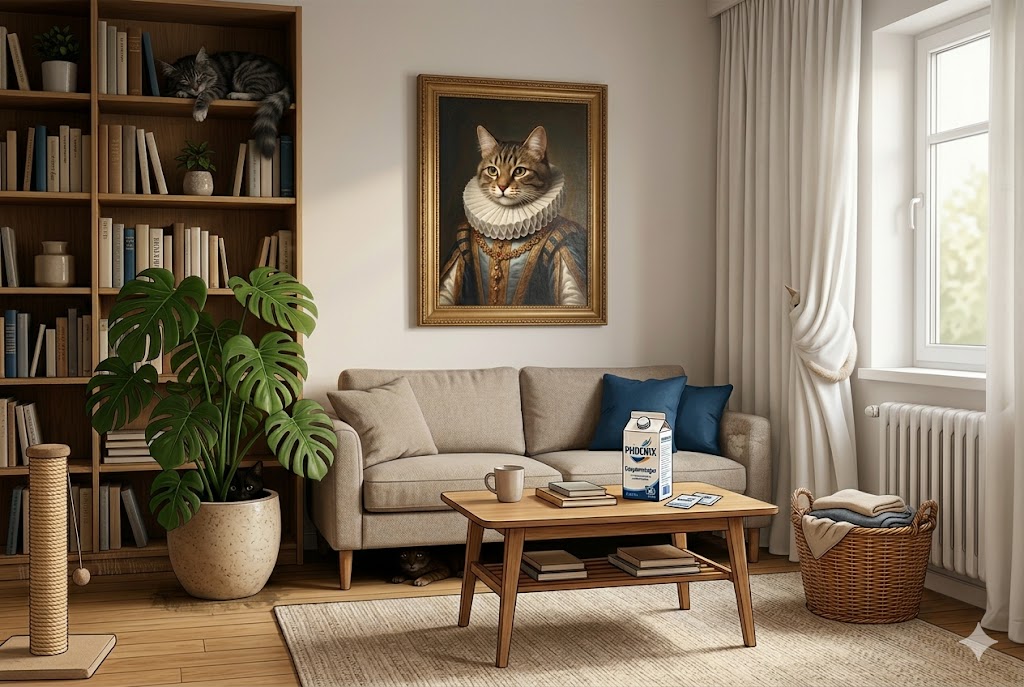
Can you find all the hidden cats? — Get a 10% discount
Join in the living room hidden picture game — whoever finds all the cats immediately receives a personal discount code.
To the search game →Ready to save your carpet?
Phoenix is available in 9 sizes from 20g (€3.50) to 1kg (€159.88), optionally with pressure sprayer, UV lamp or wet vacuum cleaner bundle.
Related Applications
What customers say about Phoenix
⚠️ Safety Notice
Keep out of reach of children and animals. Even though there is no danger, children and animals should not have direct access to the product. Phoenix is not subject to labeling requirements according to EC lists, is not classified as dangerous goods, and falls into the lowest water hazard class.