Are enzyme cleaners also suitable for the garden? 50+ uses from A to Z
Short answer: Yes. Enzyme cleaner for the garden—it works. Phoenix Enzymreiniger works outdoors just as well as indoors, anywhere water-resistant or absorbent materials need cleaning. This guide shows you 50+ uses for enzyme cleaner for the garden, with material tips and a 4-step process.
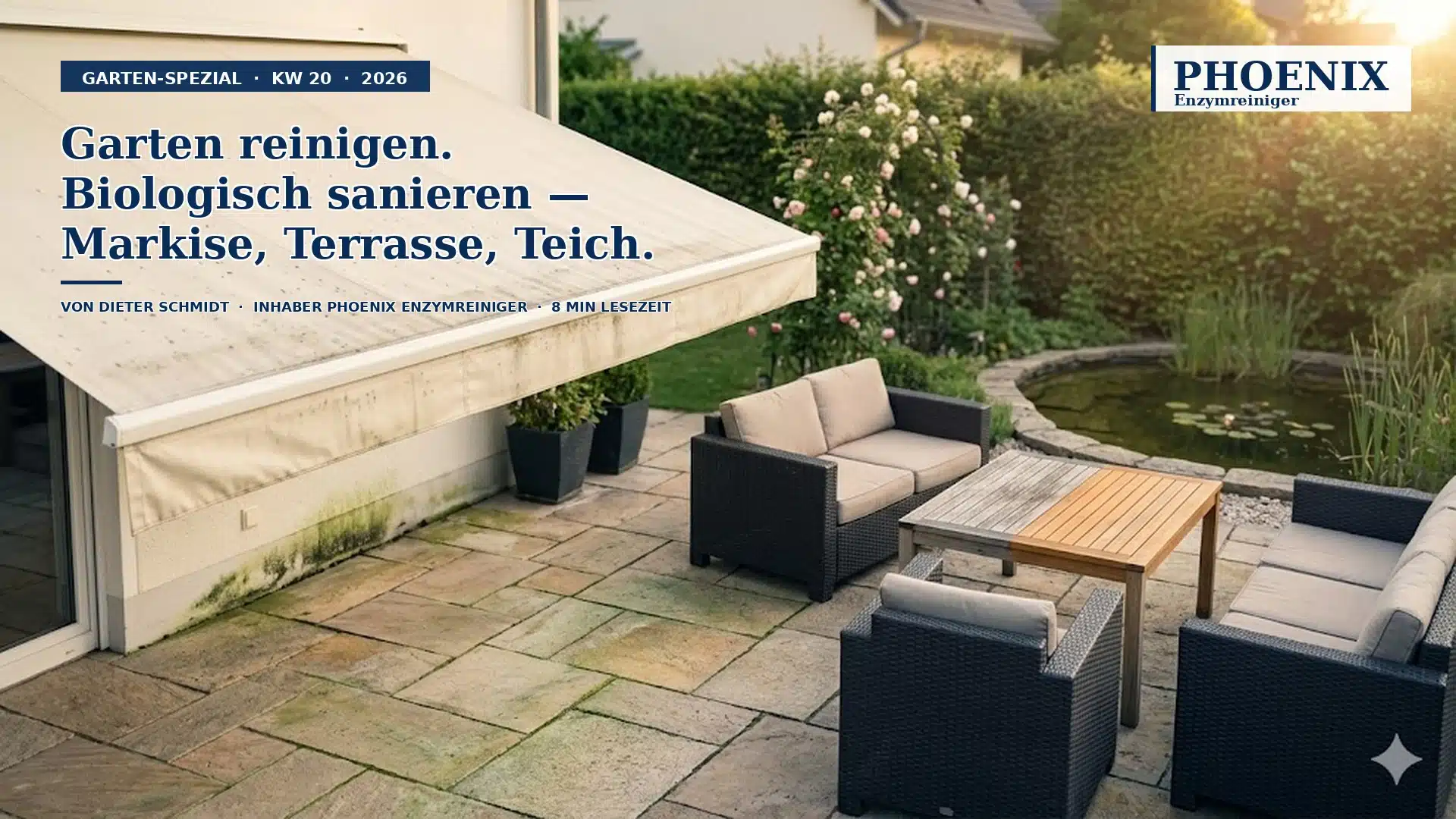
Terrace with moss growth, awning and lounge in the background — Phoenix Enzymreiniger cleans all three areas enzymatically
You want your Cleaning the garden, But chlorine cleaners attack the grout, pressure washers erode stone surfaces, and dish soap on awnings leaves sticky residue. The problem isn't the dirt itself—the problem is the method. Algae, moss, verdigris, and bird droppings are organic structures. This is precisely where the problem lies. Enzyme cleaner for the garden The key is that they can be broken down biochemically, rather than scrubbed away mechanically. Anyone wanting to clean their garden without damaging materials needs a tool that dissolves the dirt instead of grinding it off.
Phoenix Enzymreiniger is a highly concentrated granular product — the enzyme garden cleaner in its most stable form. When mixed with warm water, proteases and amylases are activated, which, together with the surfactants in Biofilm They penetrate, break down organic compounds, and thus permanently expose the substrate. This guide covers the five most important outdoor areas — sorted by search frequency and practical relevance.
Why high pressure, chlorine and home remedies are ruining your garden
The most common reflex when faced with dirty outdoor surfaces: get out the pressure washer, attach the nozzle, and go for it. The result is clean—at first glance. In reality, three things happen simultaneously:
- The stone surface is being attacked: With natural stone, concrete, and clinker bricks, the pressure tears away the top protective layer. The pores open and absorb even more dirt during the next rain.
- Algae spores are washed deeper into the material: What was previously superficially embedded, sits deeper in the joint after the high-pressure process — and reappears three weeks later from exactly that same joint.
- The grout is crumbling: High pressure destroys sand and trass joints. Result: Weeds grow where mortar used to be.
Chlorine-based cleaners bleach the coating instead of dissolving it. Visually clean, biologically unchanged—and a problem for every pond, every adjacent lawn, and every neighboring plant. Home remedies like vinegar or soft soap only work on fresh, superficial soiling. For ingrained soiling... Polysaccharide-The coating (that's what the "slime" in algae and mosses is called) does nothing to them.
Enzymatic cleavage is the only method that does not attack the substrate.. Enzymes catalyze the process—they break down organic bonds while remaining chemically unchanged themselves. What's left: loose fragments that you rinse away with clean water. No pressure, no bleaching, no grout erosion.
1. Cleaning the patio & paths — stone, concrete and clinker brick
Patios and walkways are the largest surface area in the garden—and the one that accumulates the most dirt. Pollen in spring, algae in summer, leaf tannins in autumn, moss in winter. Four seasons, four organic deposits. All four are susceptible to enzymes.
Material compatibility of substrate for substrate
- Natural stone (sandstone, slate, granite): Phoenix is pH-mild in application (8.5–9). Non-acidic, non-discoloring. Test on a sensitive area beforehand.
- Concrete blocks & paving bricks: Robust against mixing. Works very well on pollen and algae buildup.
- Wooden planks (larch, bangkirai, thermally modified ash): It works. Important: rinse thoroughly after the contact time; do not leave the wood soaked.
- WPC decking: Ideal. Phoenix loosens the stubborn algae film in the grooves that cannot be removed with a brush alone.
Enzyme cleaner for garden: Dosage & procedure for patio
Standard mixture for using the enzyme cleaner in the garden: Dissolve 20 g of Phoenix granules in approximately 250 ml of hot water, then top up to 1 liter. This mixture is sufficient to treat about 5 m² of surface area. Apply generously to the dry patio, leave to work for 30 minutes, lightly scrub with a brush, then rinse thoroughly with a garden hose. High pressure is not necessary – the organic bonds are already broken down.
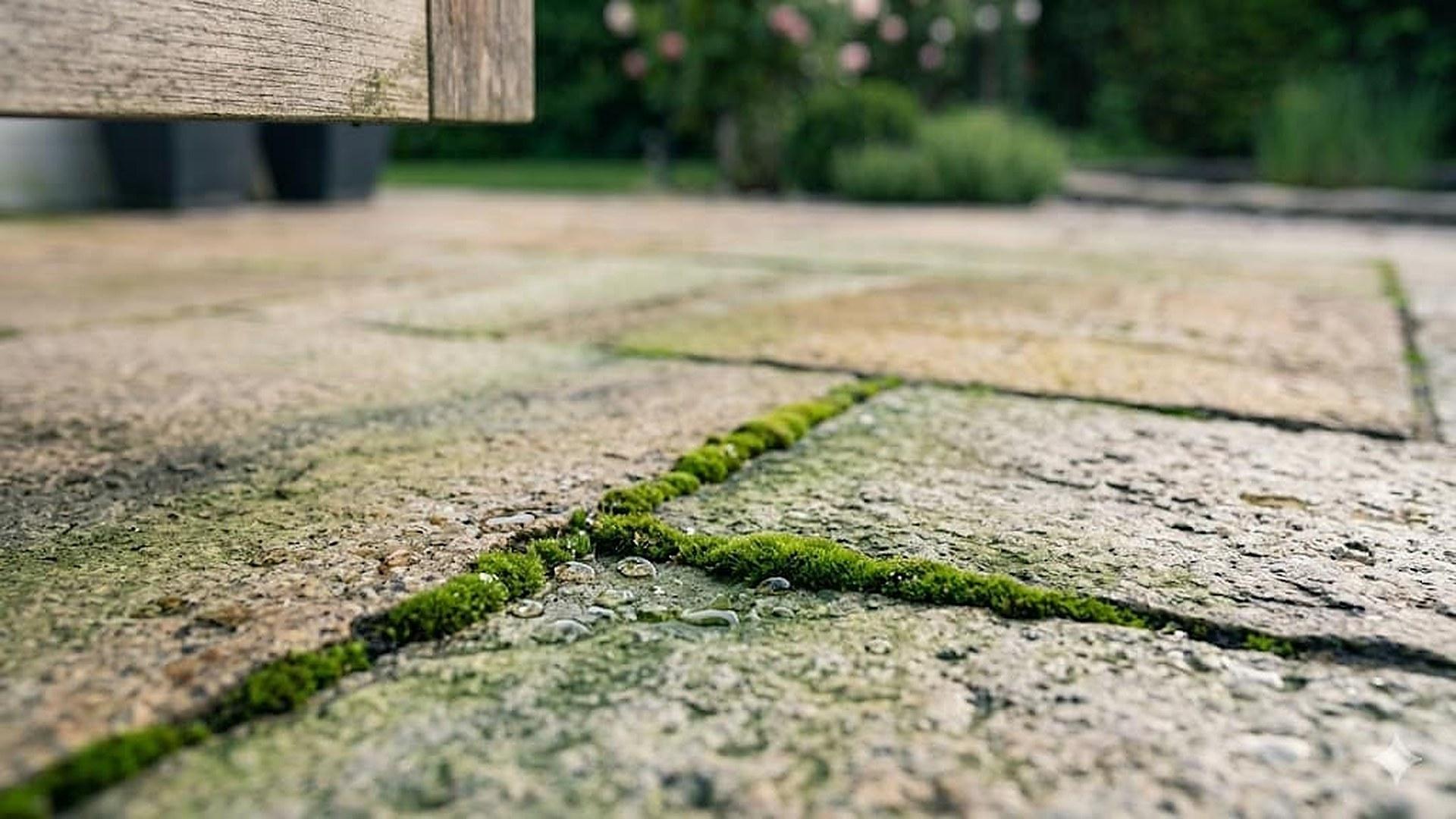
Classic damage pattern: moss in the joint, algae film on the stone — the area where Phoenix works.
2. Cleaning awnings, fabric pavilions & sun sails
Awnings are typically made of polyester-blend acrylic fabrics. They have a factory-applied waterproofing treatment—and it is precisely this treatment that is destroyed by harsh cleaners. Dish soap leaves a surfactant film that attracts water. Bleach attacks the color, causing streaks.
Phoenix Enzymreiniger works differently: The enzymes break down the organic dirt film (algae spores, pollen dust, bird droppings residue) — the waterproofing protection remains intact. Even mildew stains caused by a rolled-up, damp awning after a summer storm can be treated.
Procedure for awning (fully extended)
- Extend the awning completely on a dry, cloudy day (not in direct sunlight — the solution would dry too quickly).
- Fill a pressure spray bottle with 20 g of Phoenix mixture per 1 L.
- Start by spraying generously from the bottom, then from the top.
- Leave on for 45 minutes.
- Gently pull through with a soft brush or a flat sponge without applying pressure.
- Rinse thoroughly with a garden hose, allow the awning to dry further while retracted — but do not roll it up while damp.

Mold stain pattern after the winter break — small dark spots concentrated in the lower third.
3. Cleaning garden furniture — polyrattan, teak, metal, cushions
After a winter under a protective cover or in a carport, polyrattan furniture takes on a greenish tinge, teak appears greyish-yellow, and aluminum frames show oxidative stains. Three different materials, three different problems—but all three are organic deposits that can be enzymatically removed.
Enzyme cleaner for garden — Material-specific tips for furniture
- Polyrattan: Spray the mixture generously into the braid. Leave to work for 30 minutes. Wipe off with a damp microfiber cloth in the direction of the braiding. For heavily overgrown areas, apply a second coat.
- Teak wood / tropical wood: Phoenix removes the grey weathering layer (lignin degradation products) and restores the wood's warm tone. After cleaning, treat with teak oil – the protection lasts longer because the wood pores are no longer blocked with old dirt.
- Aluminium frame: Apply the mixture with a soft sponge, let it work for 10 minutes, then wipe off. Phoenix is not a limescale remover—you'll need a different product for limescale deposits.
- Cushions (washable cover): Pre-treat with Phoenix solution, leave to work for 20 minutes, then wash in the washing machine at 40°C.

On the left, the typical silver patina after two seasons; on the right, the freshly refreshed honey-brown tone.
4. Clean the pond, pond liner & pond edge
This is where things get tricky — and at the same time, this is where Phoenix has its greatest advantage. Surfactants in conventional cleaners are problematic for fish and microorganisms in the pond. Phoenix Enzymreiniger contains surfactants that are at least biodegradable (90%) and is classified in the lowest water hazard class. This makes it a gentle option, even near plants.
3 Use Cases Pond
- Pond liner above the water level (shoreline area): The algae film there can be treated safely. Apply the mixture to the dry area with a soft sponge. Leave to work for 30 minutes. Rinse thoroughly with water using a watering can — if possible, do not let the rinse water run into the pond, but rather direct it into the lawn or flowerbed.
- Stones, stream bowls, fountain basins: Empty the basin before cleaning, treat, let it soak in, rinse, and refill with fresh water.
- Pond edging made of natural stone/wood: Treat like a terrace, but when rinsing, orient yourself towards the flower bed instead of the pond.
Important: Phoenix should not be added to a filled fish pond. Application should always be to the drained pond, to the edge of the liner outside the water level, or to stones/wood that you can remove. This is not a statement about toxicity—it simply means that the micro-biotope of your pond should not be disturbed by large amounts of external enzyme activity.

Algae growth on the kerbstones just above the waterline — the area where Phoenix is working.
⚠ Important application note
Phoenix Enzymreiniger is not for use directly in pond water determined. Cleaning takes place exclusively on dry pond edge and on stones outside the water surface. Never add granules or solution to the pond water — this can disrupt the biological balance and harm fish.
5. Clean the facade, exterior walls & base area
The greenish-black streaks on weather-exposed sides of buildings that you see every spring are algae growths—and they not only make the facade unsightly, but also damage the plaster surface in the long run. Algae trap moisture against the wall. Damp walls = plaster cracks = entry point for frost damage.
Phoenix Enzymreiniger is used in thin-coat plaster applications (mineral plaster, silicate plaster, silicone resin plaster). The standard mixing ratio of 20 g to 1 L remains the same – even for facades. There is no increased dosage. What you need is more time: 60 minutes of contact time, then rinse with a garden hose.
Larger areas — the pressure sprayer solution
For facades of approximately 15 m² or more, a 1L pressure sprayer is worthwhile. You'll get an even application without the mixture running down unnecessarily. Three refills are sufficient for a garage wall. For multi-story buildings, use a telescopic pole – spray from bottom to top (dripping water won't draw dirt into already cleaned areas).
Solar and photovoltaic modules on the roof are a special case of facade cleaning and a classic application for enzyme cleaners for gardens: same solution, same contact time, but lower pressures for rinsing due to the seals. Phoenix is safe for glass surfaces and leaves no streaks—provided you rinse thoroughly.

Classic splash line at the base — the splash zone with permanent moisture.

Using enzyme cleaner in the garden: Instructions in 4 steps
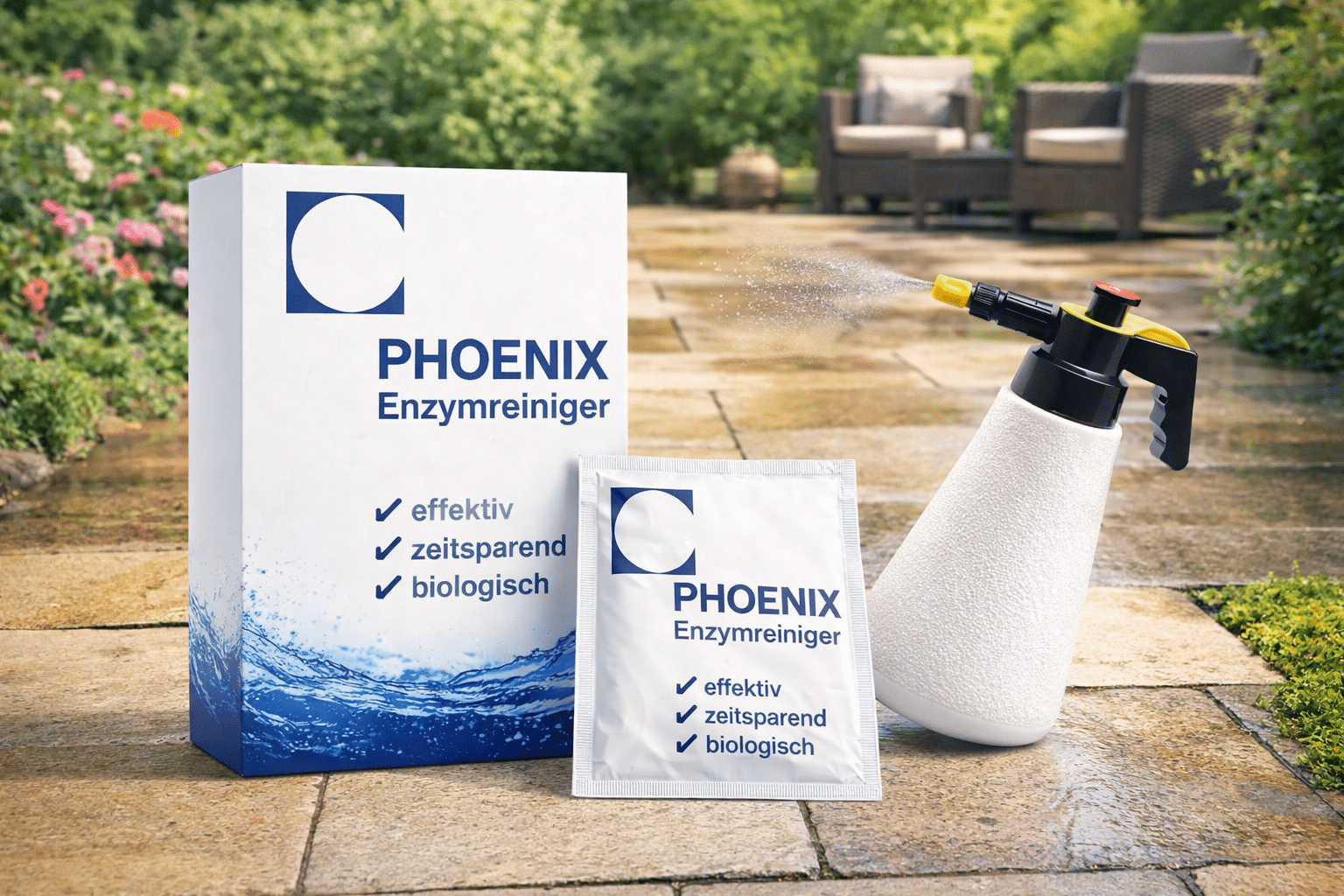
Phoenix granule concentrate plus pressure sprayer — the complete equipment for all applications.
Whether it's a patio, awning, or facade — the method remains the same. Only the contact time varies depending on the degree of soiling.
Step 1 · Mixing
Dissolve 20 g of Phoenix granules in approximately 250 ml of hot water, then top up to 1 liter. Stir briefly. The granules will dissolve completely. Full potency is maintained for 48 hours after mixing, followed by a slow degradation of the enzymes. Ready for use for up to 20 days.
Step 2 · Apply
Apply the mixture evenly to the dry surface to be cleaned using a pressure sprayer (1 L). Be generous, don't skimp – the surface must be thoroughly wet.
Step 3 · Let it take effect
30 minutes for normal soiling. 45–60 minutes for ingrained algae or moss growth. Do not allow to dry – re-spray if necessary in direct sunlight.
Step 4 · Rinse
Rinse thoroughly with a garden hose. No high pressure is needed – the organic bonds are already broken down. If necessary, lightly scrub heavily soiled areas with a soft brush.
Bonus promotion
Find 5 hidden cats — get 10% off
Our hidden object game is hidden in our tutorial article "Removing Cat Urine Smell". Anyone who finds all 5 cats automatically unlocks a 10% voucher for Phoenix Enzymreiniger.
To the articleEnzyme cleaner for the garden — universally applicable (A to Z)
Phoenix Enzymreiniger is a universal all-rounder for water-resistant and absorbent materials — cleaning, odor removal, grease removal, deep cleaning action. 50+ applications in the garden and outdoor areas, listed alphabetically:
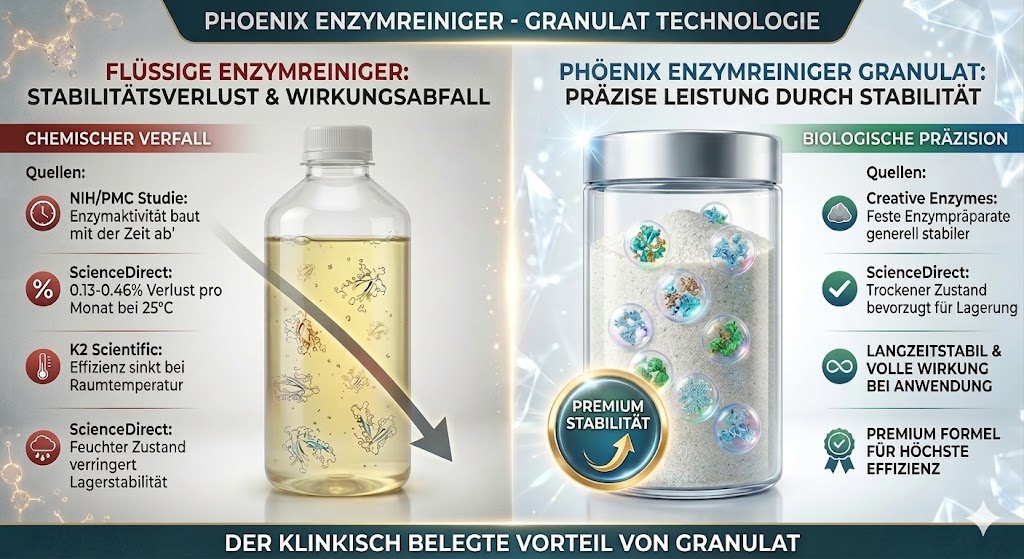
Granules instead of liquid — the crucial difference
Liquid enzyme cleaners for garden use have a problem: they lose activity even in the bottle. What you buy after 6 months of storage is no longer what was mixed in the laboratory.
Phoenix Enzymreiniger comes as highly concentrated granules. The enzymes are protected in dry form—until you activate them with warm water. Freshly mixed, they immediately unleash their full hydrolysis power. Full power for 48 hours after mixing, followed by a slow degradation of the enzymes. Ready for use for up to 20 days.
Surfactants biodegradable to at least 90%, lowest water hazard class, label-free. Made in Germany. Suitable for cleaning in the food industry (expert opinion by Dr. Mang).
⚠ Safety Notice
Keep out of reach of children and animals. Even if there is no danger, children and animals should not have direct access to the product.
Frequently asked questions about enzyme cleaners for the garden
Does Phoenix also work in winter?
Enzymes work at ambient temperatures of around 8°C. In freezing temperatures, the reaction is too slow—wait for a mild day. The prepared enzyme cleaner for the garden remains ready for use for up to 20 days, so you can mix it in advance.
Does Phoenix harm the plants around the terrace?
No. The mixture is pH-mild (8.5–9), the surfactants are at least 90% biodegradable, and it is classified in the lowest water hazard class (slightly hazardous to water). The rinse water is significantly gentler on materials than chlorine- or acid-based cleaners.
How much area can I cover with one can?
A 1000g can of Phoenix granules makes 50 liters of mixture. With normal soiling, this covers 250 m² of outdoor surface – that's an average terraced house patio plus walkway plus garage wall.
Can I use Phoenix in a pressure washer?
Yes, in devices with detergent suction. Important: Dissolve Phoenix in warm water beforehand (do not pour directly into the canister), set the nozzle to a gentle spray – high pressure is not necessary after the enzyme contact time.
Does Phoenix be effective against weeds in joints?
No. Phoenix is a cleaner for organic deposits (algae, moss, dirt), not a herbicide. For excessive growth in paving joints, mechanical removal or a joint scraper is the right solution.
Is Phoenix suitable for my wooden fence?
Yes, for both varnished and untreated fences. After cleaning, allow the wood to dry completely before applying a new coat of varnish. If the wood is untreated, seal it with wood preservative afterwards if necessary.
What about bird droppings on the car parked in the driveway?
Bird droppings on painted surfaces are not Phoenix's primary application – there's a separate application cluster for automotive paint. However, Phoenix is the right choice for driveway paving or carport floors: an organic coating that decomposes enzymatically in 30 minutes.
Does Phoenix work on Bangkirai and Cumaru wood terraces?
Yes, very good indeed. Bangkirai, Cumaru, and other tropical hardwoods are absorbent—and that's precisely where Phoenix's deep-cleaning action comes into play. The enzymes penetrate the wood pores and dissolve organic deposits that can't be removed with a brush alone. After cleaning, allow the wood to dry completely, then optionally treat it with care oil.
Can I use this to clean my conservatory — even inside?
Yes, conservatories are a classic application for Phoenix. It leaves glass surfaces streak-free, protects aluminum and wood profiles, and deeply cleans floor tiles. If there's a musty smell after a damp winter, Phoenix simultaneously breaks down the odor molecules. Don't forget to ventilate after use.
What can Phoenix do in the outdoor kitchen and at the grill?
Phoenix removes grease deposits from exterior surfaces — grill housings, stainless steel work surfaces, paving stones in front of the smoker. The surfactants it contains dissolve the grease. Do not apply to interior surfaces with direct food contact (grates, cooking chamber); for these, the Dr. Mang expert opinion regarding suitability for the food industry applies — nevertheless, rinse thoroughly after use.
Can this also be done with outdoor bins and composters?
Yes. Spray the inside of the bin with the Phoenix mixture, let it sit for 20 minutes, then rinse with a garden hose – the odor and biofilm will disappear. For the composter, only clean the outer surfaces, not the inside (this would disturb the microorganisms you need for composting).
Are glass roofs, corrugated iron sheets and zinc gutters not a problem?
On the contrary — all ideal applications for Phoenix. Glass roofs are streak-free, and corrugated metal and zinc roofs are treated gently (no acid corrosion like with special cleaners). For safety reasons, use a telescopic pole on roofs; do not climb onto the roof. Phoenix does not attack coatings or galvanizing.
Phoenix Enzymreiniger Garden — directly in the shop
Granule containers from 20 g (test pack) to 1000 g (large-scale use). Plus suitable accessories: pressure spray bottle, UV lamp for bird droppings analysis, wet vacuum cleaner.
About the productNote: PHOENIX Enzymreiniger is a branded product of Schmidt Consulting & Sales Services. In accordance with §19 of the German VAT Act (small business regulation), no VAT is charged.