Stain removal guide · Week 36 · 2026
Home remedies for grease stains: What really helps and what makes the stain worse
Gall soap, dish soap, baking soda, iron. We looked at which home remedies for grease stains live up to their promises, which ones even set the stain, and why it's so often still visible after washing.
By Dieter Schmidt · Owner Phoenix Enzymreiniger · 5 min read
You treated the stain, washed the shirt, and while it was drying, that dull shadow reappeared. Almost all home remedies for grease stains fail at the same point, and it's not your fault. It's because a kitchen stain almost never consists solely of grease.
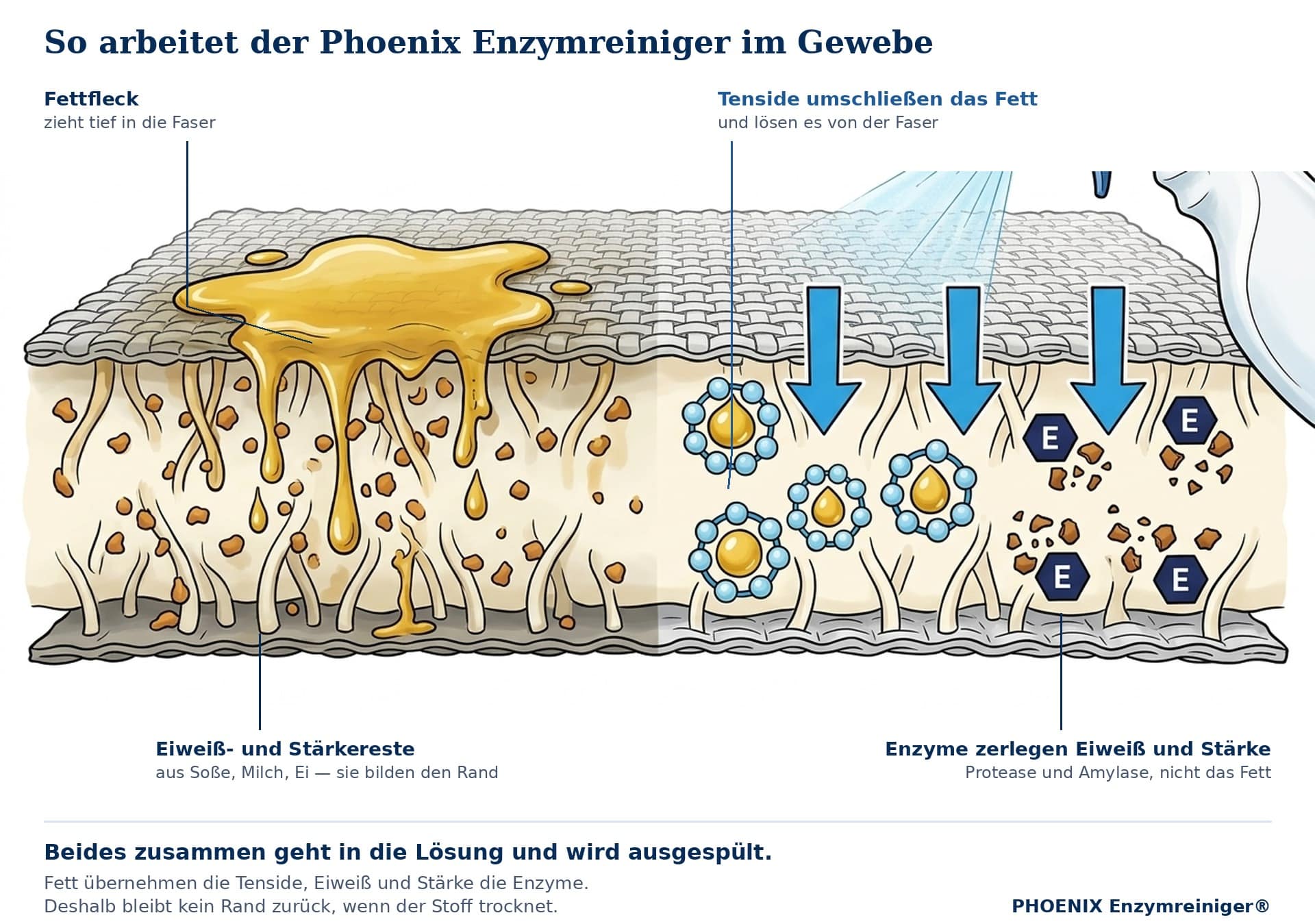
Gravy, salad dressing, a slice of pizza, butter with herbs: these contain fat, but also protein from meat, milk, or eggs, and starch from thickening agents. The usual home remedies for grease stains only attack the fat. The rest remains and becomes visible once the fabric dries.
Briefly shown in the video
The short answer to home remedies for grease stains
They work on fat, but not on everything else. Dish soap and gall soap reliably dissolve grease because they surfactants They contain what they can't remove. What they can't remove are the protein and starch residues next to them. These dry solid and form the edge. That's why the stain is often "almost" gone afterwards.
Which home remedies for grease stains actually work?
Six remedies are listed in almost every instruction manual. Here's what they can do and where their limitations lie.
| Medium | What it does | Border |
|---|---|---|
| Dish soap | Surfactants dissolve the grease from the fibers. Often sufficient for fresh stains. | Protein and starch remain |
| Gall soap | Contains ox bile, works more powerfully than dish soap, good for older stains. | can attack silk and wool |
| Baking powder, baking soda | It absorbs fresh fat as long as it is liquid. Useful as a first aid measure. | Ineffective when dried out |
| blotting paper | It removes surface fat before it penetrates deeper. Always the first thing to do. | It doesn't draw anything from the fiber |
| iron | Melt the grease so that blotting paper can absorb it. | 🔴 risky, see below |
| cornstarch | Like baking powder, it absorbs fresh fat. | only on fresh stains |
Be careful when using the iron. The trick with blotting paper and heat is in almost every other instruction manual and is the only one of the home remedies for grease stains that can actually do more harm than good. It works with pure oil, but protein coagulates when heated and hardens. With gravy, this will make the very part that later forms the rim impossible to remove. Only use it on oil without any food residue.
Why don't grease stains come out after washing?
This is the most frequently asked question on the subject, and it has a clear answer. Washing machines work with heat. Heat dissolves grease, but it causes proteins to coagulate. Therefore, the part of the stain that comes from milk, egg, or meat juice is not removed by washing, but rather set.
Therefore, the same order applies to home remedies for grease stains as to any other remedy: Treat first, then wash. If a stain has already been washed through the machine and is still visible afterwards, a second wash cycle usually won't help.
What to do about old, dried-in stains?
Most people make the same mistake here: rubbing. This spreads the grease across the surface and works it deeper into the fibers. A small stain becomes a large shadow.
The opposite is true. Soak the area thoroughly, let it sit, repeat. When it comes to grease, time almost always replaces force.
What makes Phoenix different from home remedies for grease stains?
We manufacture enzyme cleaners, so our opinion is not neutral. Nevertheless, the point remains objective: Our granules contain non-ionic surfactants, which dissolve the grease, and in addition Protease and amylase, These enzymes break down the protein and starch residues. The fat itself is not enzymatically broken down; the necessary enzyme is lacking. It's like having two tools for two problems in the same area.
The special case of the kitchen: tiles and extractor hood
Not every grease problem results in a stain on fabric. Over time, a film builds up above the stove, attracting dust and becoming sticky. This occurs on tiles, cabinet fronts, and especially in the metal filter of the range hood.
Home remedies for grease stains work much better on this surface than on fabric because it's smooth and nothing can soak into the fibers. If you... Clean the extractor hood filter If you want, remove the filter and place it in hot water with dish soap. Let it soak, brush it off, and dry it. For heavily encrusted filters, a second cleaning cycle is more effective than vigorous scrubbing.
Material note: Leather is degreased by any cleaning with grease, regardless of the product used. After drying, leather conditioner should be applied; otherwise, it will become brittle. Test silk and wool on an inconspicuous area first.
In what order do you proceed?
- Lose weight immediately. Place a paper towel on top and press down, do not wipe. What's on top doesn't need to be removed from the fibers.
- Do not rub. Rubbing enlarges the stain and works it in deeper.
- Treat before washing. The protein content is fixed after the washing process.
- Soak thoroughly instead of dabbing. The product needs to go where the fat is located.
- Repeat for old stains. Letting it soak in twice is better than scrubbing once.
If home remedies don't remove grease stains: The Grease stain remover from Phoenix Available in containers from 20 g to 1 kg. 20 g makes one liter of solution. Full potency for 48 hours after mixing, followed by a slow degradation of the enzymes. Ready for use for up to 20 days.
Safety notice: Keep out of reach of children and animals. Even if there is no danger, children and animals should not have direct access to the product.
Frequently asked questions about home remedies for grease stains
What is the best home remedy for removing grease stains?
For fresh stains, use dish soap; for older stains, use bile soap. Both dissolve grease well. The ring that sometimes remains afterwards is not from grease, but from protein and starch.
Does baking soda help against grease stains?
Only as long as the stain is fresh and still wet. Then the powder absorbs the grease. Nothing happens on a dried stain.
Can I remove grease stains from leather?
Yes, on smooth leather, using minimal moisture and without rubbing. Suede and nubuck leather require professional cleaning. Apply leather conditioner after each treatment.
What to do if the stain is still there after washing?
Do not wash again. Treat first, let it soak in, then wash. For stains that have already been through the washing machine twice, multiple treatments are usually the only solution.
Can grease be removed from a tablecloth?
Yes, cotton and linen are suitable. It's important that the blanket hasn't been washed in hot water beforehand.
The data for further reading
| Active ingredients | Under 5 % non-ionic surfactants, protease, amylase |
| reach | 20 g yields 1 liter of solution |
| PH value | 8.5 to 9.0, gentle on materials |
| surfactants | at least 90% biodegradable % |
| classification | Lowest water hazard class, not classified as dangerous goods, phosphate-free, chlorine-free |
| Origin | Made in Germany, expert opinion by Dr. Mang (Chemical Laboratory Frankfurt) |