
Description
Removing mold without chlorine — biocide-free and gentle on materials
For walls and ceilings, window frames and window rubber, silicone joints, basements — and for mildew stains on clothing, mattresses and tents.
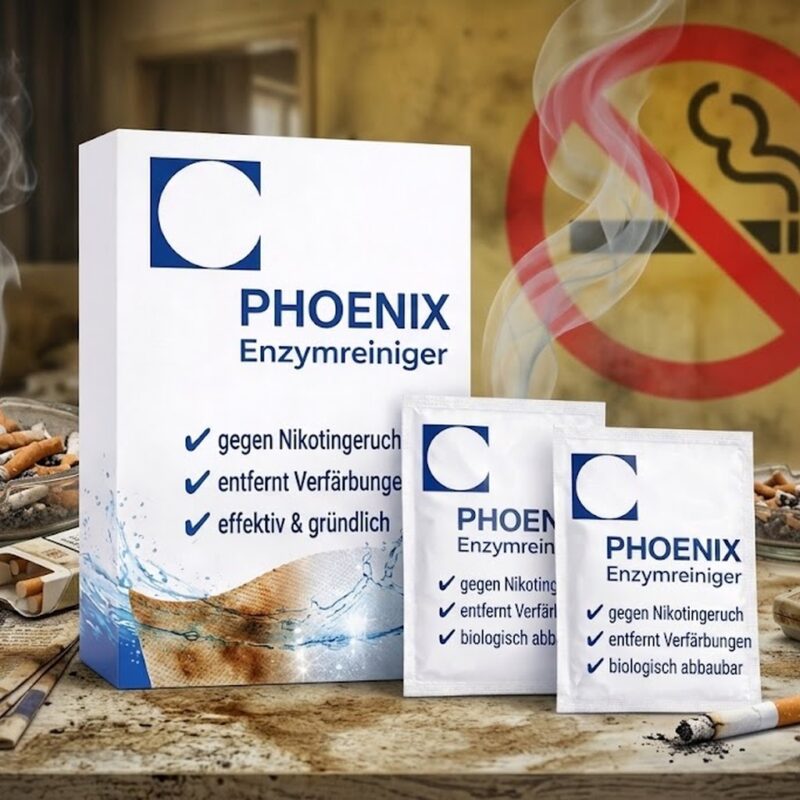
Phoenix Enzymreiniger — Granules, freshly mixed, Made in Germany.
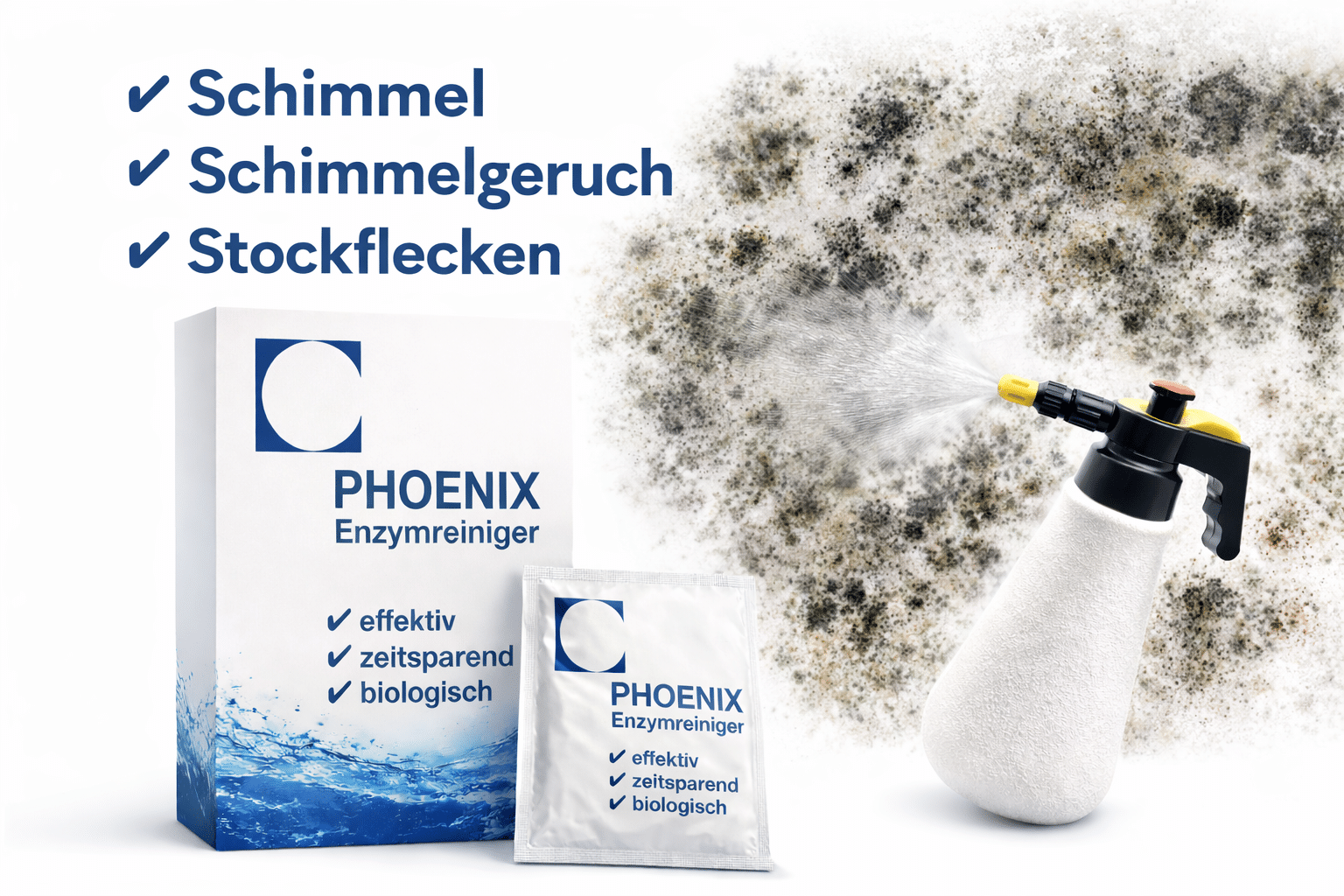
How do you remove mold without chlorine? Phoenix Enzymreiniger enzymatically dissolves organic mold residues from the material instead of bleaching them. 20 g of granules make 1 liter of solution. Spray the surface until saturated, leave to act for 30 to 60 minutes, wipe off while damp, and dry completely. This product is not a biocide according to EU Regulation 528/2012 and is therefore not subject to the self-service ban that has applied to biocidal mold removers since 2025. It eliminates existing residues and the musty odor—the underlying structural cause must be addressed separately.
You want Remove mold, Without bringing a chlorine bomb into your home? Phoenix works enzymatically: Amylase and protease dissolve the organic mold residues and their breeding ground directly within the material and break down the odor molecules that cause the musty smell. Important to note: Phoenix doesn't kill anything and is Not a biocide according to EU Regulation 528/2012 — It removes organic matter purely enzymatically. This allows you to remove mold from walls and ceilings, window frames and window seals, eliminate musty basement smells after water damage, and dissolve mildew stains on clothing, tents, and mattresses — biocide-free, chlorine-free, and bleach-free.
Phoenix Enzymreiniger — Short & sweet
- Biocide-free deep penetration action: Amylase and protease break down organic mold residues and odor molecules into odorless, water-soluble fragments.
- Not a biocide according to EU Regulation 528/2012: No licensing requirement, no self-service ban, freely tradable
- Gentle on materials: Plaster, concrete, OSB wood, silicone, wallpaper, plastic window frames, textiles and tent fabric can tolerate the gentle application (pH 8.5–9)
- Granule concentrate: Not classified as hazardous material, compact storage, full enzyme activity when freshly mixed
- Made in Germany: Lowest water hazard class, surfactants at least 90% biodegradable (%)
Why does removing mold with enzymes work?
From a chemical perspective, mold residues are complex organic structures — Proteins, lipids, polysaccharides. Mildew stains on textiles consist of precisely these building blocks. The molecules that carry the musty smell are small volatile compounds such as... Geosmin — also organic.
Traditional mold removers containing chlorine visually bleach the surface. The organic matter underneath remains in the material, and the musty odor returns. Furthermore, since 2025, biocidal mold removers have been subject to a ban on self-service sales. EU Regulation 528/2012 — you can no longer buy them freely off the shelf at the hardware store.
Phoenix works differently. Specific Enzymes — Amylase and protease — They break down the organic mold residues and odor molecules into odorless, water-soluble fragments: amino acids, free sugar molecules. The substrate disappears, and the odor goes with it.
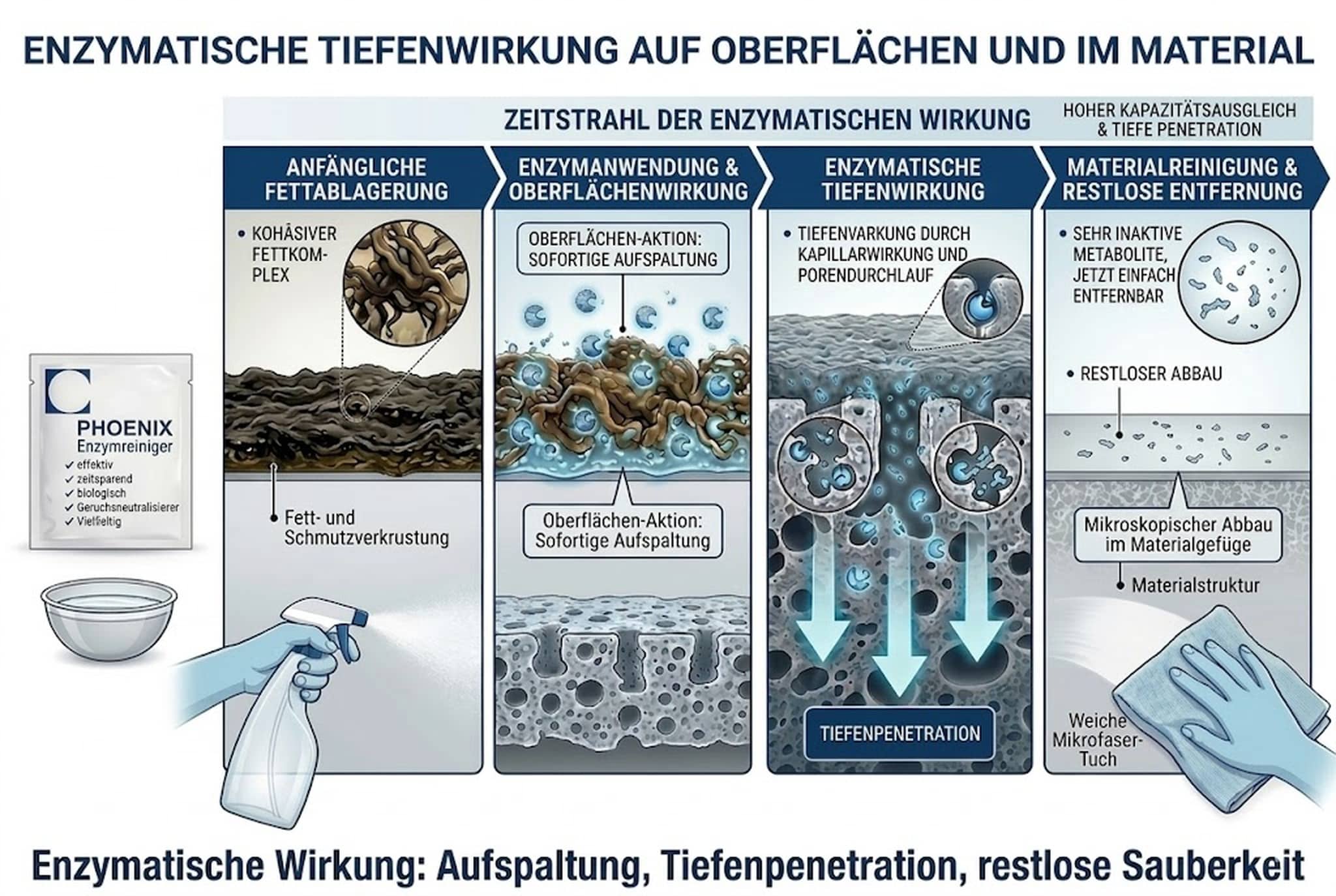
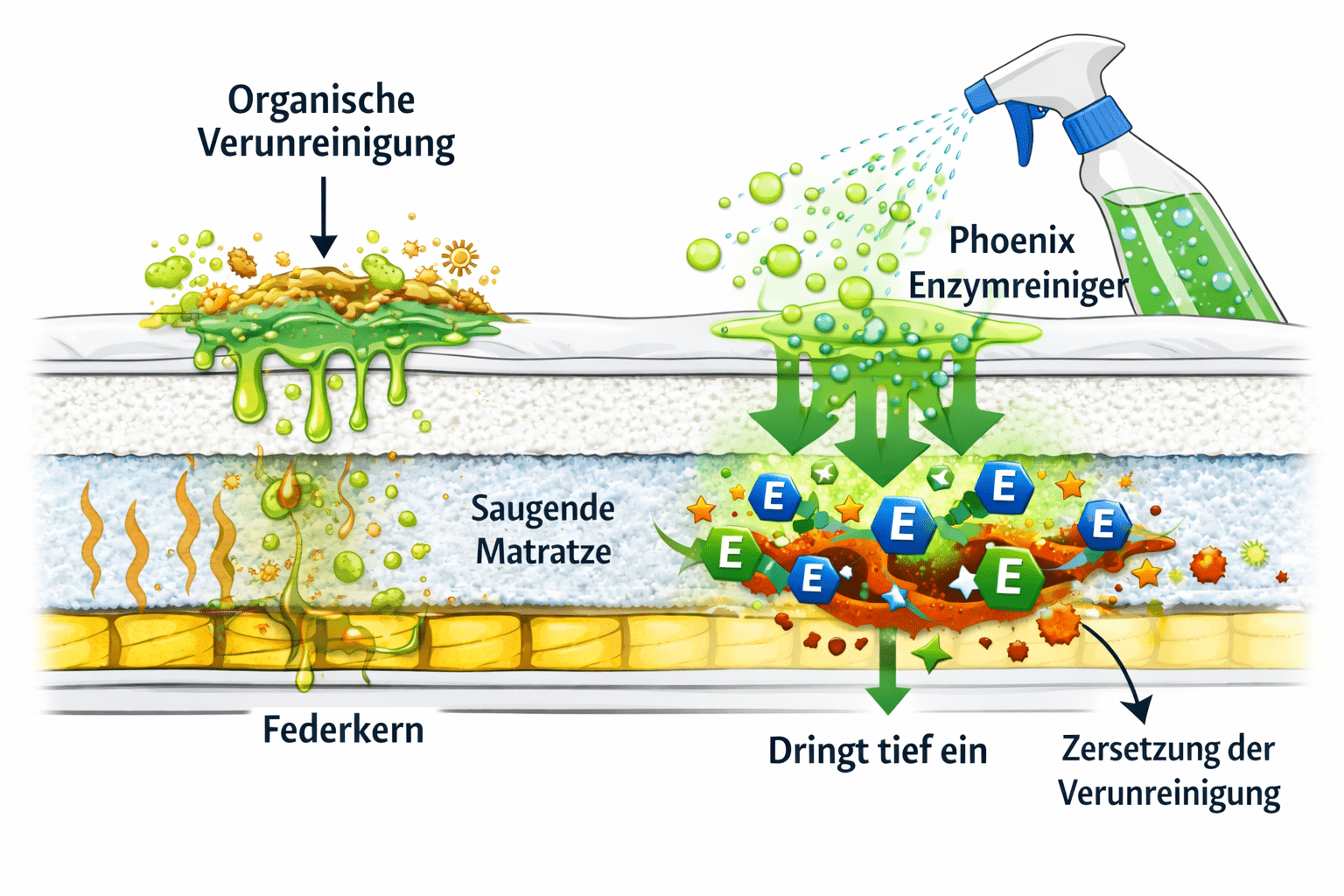
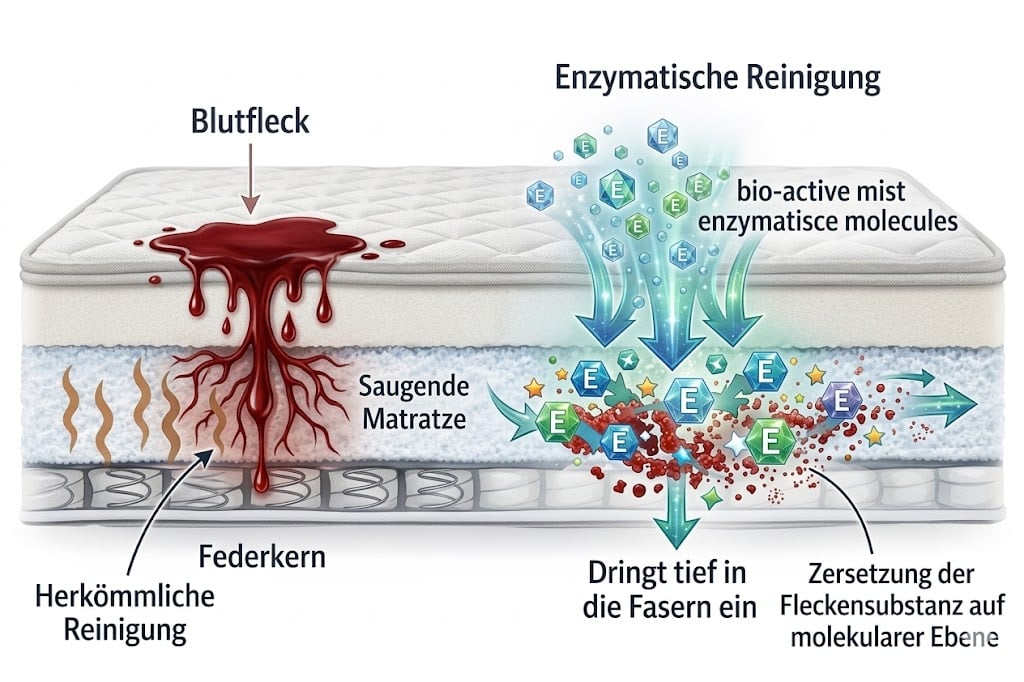
Sketch: Mold residues are embedded several layers deep in the material — Phoenix enzymes penetrate and break down the pathogens where they are located.
Does the color of the mold matter?
Not for cleaning. The color indicates the type of stain and the surface it's on, but not how easily the residue can be removed. The crucial factor is the material it's on—and you'll find the material table below.
A guide to identifying black, green, yellow, white, brown and blue coatings is available in the Guide, Part 2.
What materials can Phoenix use?
The solution is slightly alkaline (pH 8.5–9) and does not bleach. The absorbency of the substrate is crucial – this determines the required contact time.
| Area | Proceed | What to look out for |
|---|---|---|
| Plaster, concrete, masonry | Spray until saturated, leave on for 1 to 4 hours. | It's highly absorbent, a second coat is worthwhile. Lime plaster neutralizes vinegar — enzymes do not. |
| Wallpaper, woodchip wallpaper | Spray with a damp cloth, leave on for 30 to 60 minutes, then remove in one direction. | Do not soak, otherwise the paste will come loose. |
| Plastic window frames, sealing rubber | Work into the fold with a brush, leave for 30 minutes, then remove. | The solution is easily tolerated. Wipe the fold dry afterwards. |
| Silicone, tile grout | Work in, leave on for 30 minutes | Cement joints are completely cleaned. Pigments that have migrated into silicone remain visible — Phoenix does not bleach. |
| Wood, OSB, roof truss | Apply a thin layer, leave on briefly, remove with a damp cloth | Water causes wood to swell. Use sparingly. |
| Textile, polyester, tent fabric | Spray on, leave for 1 to 2 hours, then wash in cold water or at 30°C. | Test wool and silk on a hidden area beforehand. |
| Mattress, upholstery | Damp, not wet, 30 to 60 minutes, vacuum up | Allow to dry completely, otherwise the smell will return. |
| Leather | Wipe clean only, do not soak. | The cleaner degreases. Then re-grease. |
Can I also use this to remove mildew stains from fabric?
Yes. Mildew stains are the same organic substance, just on fabric instead of plaster. Apply the solution to the stains, let it soak in for 1 to 2 hours, then wash in cold water or at 30°C. For multiple items, add an additional 20g of granules directly to the drum.
Material for material — cotton, wool, mattress, tent, leather — is listed on its own page. Removing mildew stains.
✨
✨
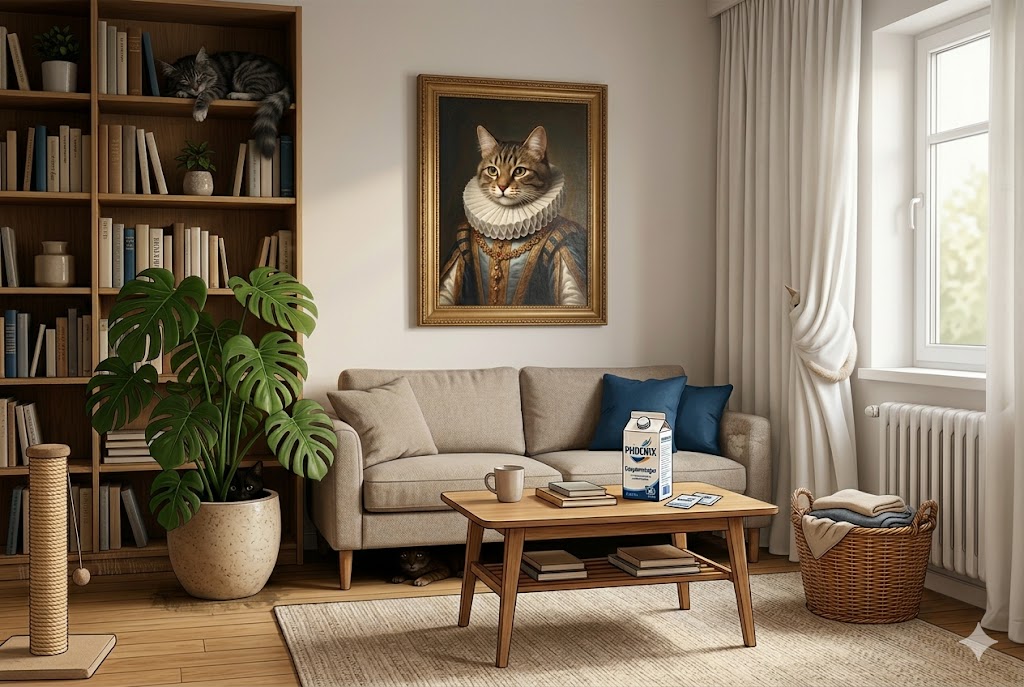
Can you find all the hidden cats? — Get a 10% discount (%)
Join in the living room hidden picture game — whoever finds all the cats immediately receives a personal discount code.
What size do you need?
20 g makes 1 liter of solution. Depending on absorbency, 1 liter is sufficient for 5 to 8 m² of wall surface. It will cover more on concrete and painted surfaces, but less on fresh lime plaster and woodchip wallpaper.
| Size | results | sufficient for | typical case |
|---|---|---|---|
| 10 g | 0.5 liters | 2 to 4 m² | Sample. A window reveal, a few silicone joints. |
| 20 g | 1 liter | 5 to 8 m² | A corner of a room or the wall behind a wardrobe. |
| 40 g | 2 liters | 10 to 16 m² | An entire wall, or bathroom and window together. |
| 60 to 100 g | 3 to 5 liters | 15 to 40 m² | A complete room, with a second passageway on the plaster. |
| 200 to 250 g | 10 to 12.5 liters | 50 to 100 m² | Several rooms or a basement. |
| 500 g to 1 kg | 25 to 50 liters | 125 to 400 m² | Apartment after water damage, renovation, commercial. |
When in doubt, go for a larger size. Stored dry, the granules have a shelf life of several years; a mixed solution, however, does not. A second coat on absorbent plaster yields significantly more results than a sparing first coat.
Why not just use vinegar or chlorine?
Vinegar fails on lime plaster because the lime neutralizes the acid within minutes—and the organic matter in the vinegar itself becomes a breeding ground for mold. Chlorine bleaches the pigments, the organic residue remains in the material, and the odor returns. Furthermore, since 2025, biocidal mold removers have been subject to a ban on self-service.
All seven common home remedies are compared honestly in the Guide, Part 1.
Removing mold — step by step
- Mixing: First, completely dissolve 20 g of Phoenix granules in approximately 250 ml of hot water – this activates the enzymes. Then fill up to 1 liter and pour into the pressure sprayer.
- Put on your own protective gear: When in contact with mold contamination indoors, wear an FFP2 or FFP3 respirator, safety goggles, and rubber gloves. This protection applies to the airborne spores, not to Phoenix mold.
- Material saturation: Spray the affected area until saturated – also treat the inconspicuous edges. For porous materials such as plaster and OSB, allow sufficient time for the solution to penetrate deeply.
- Effects: 30 to 60 minutes for superficial infestations. 2 to 4 hours for deep infestations after water damage or old infestations.
- Wipe clean: Wipe clean with a damp microfiber cloth, applying pressure in one direction only; do not rub. Dispose of the cloth afterwards. For textiles, wash in a normal cycle.
- Allow to dry completely: Natural ventilation, heating, or a fan. Only apply a new coat of paint or put furniture back after it is completely dry.
How long does the mixed solution remain effective?
Full potency for 48 hours after mixing, followed by a slower degradation of the enzymes. Ready for use for up to 20 days. Freshly mixed solution provides maximum activity—for stubborn mold residues, we recommend a fresh batch.
Expert hacks for tough cases
💡 Double pass for deep plastering
After the first pass and wiping, lightly spray the surface a second time and let it dry on the plaster. This allows the enzymes in the building material to work until all organic residue is gone before you apply the renovation paint.
💡 Window seal and window frame
Mold on windows almost always develops due to condensation that collects in the seal. Work the solution into the rubber seal with a brush, let it soak in for 30 minutes, then wipe it off with a narrow cloth. Afterwards, wipe the seal dry and ensure that any residual water can evaporate when ventilating the room—otherwise, the mold will reappear in four weeks.
💡 Basement smell without visible infestation
The musty smell is caused by geosmin and other metabolic products deep within plaster, wooden beams, and old cardboard boxes—even without visible mold. Apply the solution liberally to walls, floors, and wooden elements. Keep basement windows closed in summer; ventilate only from October to March when the outside air is cooler than the basement.
💡 After the water damage
If the technical drying process is complete and the musty odor persists: Apply the solution generously to all previously affected areas and let it work for 2 to 4 hours. The enzymes will break down the organic residues and odor molecules that remain in the material despite drying.
What accessories do you need and for what purpose?
| Accesories | For what | When you don't need it |
|---|---|---|
| Pressure sprayer 1 liter | Complete material saturation on walls and ceilings, even spray mist | For individual joints or fabric stains, a spray bottle is sufficient. |
| UV lamp (black light) | Makes dried urine and organic stains visible through fluorescence. | Useless against mold and musty smells — they don't light up. |
| Spray extraction vacuum cleaner | Removes the dissolved substance from mattresses, upholstery, and car seats. | A microfiber cloth is sufficient for hard surfaces. |
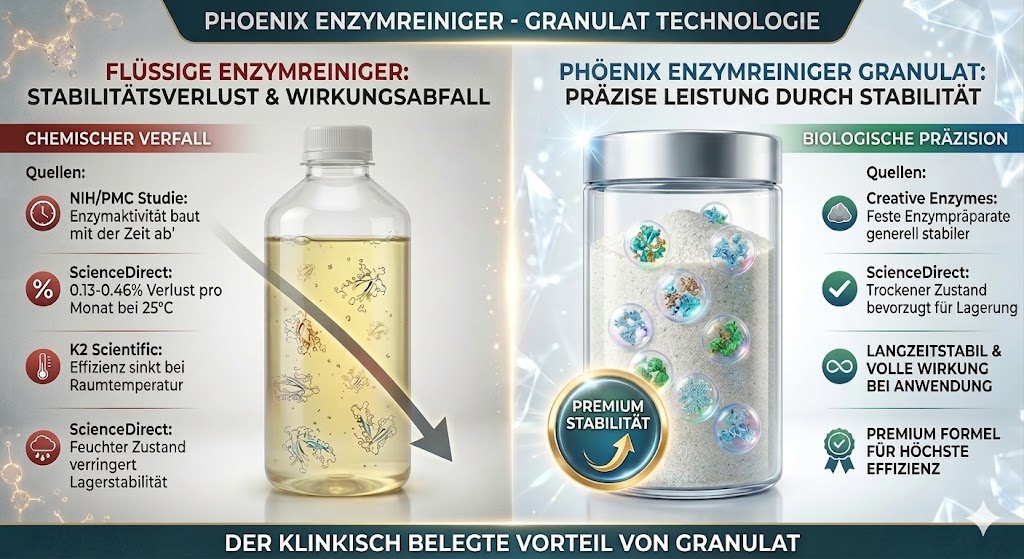
Why granules instead of ready-made solution?

⚠️ Safety Notice
Keep out of reach of children and animals. Even if there is no danger, children and animals should not have direct access to the product.
Frequently Asked Questions — Removing Mold
Is Phoenix a disinfectant or a biocide?
Phoenix Enzymreiniger is not a biocide according to EU Regulation 528/2012 — it is not a pesticide and contains no biocidal substances. It works purely enzymatically, breaking down organic mold residues, spore shells, and odor molecules. Therefore, it requires no authorization and is not subject to self-service restrictions.
How do I remove mold from the window frame and window seal?
Phoenix Enzymreiniger is applied to the rubber seal with a brush and left to work for 30 minutes. Then, it is removed with a narrow cloth, and the seal is wiped dry. Plastic frames and sealing rubbers are compatible with this gentle solution. The cause is almost always condensation that remains in the seal—without this treatment, the problem will return.
Why doesn't the black spot on the silicone joint disappear completely?
Phoenix Enzymreiniger does not bleach. If pigments have penetrated deep into the silicone, the discoloration will remain visible. However, the organic residue and odor are eliminated. If the appearance is important to you: replace the silicone, after treating the surface.
How do I get mildew stains out of clothes?
Apply Phoenix Enzymreiniger directly to the stains and leave to work for 1 to 2 hours, then wash the garment as usual. For stubborn stains, soak overnight. Test wool and silk on a hidden area first. Do not leave the garment in the sun while the stain is wet.
Does Phoenix help against musty basement smells?
Phoenix Enzymreiniger enzymatically breaks down odor molecules like geosmin instead of masking them. These molecules are deeply embedded in plaster, masonry, and wood—that's why ventilation alone isn't enough. Keep basement windows closed in summer; ventilate only from October to March.
Which materials are compatible with Phoenix?
Phoenix Enzymreiniger is suitable for plaster, concrete, OSB wood, silicone, tile grout, washable wallpaper, plastic window frames, rubber seals, textiles, polyester, and coated nylon. For very delicate natural materials such as untreated leather or silk, test on an inconspicuous area first.
Does Phoenix protect against renewed mold growth?
Phoenix Enzymreiniger removes existing organic residues, nothing more. Approximately 60% of all mold cases are caused by structural issues—thermal bridges, moisture, or insufficient drying. If the underlying cause remains, the mold will return. No cleaner can replace professional remediation.
How much granulate do I need?
Phoenix Enzymreiniger is dosed at 20 g per 1 liter of water. Depending on absorbency, 1 liter is sufficient for 5 to 8 m² of wall surface. For entire apartments or basement renovations, larger containers of 500 g or 1 kg are recommended.
Phoenix Enzymreiniger — further applications

Reviews
There are no reviews yet